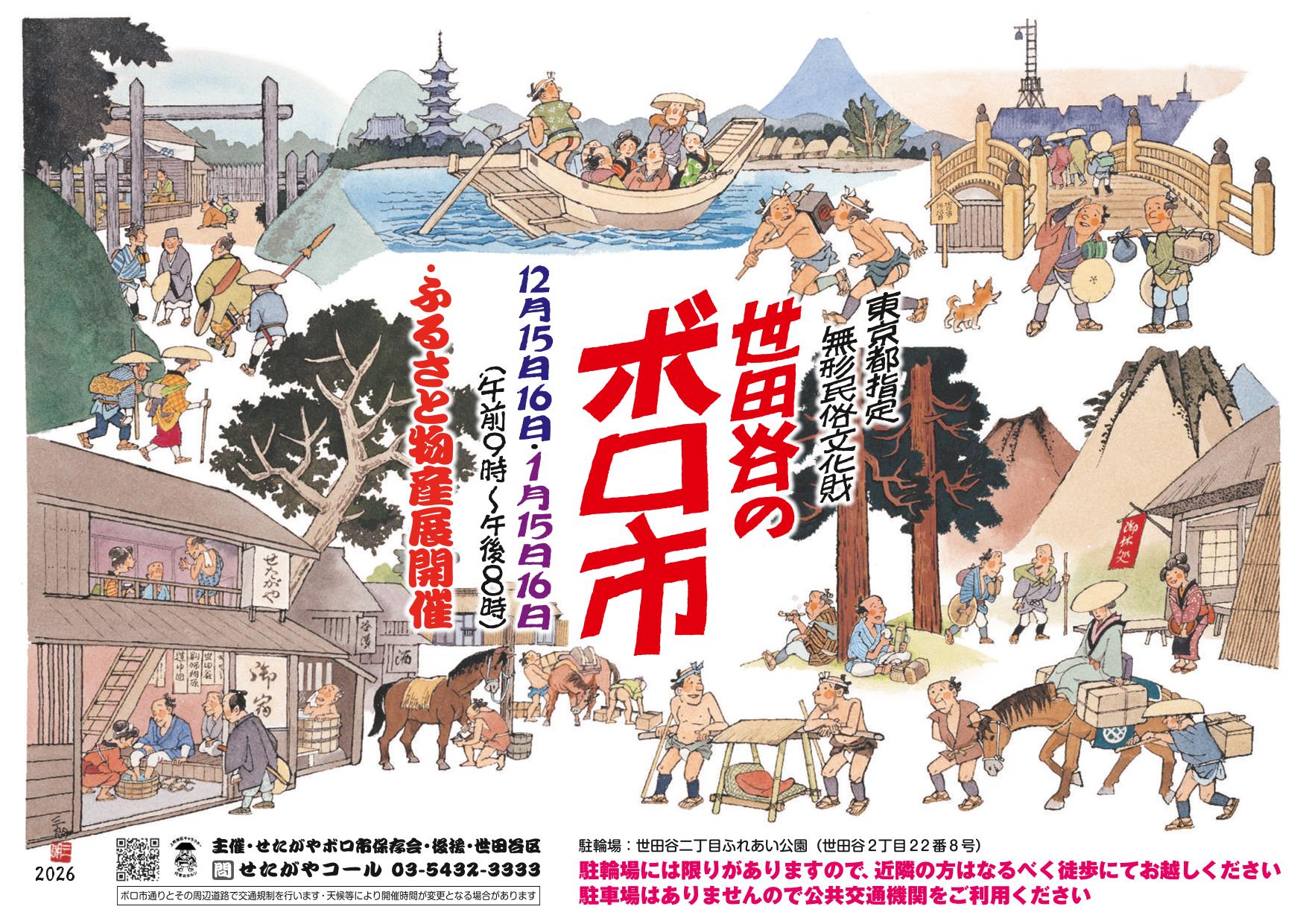
Four winter days when a Setagaya street becomes a market
Antiques, old clothes, plants and freshly made rice cakes fill Boroichi-dori in Setagaya, Tokyo, on 15–16 December and 15–16 January, at a market that traces its start to 1578.

What you will see
The Setagaya Boroichi is a street market held on two days in December and two days in January in Setagaya City, Tokyo. Stalls line Boroichi-dori, a street around the Daikan Yashiki, and the nearby streets, and the city says about 200,000 people come each day. Last season, Tokyu, the railway company that serves the area, put the number of stalls at about 700 or more, selling antiques, old clothes, plants and food.
A leaflet on the city's market page lists stalls of Western clothes, household goods, food, pickles, pestles and mortars, antiques and plants. The market's best-known food is daikan mochi, a freshly made rice cake. The leaflet says a long queue forms for it every year.
At the centre of the market is the Daikan Yashiki, the official residence of the Oba family. For generations, they served as daikan, the local governors of the 20 villages that the Hikone domain held in Setagaya. Its thatched main house and gate became a national Important Cultural Property in 1978, the first residential buildings in Tokyo to receive that status. The site has been a Tokyo historic site since 1952. The Setagaya Museum of History stands on the same grounds, and entry is free.
On the same four days, Setagaya's partner towns sell their local products at the Furusato Bussanten (hometown products fair), 9:00–20:00, in the car park of the Setagaya Shinkin Bank head office (Setagaya 1-23-3).
Why this season
The market traces its start to 1578, when Hojo Ujimasa, lord of Odawara Castle, opened a rakuichi in Setagaya-shinjuku, a stop on the road between Edo and Odawara. A rakuichi was a free market: no market tax was charged, and traders could sell freely. It was held six times a month, on days with a 1 or a 6, so it was also called the rokusai-ichi.
After the Hojo fell and Setagaya Castle was abandoned in 1590, the market quickly declined. It lived on as a year-end market on 15 December, selling farm tools, old clothes and goods for the New Year to the farming villages around. After Japan changed to the solar calendar in the Meiji era, it was also held on 15 January, and later on 15–16 December and 15–16 January, as it is today.
From the late 1880s, old clothes and rags (boro) became the main goods, and people began to call the year-end market the Boroichi, the "rag market". The name became official after the Second World War. Farmers bought the rags to weave into their straw sandals (waraji), which made them much stronger, and making sandals in the quiet farming months brought in cash.
Today the market is a Tokyo-designated Intangible Folk Cultural Property. It is run by the Setagaya Boroichi Preservation Society, with the support of Setagaya City.
In the Edo period, the daikan led a procession through the market once on each market day, to guard against fire and keep order. Since 1968, local people have re-enacted it in period costume as the Daikan Gyoretsu. In recent years it has been held once every five years, and the city says the next one is planned for its fiscal year 2027, which begins in April 2027. So there is no procession at the 2026–27 markets.
When to go
The market is held on the same four days every year: 15 and 16 December, and 15 and 16 January, from 9:00 to 20:00. For 2026–27, the city lists Tuesday 15 and Wednesday 16 December 2026, and Friday 15 and Saturday 16 January 2027. GO TOKYO, Tokyo's official travel guide, lists the same dates.
- Bad weather. The city says the hours may change because of the weather, and the market may be cancelled in a storm. It posts changes on its website and on the X account of the Setagaya General Branch, the city office for the area.
- The museum. The Setagaya Museum of History opens 9:00–16:30 and is closed on Mondays, on public holidays and from 29 December to 3 January. On market days it stays open until the market closes. Its special exhibition on Edo-period paintings runs until 20 December 2026.
- The Daikan Yashiki. In autumn 2026, the city opened its zashiki, the tatami rooms, from 1 October to 9 December, 13:00–16:00, so this period ends before the market. At other times, you can look in from the doma, the earth-floored entrance.
Getting there and visiting
By train. The market is a 3-minute walk from Setagaya Station or Kamimachi Station on the Setagaya Line. This line belongs to Tokyu, a private railway, and runs between Sangenjaya and Shimo-Takaido, with ten stations.
- From Shibuya: take the Tokyu Den-en-toshi Line to Sangenjaya and change to the Setagaya Line. From Sangenjaya, Setagaya is the fourth stop and Kamimachi the fifth.
- From Shinjuku: take the Keio Line to Shimo-Takaido and change to the Setagaya Line. From Shimo-Takaido, Kamimachi is the fourth stop.
- From the Odakyu Line: Gotokuji Station is beside Yamashita Station on the Setagaya Line.
- Rail passes: Tokyu, Keio and Odakyu are private railways, and the Japan Rail Pass does not cover them. For IC cards, see Getting around Japan.
By bus. Tokyu Bus and Odakyu Bus stop at Setagaya-eki-mae and Kamimachi, a minute's walk from the market.
Not by car. There is no parking, and the city asks visitors to come by train or bus. Traffic is restricted on Boroichi-dori and the roads around it from 7:00 to 22:00.
Extra trains. Last season, Tokyu ran extra Setagaya Line trains on all four market days, from about 9:00 to about 22:00, with five or six more trains an hour in the daytime. It asked riders to top up their IC cards before coming, and said it might limit entry at the Sangenjaya and Shimo-Takaido ticket gates when crowded. It announced those trains on 2 December 2025 and published the timetable from 5 December, so look for this season's notice on Tokyu's website in early December.

Good to know
- Crowds. The city says about 200,000 people come each day. Children must be with an adult, and the city asks you to take care that they do not get lost.
- Eating. The city asks visitors to avoid eating in the market area as much as possible, and not to eat or drink on private land. Eating, drinking and smoking are not allowed anywhere in the museum or the Daikan Yashiki.
- Rubbish. There are no rubbish bins in the market, so take your rubbish with you.
- Paying. The city's market page and its leaflet do not say how you can pay at the stalls.
- Toilets. The leaflet's map of the market marks toilets. The museum has a multipurpose toilet, for wheelchair users, with an ostomate fitting and a baby chair, on the first floor of its main building.
- Wheelchairs. The museum lends wheelchairs; ask at its office. We found no official advice for wheelchair users in the market streets.
- Cold. JMA, the Japan Meteorological Agency, gives Tokyo's averages for 1991–2020 as a high of 12.0°C (54°F) and a low of 3.8°C (39°F) in December, and 9.8°C (50°F) and 1.2°C (34°F) in January. The market is outdoors and runs until 20:00. For an evening visit, wear a warm coat, gloves and shoes you can stand and walk in for hours.
- English. The city's market page is in Japanese, with an English leaflet on the market's history. GO TOKYO has an English page with this season's dates.
Fitting it into a Tokyo winter trip
The market opens at 9:00, and Sangenjaya is on the Den-en-toshi Line from Shibuya. So it fits into a morning before Shibuya and Meiji Jingu, Day 3 of our five-day winter plan for Tokyo.
- In December (15–16 December 2026, Tuesday and Wednesday). Senso-ji in Asakusa holds its hagoita (battledore) fair on 17–19 December every year, so you can see two year-end markets in one week. For this season's Christmas markets and lights, see Christmas markets and winter lights in Japan, 2026–27.
- In January (15–16 January 2027, Friday and Saturday). The market comes after the New Year break; the museum on the Daikan Yashiki grounds is closed from 29 December to 3 January. For what closes over New Year, see New Year in Japan, 2026–27.
Two simple plans:
- A morning at the market. Arrive at 9:00, when the market opens, and see the museum, which opens at the same time and is free. Then take the Setagaya Line back to Sangenjaya for Shibuya.
- An evening at the market. The market runs until 20:00, and on market days the museum stays open until the market closes. Last season, Tokyu's extra trains ran until about 22:00.
Nearby and further reading
- Tokyo in winter: a five-day plan
- Christmas markets and winter lights in Japan, 2026–27: dates by city
- New Year in Japan, 2026–27: what's open, what's closed and how to get around
- Tokyo
- December in Japan
For this winter's other festivals and their dates, see Winter festivals in Japan, 2026–27.
Dates for the 2026–27 season
- Every year: 15–16 December and 15–16 January, 9:00–20:00.
- Confirmed for 2026–27: Tuesday 15 and Wednesday 16 December 2026, and Friday 15 and Saturday 16 January 2027, as listed by Setagaya City, with the hometown products fair on the same days, 9:00–20:00.
- Confirmed for 2026–27: the museum's special exhibition runs until 20 December 2026, open until the market closes on 15 and 16 December. The museum is closed from 29 December 2026 to 3 January 2027.
- Last season: the market was held on 15–16 December 2025 (Monday and Tuesday) and 15–16 January 2026 (Thursday and Friday). Tokyu announced extra Setagaya Line trains for those days on 2 December 2025 and ran them from about 9:00 to about 22:00. Look for this season's notice on Tokyu's website in early December.
- Not this season: the next Daikan Gyoretsu procession is planned for the city's fiscal year 2027, which begins in April 2027.
Before you go
- Where | Boroichi-dori and nearby streets around the Daikan Yashiki, Setagaya 1-chome, Setagaya City, Tokyo. 3 minutes' walk from Setagaya or Kamimachi Station on the Tokyu Setagaya Line
- When | Every year on 15–16 December and 15–16 January, 9:00–20:00. In 2026–27: Tuesday 15 and Wednesday 16 December 2026, Friday 15 and Saturday 16 January 2027 (Setagaya City)
- Getting there | Tokyu Den-en-toshi Line from Shibuya to Sangenjaya, or Keio Line from Shinjuku to Shimo-Takaido, then the Setagaya Line. These are private railways; the Japan Rail Pass does not cover them. No parking
- Crowds and rules | About 200,000 people a day. The city asks you to avoid eating in the market area as much as possible. There are no rubbish bins
- Weather | Tokyo in December: average high 12.0°C (54°F), low 3.8°C (39°F). January: 9.8°C (50°F) and 1.2°C (34°F)
- Checked | 17–25 November 2026 · 16 official sources
Places in this story
- Meiji Jingu — A shrine for Emperor Meiji and Empress Shoken, founded in 1920. It stands in a 70-hectare forest planted from about 100,000 trees donated from across Japan, next to Harajuku Station.
- Senso-ji — Said to be the oldest temple in Tokyo, founded in 628 by temple tradition. Walk through the Kaminarimon gate and along the Nakamise shopping street to the main hall of Kannon.
Sources
Sources (16) · checked 17 November 2026
- 世田谷区|世田谷のボロ市(最終更新2026年10月29日。12月15日・16日、1月15日・16日の4日間、午前9時〜午後8時、天候による開催時間の変更・荒天時の中止と区のホームページ・世田谷総合支所のXでのお知らせ、1日におよそ20万人、代官屋敷を中心にしたボロ市通り〈世田谷1丁目〉とその周辺、世田谷線 世田谷駅・上町駅から徒歩3分、駐車場なし・電車とバスで、駐輪場、交通規制〈午前7時〜午後10時〉、会場内での食事は可能な限り控える・私有地等での飲食は止める、子どもに大人の同伴・迷子、ごみ箱なし・持ち帰り、天正6年〈1578年〉北条氏政の楽市・六斎市・歳の市・明治以降の12月と1月の15・16日、明治20年代からボロ市の呼び名・戦後に正式名称、代官の市町見廻りと代官行列〈昭和43年から、近年は5年に1度、次回は令和9年度予定〉)
- 東急電鉄|ニュースリリース「2025年12月15日(月)・16日(火)、2026年1月15日(木)・16日(金) 世田谷ボロ市の開催に合わせ、世田谷線は列車を増発した臨時ダイヤで運行します」(2025年12月2日。9時頃〜22時頃の臨時ダイヤ、日中は1時間あたり5〜6本増発、交通系ICへの事前のチャージ、三軒茶屋駅・下高井戸駅改札口の入場制限、臨時ダイヤの時刻表は12月5日から、ボロ市通りに骨董品・古着・植木・食料品など約700店舗以上、9時〜20時)
- 世田谷区|世田谷のボロ市 日本語版リーフレット(「世田谷のボロ市」のページの添付ファイル。東京都指定無形民俗文化財、交通のご案内〈東急世田谷線 世田谷駅・上町駅から徒歩3分、東急バス・小田急バス 世田谷駅前・上町停留所から徒歩1分、地図:東急田園都市線 三軒茶屋〈至渋谷〉・京王線 下高井戸〈至新宿〉・小田急線 豪徳寺と山下駅〉、会場図とトイレ、主催 せたがやボロ市保存会・後援 世田谷区、駐車場なし、ボロ市のはじまり〈天正6年の楽市、一の日と六の日、相州街道、北条氏の滅亡と世田谷城の廃止で衰退、12月15日の歳の市、明治の新暦で正月15日も〉、ボロ市の名の由来〈わらじに編みこむボロ、農閑期の副業〉、出店数、一日二十万人、洋品・雑貨・食料品・漬け物・杵・臼・骨董・植木、代官餅の行列、代官屋敷)
- GO TOKYO(東京観光財団)|Setagaya Boro-ichi (Flea Market)(英語。2026年11月2日更新、2026年12月15・16日と2027年1月15・16日、9:00〜20:00、東急世田谷線 上町駅・世田谷駅、1578年から、boro、代官餅〈つきたての餅〉、東京都の無形民俗文化財)
- 世田谷区|世田谷区立郷土資料館(最終更新2026年11月15日。代官屋敷の敷地内、彦根藩世田谷領20ヵ村の代官を世襲した大場家の役宅、昭和27年11月3日に都史跡、主屋と表門は昭和53年1月21日に国の重要文化財、開館 午前9時〜午後4時30分、休館日 毎週月曜日・祝日・年末年始〈12月29日〜1月3日〉、入館無料、特別展「江戸の絵画を楽しむ」2026年10月17日〜12月20日〈12月15日・16日は世田谷のボロ市終了時刻まで開館〉、上町駅から徒歩5分)
- 世田谷区|世田谷代官屋敷の座敷を公開しています(最終更新2026年10月29日。令和8年10月1日〜12月9日の午後1時〜4時、休館日、座敷公開時間外は土間から見学可、無料、大場家住宅主屋・表門は昭和53年1月21日に住宅建造物として都内で初めて国の重要文化財)
- 世田谷区|「世田谷のボロ市」ふるさと物産展を開催します(最終更新2026年11月2日。2026年12月15日〈火〉・16日〈水〉、2027年1月15日〈金〉・16日〈土〉、各日9時〜20時、天候などによる時間の変更、世田谷信用金庫本店駐車場〈世田谷1-23-3〉、区の交流自治体の名産品、駐車場なし、交通規制7時〜22時、会場内の飲食・ごみ・子どもについてのお願い)
- 世田谷区|世田谷のボロ市 英語版リーフレット(「世田谷のボロ市」のページの添付ファイル。Raku-ichi〈1578年、北条氏政〉、Rokusai-ichi、1590年の世田谷城の廃止、12月15日の year-end market、明治以降12月と1月の15・16日、boro とわらじ)
- 世田谷区|令和8年度ボロ市ポスター(「世田谷のボロ市」のページの添付ファイル。東京都指定無形民俗文化財、12月15日・16日・1月15日・16日〈午前9時〜午後8時〉、ふるさと物産展、主催 せたがやボロ市保存会・後援 世田谷区、交通規制と天候等による開催時間の変更、駐車場なし)
- 世田谷区|9月2日(月曜日):東京農業大学の学生がせたがやボロ市保存会にボロ市に関するヒアリングを実施しました。(世田谷地域「地域交流ラボ」)(最終更新2025年12月26日。「世田谷のボロ市」を主催するせたがやボロ市保存会、東京都無形民俗文化財にも指定)
- 世田谷区|Setagaya Museum of History(郷土資料館の英語のパンフレット。開館 9 a.m.–4:30 p.m.、ボロ市〈12月15・16日、1月15・16日〉の開催中は終了まで開館、休館日、入館無料、館内と代官屋敷での飲食・喫煙の禁止、車いすの貸出、本館1階の多目的トイレ〈車いす・オストメイト・ベビーチェア〉、上町駅から徒歩5分、地図〈渋谷-田園都市線-三軒茶屋-世田谷線、新宿-京王線-下高井戸〉、住所 世田谷1-29-18)
- 東急電鉄|Setagaya Line|Routes(英語サイトの世田谷線のページ。駅の並び:三軒茶屋・西太子堂・若林・松陰神社前・世田谷・上町・宮の坂・山下・松原・下高井戸)
- JAPAN RAIL PASS(JRグループ)|Scope of validity
- 気象庁|東京(東京都)平年値(年・月ごとの値)
- 浅草寺|納めの観音ご縁日・羽子板市
- 世田谷区|区のおしらせ「せたがや」令和7年11月25日号 1面:世田谷のボロ市(2025年12月15日〈月〉・16日〈火〉、2026年1月15日〈木〉・16日〈金〉、午前9時〜午後8時、ふるさと物産展、天正6年から448年、世田谷線 上町駅・世田谷駅、バスは上町・世田谷駅前、駐車場なし、交通規制、ごみの持ち帰り)