When all of Naha takes hold of one straw rope
On a Sunday in October, a giant rope of rice straw is laid along Route 58 in central Naha. Thousands of people, visitors included, take hold of its side ropes and pull, east against west.

What you will see
The Naha Great Tug-of-War (Naha Otsunahiki) is a tug-of-war on a giant rope of rice straw, laid along a main road in the centre of Naha, the capital of Okinawa Prefecture. The group that runs it, the Naha Great Tug-of-War Preservation Society, calls it Okinawa's largest traditional event. It is the main event of the Naha Great Tug-of-War Festival, three days of events across the city.
The rope comes in two halves. The western half is the female rope (miinna), and the eastern half is the male rope (wuunna). Each ends in a loop. The larger female loop goes over the male loop, and a rosewood bar, the kanuchi-bo, joins them. The bar is 3.65 metres long and weighs 365 kg, numbers chosen for the days of the year.
The society's outline gives the joined rope as 200 metres long, 1.56 metres thick and 40 tonnes in weight; Okinawa's visitor bureau gives 43 tonnes. In 1995, Guinness World Records first listed it as the world's largest rope made of rice straw.
Along the main rope hang 280 side ropes (tiinna), each about 7 metres long. The society's outline counts about 15,000 pullers among about 285,000 people. It invites people to pull the rope, not only to watch, and the visitor bureau says everyone can join in.
Before the pull comes the shitaku: a lead performer dressed as a figure from history, with attendants and a flag bearer, stands on the rope and faces the other side. Three-legged gongs (shogu), struck in front of the judges' stand, give the signal to start, and a siren ends the pull. Flags set 5 metres to each side of the centre mark the winner.
When it is over, people take home pieces of the side ropes. The society says that taking home a piece is believed to bring happiness.
Earlier in the day comes the flag procession. Each hatagashira is the great flag of a district of Naha, its symbol and guardian, designed and made by local craftsmen. Its banner shows a phrase from well-known books, old and new. Young men in black costume make the flags dance. The society recognises 14 traditional flags, seven for the east and seven for the west. They march with children carrying district flags, drums, gongs and conch-shell horns, and their order changes every year.

Why this season
The society dates the tug to around 1450, in the time of the Ryukyu Kingdom. It continues the rope of the "four towns" of old Naha, a trading port. In Okinawa's farming villages, tug-of-wars began as prayers for rain and good rice harvests. Naha's was a town rope, a symbol of the port city.
Joining the female and male ropes stands for the meeting of yin and yang, a wish for people to flourish. An old record says the tug was pulled to pray for peace in the land and safety at sea. In those days it took place around the sixth month of the year. From the late 19th century, it was held now and then to mark celebrations, but it stopped after 1935.
October came with the revival. In 1971, the year before Okinawa's return to Japan, the city brought the tug back to mark 50 years since Naha became a city. It was held on 10 October, the day of the "10.10 air raid". On 10 October 1944, US carrier aircraft bombed the whole Nansei island chain, and about 90% of Naha was destroyed in a single day.
Today the tug is held on the Sunday before Sports Day, a national holiday on the second Monday of October. People pull with wishes for peace, the prosperity of the city, good business, a happy family and children. The society says that for Naha's people, pulling the rope together is a way to share prosperity, happiness and unity. It is Naha's own festival. If you join in, follow the rules below.
When to go
The festival runs over the three-day weekend. In 2026, it was set for Saturday 10 to Monday 12 October, with the flag procession and the tug on the Sunday.
The 2026 timetable for the Sunday:
- 10:15: Kokusai-dori closes to traffic, and the flag procession starts once it is closed. The preservation society listed the procession as 10:25–12:55.
- 13:00: the procession ends and Kokusai-dori reopens.
- 13:10: Route 58 closes to traffic between the Matsuyama and Izumizaki intersections.
- 13:30: the rope ceremony begins.
- 15:15–15:45: the pull.
- 18:00: Route 58 reopens.
The organisers note that, except for the road closures, times can move on the day. The pull itself is short: about 30 minutes in the 2026 plan, after nearly two hours of ceremony. Times also change from year to year. In 2025, the festival plan gave 14:30–19:00 for the tug, road closures included.
Where to watch. The tug takes place on Route 58 around the Kumoji intersection. In the 2026 plan, the flag procession used Kokusai-dori from the Asato junction to the intersection in front of Palette Kumoji, a large shopping centre next to Kenchomae Station.
Other festival events in 2026. A traditional performing arts night parade was scheduled for the Saturday evening on Kokusai-dori, with the street closed to traffic 17:15–20:30. On all three days, RBC, a local broadcaster, planned its Citizens' Festival in Onoyama Park, 11:00–21:00, with stages, food stalls and fireworks every evening from 20:30.

Getting there and visiting
To Okinawa. Fly to Naha Airport. Direct flights take about 2 hours 20 minutes from Tokyo Haneda and about 1 hour 50 minutes from Osaka Kansai (as of April 2026).
Monorail. The Yui Rail monorail is Okinawa's only rail line. It runs from Naha Airport through central Naha. Kenchomae Station is 13 minutes from the airport, and the fare is ¥290 (children ¥150). The Japan Rail Pass is not valid: Yui Rail is not a JR line, and the pass does not list it. You can pay with a QR-code ticket from the machines, the OKICA card, Suica and the transit IC cards that work with it (such as PASMO and ICOCA), or a contactless credit or debit card.
Nearest station. The 2026 festival map shows Kenchomae Station close to the Kumoji intersection. The station has lifts and escalators from the street to the platform, a multipurpose toilet with a baby seat, and coin lockers (¥400–1,000, until the last train).
Do not drive. Okinawa's visitor bureau lists no parking. The 2026 flyer for the RBC Citizens' Festival also said there was no parking at Onoyama Park, asked people to come by monorail, bus or taxi, and expected heavy crowds. The 2026 traffic plan moved many bus routes in central Naha onto other roads during the closures. We found no official notice of extra monorail trains for the 2026 festival. Check Yui Rail's page for extra timetables (in Japanese) in the days before.
Driving elsewhere. To rent a car later in your trip, you need an International Driving Permit under the 1949 Geneva Convention, or an approved Japanese translation for a few countries' licences.
Good to know
Safety. The preservation society says that joining or watching the tug with small children, while pregnant, or in high heels is dangerous, and asks people to take care. When you pull, rest from time to time before you join again. Watch out for heatstroke and drink water.
Rules. At the tug venue, the society bans knives and other blades, drinking alcohol, and photos from drones. The 2025 festival plan, published by the city, banned kitchen knives, knives and scissors, and drone filming at every venue. So do not bring scissors or a knife to cut a piece of rope. The official pages do not say how the pieces are cut.
Weather. Naha's October averages are a high of 28.1°C (83°F) and a low of 23.5°C (74°F), with 179.2 mm of rain (Japan Meteorological Agency, 1991–2020). On average, 1.1 typhoons come close to Okinawa in October. The society notes that the date can change if a typhoon comes. Japan's Heat Stroke Alert is published in English; in 2026, it ran until 21 October. Bring a hat, light clothes, flat shoes and a rain jacket.
Toilets. The 2026 festival map showed public toilets in Matsuyama Park, in Miebashi Park and near Palette Kumoji, and five convenience stores near Route 58 that offered their toilets.
Wheelchairs and strollers. The official tug pages do not mention places to watch from a wheelchair. The Naha City Tourist Information Center, in the Tenbusu Naha building on Kokusai-dori, rents wheelchairs and strollers for ¥1,000 a day. Book by phone (098-868-4887); bookings open one month before the month of use. It has no nursing room; the nearest is at the Daiichi Makishi Public Market.
Payment. The official tug pages do not say how food stalls take payment. At the RBC Citizens' Festival in Onoyama Park, the 2026 flyer said that purchases were by AEON Pay, WAON (Japanese payment services) or cash only.
English. The preservation society's website and the Naha City Tourism Association's festival page are in Japanese only. Okinawa's visitor bureau has an English page on the festival. The tourist information centre opens 9:00–19:00, with service in English, Chinese and Korean, and has coin lockers (¥300–600, 9:00–20:00).

Nearby and further reading
Kokusai-dori, where the flags parade, is Naha's main street. Nearby is the Makishi Public Market, which locals call the "Kitchen of Okinawa". Take the fish or meat you buy there to the second floor, and the staff will cook it for you.
Dates for autumn 2027
- Not yet announced on 12 November 2026: the date of the 2027 tug. By the society's rule, the Sunday before Sports Day, it would be Sunday 10 October 2027, as Sports Day falls on Monday 11 October. The date can change if a typhoon comes.
- Where to look: the preservation society's website and the festival page on Naha Navi, the Naha City Tourism Association's site (both in Japanese).
- Rooms: with the Monday holiday, Saturday 9 to Monday 11 October 2027 is a three-day weekend, so book early.
- 2026, for reference: the flag procession and the tug were set for Sunday 11 October (times above).
- 2025, for reference: the tug was on Sunday 12 October.
Before you go
- Where | Route 58 at the Kumoji intersection in central Naha, Okinawa Main Island. The flag procession before the tug uses Kokusai-dori (Kokusai Street)
- When | The Sunday before Sports Day (the second Monday of October). 2026 plan: Sunday 11 October; flag procession 10:25–12:55, rope ceremony from 13:30, pulling 15:15–15:45. 2027 not yet announced (Sunday 10 October by that rule)
- Cost | Free to watch and to pull. There is no parking for the festival
- Getting there | Fly to Naha Airport, then take the Yui Rail monorail to Kenchomae Station: 13 minutes, ¥290. The JR Pass is not valid
- Weather | Naha in October: average high 28.1°C (83°F), low 23.5°C (74°F), 179 mm of rain. A typhoon can change the date
- Checked | 8–25 November 2026 · 27 official sources
Places in this story
- Okinawa — destination guide
- Kokusai-dori and Makishi Public Market — Naha’s main street leads to the market known as the Kitchen of Okinawa.
Sources
Sources (27) · checked 8 November 2026
- 一般社団法人 那覇大綱挽保存会|那覇大綱挽について(沿革・実施計画概要(実施期日・大綱の規格・参加人員)・用語・ギネス認定)
- 沖縄観光コンベンションビューロー(VISIT OKINAWA JAPAN)|Naha Great Tug-of-War Festival(英語。2026年の日程・料金・駐車場・イベントサイト(NAHANAVI)は日本語のみ)
- 那覇市観光協会(NAHANAVI)|第56回那覇大綱挽まつり(2026年。主催・主管・開催期間・各催し・タイムスケジュール・会場マップ・交通規制)
- 一般社団法人 那覇大綱挽保存会|祭りを楽しむ(綱挽への参加の呼びかけ・ご協力願い・ご注意・禁止事項)
- 一般社団法人 那覇大綱挽保存会|旗頭行列(14旗・伝統楽器)
- 沖縄県公文書館|パスファインダー No.23 10・10空襲(PDF)
- 内閣府|国民の祝日について
- 那覇市|第55回「那覇大綱挽まつり」実施要項(2025年、PDF。行事日程・刃物とドローンの禁止)
- 那覇大綱挽まつり実行委員会(NAHANAVI掲載)|旗頭行列・那覇大綱挽タイムスケジュール(2026年、画像。交通規制・大綱式典・綱挽の時刻、RBCの生放送)
- 一般社団法人 那覇大綱挽保存会|那覇大綱挽 公式サイト トップ(2026年 第56回の開催日(予定)・旗頭行列と大綱挽の時間、第55回(2025年10月12日)開催御礼)
- 那覇大綱挽まつり実行委員会(NAHANAVI掲載)|那覇大綱挽まつり会場全体マップ(2026年、画像。会場・交通規制の時間と区間・トイレ・トイレ協力店舗)
- ゆいレール(沖縄都市モノレール)|駅情報:県庁前駅(駅の概要・駅設備・コインロッカー・運賃表)
- 那覇大綱挽まつり実行委員会(NAHANAVI掲載)|那覇大綱挽まつりによる交通規制計画及びバス路線変更計画(2026年10月10日・11日、PDF)
- 琉球放送(NAHANAVI掲載)|第56回那覇大綱挽まつり RBC市民フェスティバル チラシ(2026年、画像。開催時間・花火・会場マップ・支払い方法・駐車場・混雑の注意)
- 沖縄観光コンベンションビューロー(VISIT OKINAWA JAPAN)|Domestic Flights
- 内閣府|沖縄都市モノレール(ゆいレール)
- JAPAN RAIL PASS(JRグループ)|Scope of validity
- 沖縄都市モノレール(ゆいレール)|Information(乗車券の種類・英語)
- ゆいレール(沖縄都市モノレール)|乗車券の種類・運賃(QR乗車券・OKICA・Suica・タッチ決済乗車サービス)
- 沖縄都市モノレール(ゆいレール)|Suica(ICカード)
- ゆいレール(沖縄都市モノレール)|臨時ダイヤのご案内(一覧)
- 警察庁|日本で自動車等を運転するための方法(PDF)
- 気象庁|那覇(沖縄県)平年値(年・月ごとの値)
- 気象庁|台風の平年値
- 環境省|熱中症予防情報サイト Heat Stroke Alert(英語)
- 那覇市観光協会(NAHANAVI)|那覇市観光案内所(2026年6月14日更新)
- 沖縄観光コンベンションビューロー(VISIT OKINAWA JAPAN)|Get to Know Naha
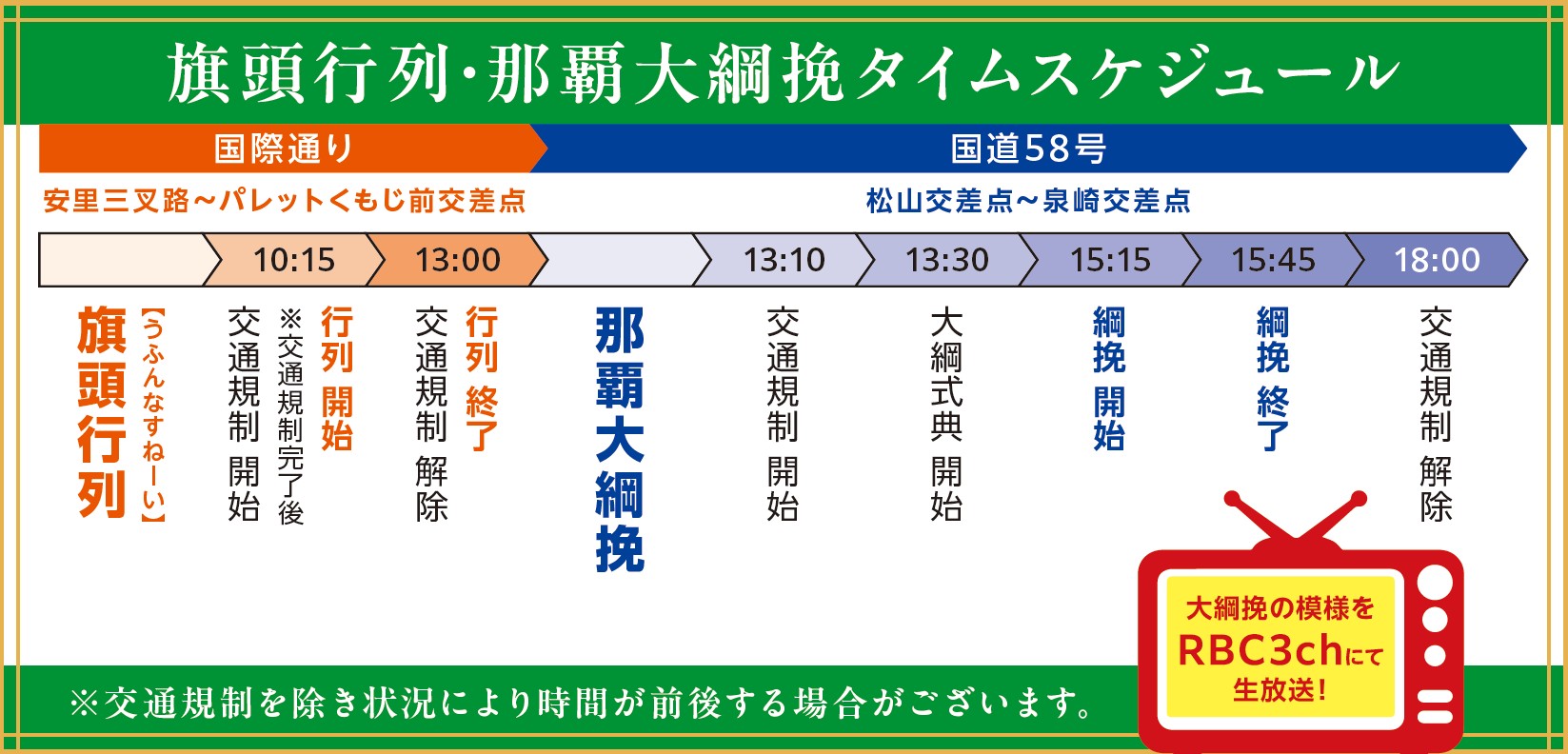
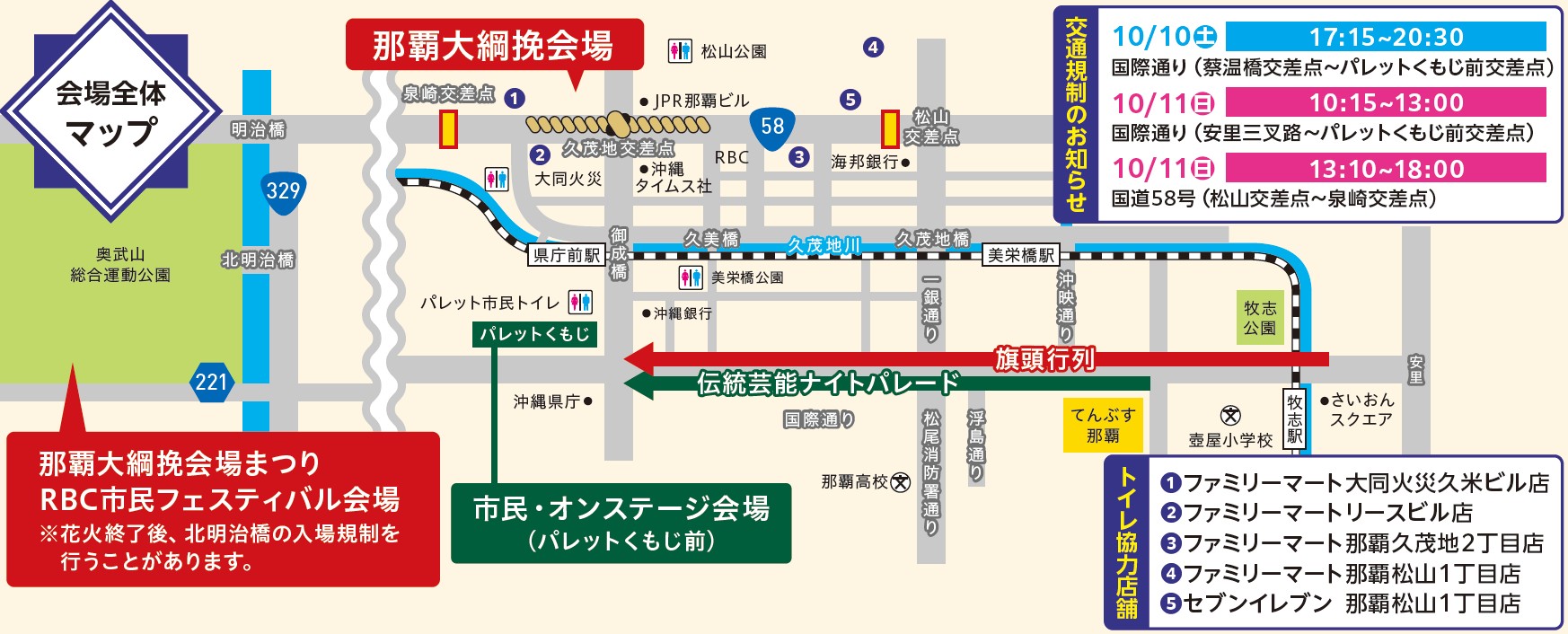
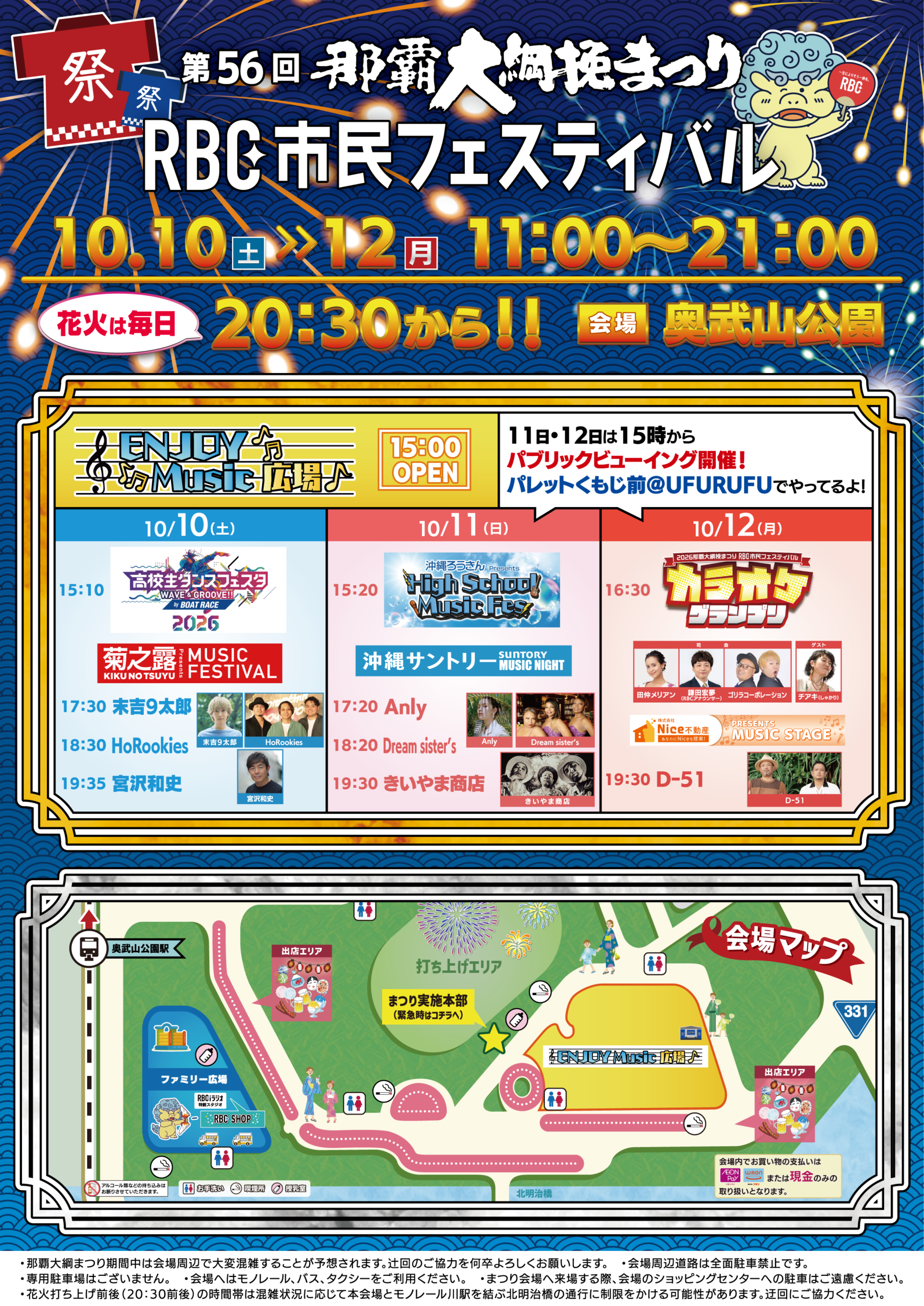
Photo credits
- The great rope laid out on Route 58 in Naha, October 2009. Not a current view. Photo: Matthew Rings · Public domain
- The great rope of the Naha Great Tug-of-War, with a man in black costume standing on it, October 2008. Not a current view. Photo: Mitsuru Ogino · CC BY-SA 3.0
- The east side's flags (hatagashira) at the Naha Great Tug-of-War, October 2008. Not a current view. Photo: Mitsuru Ogino · CC BY-SA 3.0
- Performers dressed as figures from history (shitaku) at the Naha Great Tug-of-War, October 2026. Not a current view. Photo: Petty Officer 1st Class Macadam Weissman, U.S. Navy · Public domain


