An eye that opens in the melting snow
Near the top of Mount Hachimantai, on the border of Akita and Iwate in northern Tohoku, a pond thaws from its edges and its centre. For a short time each spring, it looks like a giant eye.

What you will see
Mount Hachimantai rises on the border of Akita and Iwate prefectures, inside Towada-Hachimantai National Park. Its top is a wide, flat plateau at 1,613 metres, with quiet ponds, wetlands and forests of Maries' fir. One of these ponds is Kagami-numa ("mirror pond"). It is in Semboku, on the Akita side.
In late spring, open water first shows as a ring around the edge of Kagami-numa. Later, the snow and ice left in the middle begin to thaw as well. From above, the pond then looks like a huge eye, which is why it is called the Hachimantai Dragon Eye.
The Hachimantai City Tourism Association describes four stages:
- A flat snowfield hides the pond. Only a large hollow shows where it is.
- Meltwater runs into the pond. A crescent of water opens along the edge, and the centre seems to rise.
- A dark "pupil" appears in the middle. Where the snow meets the air, it melts fast, and the eye will soon open.
- The eye is complete. On a clear day, the water looks bright blue.
The walk starts at Mikaeri Pass, on the prefectural border, where the rest house stands at 1,541 metres. From the pass you can see Mount Iwate and other peaks to the south.

Why this season
Snow builds up over the pond all winter. In spring, meltwater lifts the snow in the middle of the pond, and as it gets warmer, that snow melts from its centre. The eye appears only when the amount of snow, the speed of the melt and the weather are all right.
Getting there also depends on the snow. The Hachimantai Aspite Line, a mountain road of about 27 km between Iwate and Akita, is usually closed from early November to mid-April. After it opens, walls of snow several metres high line the road until about mid-May. Their height is different every year. The association says these "snow corridors" are at their best from late April to mid-May.
When to go
The tourism association says the eye can be seen from mid-May to mid-June. Akita Prefecture says it usually "opens" in late May to early June, and the Ministry of the Environment gives the same period. Both the association and Akita Prefecture say the timing changes with the snow and the weather.
The association posts photos of the pond almost every day in the season. In recent years, it posted that the eye had opened on:
- 7 June 2021
- 11 June 2022
- 18 May 2024 (it wrote that the shape could now be called open)
- 13 June 2025
- 11 June 2026
The 2023 gallery has no such post. In 2026, Akita Prefecture's record shows the eye shape almost gone by 23 June, and the snow fully melted by 1 July. So the best days can be few. This page does not predict a date for 2027.
How to check. The association's Dragon Eye page shows dated photos and has a short English introduction. Akita Prefecture's page (in Japanese) adds photos and links to its X account; its English page still shows 2025 photos. Fog can hide the pond: on 5 June 2026, the association took its photo in a short break in thick fog. If you can, keep a spare day.
Crowds. Akita Prefecture asks people to come on weekdays. At weekends in the season, the Aspite Line is often jammed. On weekdays there is less traffic and more space in the car park. At the busiest times, follow the staff who direct traffic.

Getting there and visiting
- By train and bus from Morioka. The Japan Rail Pass covers JR trains such as the Tohoku Shinkansen to Morioka. In the November 2026 timetable, Hayabusa 1 leaves Tokyo at 6:32 and reaches Morioka at 8:44. From Morioka Station, Iwate Kenpoku Bus, a local bus company, runs the seasonal Hachimantai Nature Walk Bus to the summit every day in the season (18 April–25 October in 2026). In spring 2026 there was only one round trip a day: Morioka Station East Exit stop 3 at 9:10, arriving at Hachimantai Chojo (summit) at 11:05; back from the summit at 14:00, arriving at Morioka at 15:45. In the November 2026 timetable, the last weekday Shinkansen for Tokyo leaves Morioka at 20:50, so a day trip from Tokyo is possible. This bus is not JR, so the Japan Rail Pass does not cover it. In the Dragon Eye season, traffic near the summit can make the bus late.
- Tickets. You do not book. Passengers board in the order they queue, and pay when they get off. A special ticket cost ¥1,700 each way for adults in 2026; buy it before boarding at the bus information centre near East Exit stop 7. You can also pay in cash or with a transport IC card, but the driver cannot change ¥5,000 or ¥10,000 notes, and IC cards sometimes do not work. The bus company has an English page, and the tourism association explains in English how to find the ticket counter and the bus stop.
- Free guided walk. In 2026, bus passengers could join a free guided walk at the summit. The Dragon Eye course (90 minutes) ran from 9 May to 5 June. The guides' own website is in Japanese only.
- Staying a night. For guests at inns in Matsukawa Onsen and Hachimantai Onsenkyo, hot-spring areas on the Iwate side, the bus company sold a ticket for ¥2,300 each way in 2026.
- From the Akita side. In the 2026 season, buses from Tazawako Station (Akita Shinkansen) run by Ugo Kotsu, a bus company, did not go to the summit; all of them ended at Tamagawa Onsen. Some pages still show the old route.
- By car. You need an International Driving Permit or other papers accepted in Japan. The summit is about 40 minutes from Matsuo-Hachimantai Interchange or about 50 minutes from Kazuno-Hachimantai Interchange on the Tohoku Expressway. The association's spring plan suggests renting a car at Morioka Station. The Hachimantai Tenbo car park at the top has 107 spaces and charges a fee. From the opening in April until late May, the Aspite Line closes at night, and it can also close in the day if snow or ice is likely. Apart from the rest house, there are no toilets along the road, so use the toilets at a visitor centre at the foot of the mountain first, in case of traffic jams.
- The walk. Kagami-numa is about 20 minutes on foot from the rest house. The path starts as a gentle stone-paved slope. After the turn-off for Kagami-numa, you walk on snow. Wear rubber boots or other waterproof shoes. The rest house rents boots for a fee, in limited sizes.
- Rest house. The Hachimantai Mountaintop Rest House is open from mid-April to early November, 9:00–17:00 (to 16:30 while the road closes at night). It has a rest area, a snack corner and a shop.
Good to know
- Stay behind the rope. The pond is still melting. Going down onto it is very dangerous, and the snow at the edge can collapse and drop you into the water. Akita Prefecture asks visitors not to go past the rope towards the pond.
- Cold. The figures here are not for the summit. The Japan Meteorological Agency's Hachimantai station in Akita is at 578 metres, about 960 metres lower than the rest house. There, May averages 11.2°C (52°F) with lows of 5.8°C (42°F), and June 15.5°C (60°F) with lows of 10.5°C (51°F) (1991–2020). At the top you stand on snow, sometimes in fog, so bring a warm jacket, gloves and rain gear.
- Toilets. Along the Aspite Line, the only toilets are at the rest house.
- Wheelchairs and strollers. The path starts as a gentle stone-paved slope, then crosses snow. The official pages do not say whether wheelchairs or strollers can use it.
- Bears. Many of Japan's national parks overlap with bear habitat. The Ministry of the Environment advises: do not walk alone, make noise (a bell, a radio, your voice), and take extra care where you cannot see far. If you see a bear, do not go near it to take photos; move back slowly while watching it. You cannot take bear spray on a plane, so find out where to buy or rent it after you arrive. The Hachimantai Visitor Center on the Akita side posts news about bear sightings, in Japanese.
- Photos and drones. Take photos from behind the rope. The area is national forest. To fly a drone near the Dragon Eye, you must first send a forest-entry notice to the Forestry Agency's Akita office, about a week ahead, and tell it your purpose, route, height and time. You must also follow Japan's aviation rules for drones. Akita Prefecture also asks drone users to check with the Ministry of the Environment's park office.

Nearby and further reading
For rail passes and IC cards, see Getting around Japan. For autumn in the same national park, see Hakkoda and the Oirase Stream. In April, see the weeping cherries of Kakunodate, also in Semboku.
Dates for summer 2027
- Not announced on 11 November 2026: the 2027 opening date of the Aspite Line, the bus season, timetable and fares, and the guided walks. The bus company will post next season's service when it is decided. In 2026, Akita Prefecture announced the opening date on 25 March.
- 2026, for reference: the Aspite Line was set to open on 15 April at 10:00, and the rest house on the same day. The bus ran from 18 April to 25 October; the spring service ended on 5 June, and the Dragon Eye guided course ran 9 May–5 June. Part of the Hachimantai Jukai Line, another road up from the Iwate side, was closed all season, so the bus used the Aspite Line. A landslide damaged that road; in May 2026 the closure was planned to last until April 2027. The association declared the eye open on 11 June, and Akita Prefecture's record shows the shape almost gone by 23 June.
Before you go
- Where | Kagami-numa, a pond near the 1,613 m summit of Mount Hachimantai, Towada-Hachimantai National Park, on the Akita–Iwate border (Tohoku region). About 20 minutes on foot from the Hachimantai Mountaintop Rest House
- When | Typically mid-May to mid-June, depending on snow and weather. The full "eye" may last only a short time. In 2026 the tourism association declared it open on 11 June; by 23 June the shape had almost gone
- Road | The Hachimantai Aspite Line is usually closed from early November to mid-April. In 2026 the opening was set for 15 April. The 2027 date had not been announced on 11 November 2026
- Bus | In spring 2026, one Iwate Kenpoku Bus round trip a day from Morioka Station (9:10, back at 15:45). No booking. ¥1,700 each way with a special ticket. The Japan Rail Pass does not cover it
- Walk | Part of the path is on snow. Wear waterproof boots (paid rental at the rest house, limited sizes). Stay behind the rope at the pond
- Checked | 11–25 November 2026 · 32 official sources
Sources
Sources (32) · checked 11 November 2026
- 観光庁(多言語解説文データベース)|Hachimannuma Pond and the Hachimantai Summit(八幡沼と八幡平山頂。1,613mの台地・鏡沼のドラゴンアイ・見返峠)
- 東北観光推進機構(旅東北)|ドラゴンアイ(鏡沼)(秋田県仙北市田沢湖玉川・メガネ沼・アクセス)
- 八幡平市観光協会|八幡平ドラゴンアイ(例年5月中旬〜6月中旬・英語の説明・2026年ギャラリー:6月11日「開眼を宣言します」・6月5日の濃霧)
- 八幡平市観光協会|八幡平スプリングフェスティバル2026(PDF。アスピーテライン4月15日10時開通・雪の回廊・ドラゴンアイができるまで・山頂散策マップ・徒歩約20分・長靴レンタル・レストハウス・展望駐車場107台・渋滞・散策バスと無料ガイド)
- 八幡平市観光協会|八幡平山頂レストハウス(標高1541m・営業時間・営業期間・フロア)
- 秋田県(鹿角地域振興局)|「八幡平ドラゴンアイ」発信局(2026年8月19日更新。平日の来訪・トイレ・ロープ・ドローンと入林届・2026年の様子・Q&A)
- 八幡平市観光協会(VISIT八幡平)|Spring Morioka-Hachimantai 2 nights 3 days travel plan(英語。雪の回廊は4月下旬〜5月中旬・盛岡駅前のレンタカー)
- 環境省|十和田八幡平国立公園 八幡平自然探勝路コース(鏡沼は5月下旬〜6月上旬にドラゴンアイ)
- 八幡平市観光協会|八幡平ドラゴンアイ 2021年ギャラリー(6月7日「本日午後開眼しました」)
- 八幡平市観光協会|八幡平ドラゴンアイ 2022年ギャラリー(6月11日「開眼!」)
- 八幡平市観光協会|八幡平ドラゴンアイ 2024年ギャラリー(5月18日「開眼といえる形になりました」)
- 八幡平市観光協会|八幡平ドラゴンアイ 2025年ギャラリー(6月13日「八幡平市観光協会は開眼を宣言します」)
- 八幡平市観光協会|八幡平ドラゴンアイ 2023年ギャラリー(開眼を伝える書き込みなし。5月16日「見応えのある形になりました」、6月3日「開眼間近」)
- 秋田県|The information center of "Hachimantai Dragon Eye"(英語。2025年7月8日更新)
- JAPAN RAIL PASS(JRグループ)|Scope of validity
- JR東日本|Timetable List of Stations(Shinkansen Hayabusa 1/Komachi 1、東京6:32発・盛岡8:44着・八戸9:21着・新青森9:49着、全車指定席、2026年11月の時刻表。2027年2月は毎日この時刻の表示)
- 岩手県北バス|【八幡平自然散策バス】盛岡駅から八幡平頂上へ!(2026年度の運行終了・運行期間・料金・乗り方・樹海ライン通行止め・渋滞による遅れ)
- 岩手県北バス|Hachimantai Nature Walk Bus(英語。予約不要・専用乗車券・現金とICカード・ガイドのサイトは日本語のみ)
- 岩手県北バス|2026 Season From Morioka to Hachimantai(春号の時刻表・往路、英語、画像。盛岡駅3番のりば9:10発・八幡平頂上11:05着)
- 岩手県北バス|2026 Season From Hachimantai to Morioka(春号の時刻表・復路、英語、画像。八幡平頂上14:00発・盛岡駅15:45着)
- JR東日本|Morioka Station Timetable(Tohoku Shinkansen for Tokyo、平日、2026年11月。東京行きの最終20:50)
- 八幡平市観光協会(VISIT八幡平)|How to Ride the Bus (Morioka Station)(英語。乗車券売り場と3番のりばへの行き方)
- 羽後交通|路線名から探す(令和8年度の八幡平線は運行休止、全便玉川温泉が終点)
- 警察庁|外国の運転免許をお持ちの方
- 岩手県(盛岡広域振興局土木部 岩手土木センター)|令和8年度 岩手土木センターの業務概要(PDF。アスピーテラインの冬季通行止め・3月からの除雪・開通から5月下旬の夜間通行止め)
- 気象庁|八幡平(秋田県)平年値(年・月ごとの値)主な要素(1991〜2020年)
- 気象庁|過去の気象データ検索 秋田県の地点選択(八幡平:標高578m)
- 環境省|国立公園に出かける前に知っておきたいクマのこと(出会わないための対策・出会ったときの行動・クマ撃退スプレーと航空機)
- 八幡平ビジターセンター(秋田県鹿角市)|トップページ(開花情報やツキノワグマの出没情報・2026年度の開館は4月11日〜11月上旬)
- 林野庁 東北森林管理局|国有林野内で無人航空機(ドローン、ラジコン機等)を飛行させる場合(入林届・事前に日時と経路を伝える)
- 秋田県(鹿角地域振興局)|令和8年度八幡平アスピーテライン開通式について(2026年3月25日資料提供、PDF。4月15日午前10時に全線開通予定)
- 八幡平ビジターセンター|【区間の一部で終日通行止め】八幡平樹海ライン 道路情報(2026年5月13日更新。地滑りによる陥没・2027年4月までの予定)
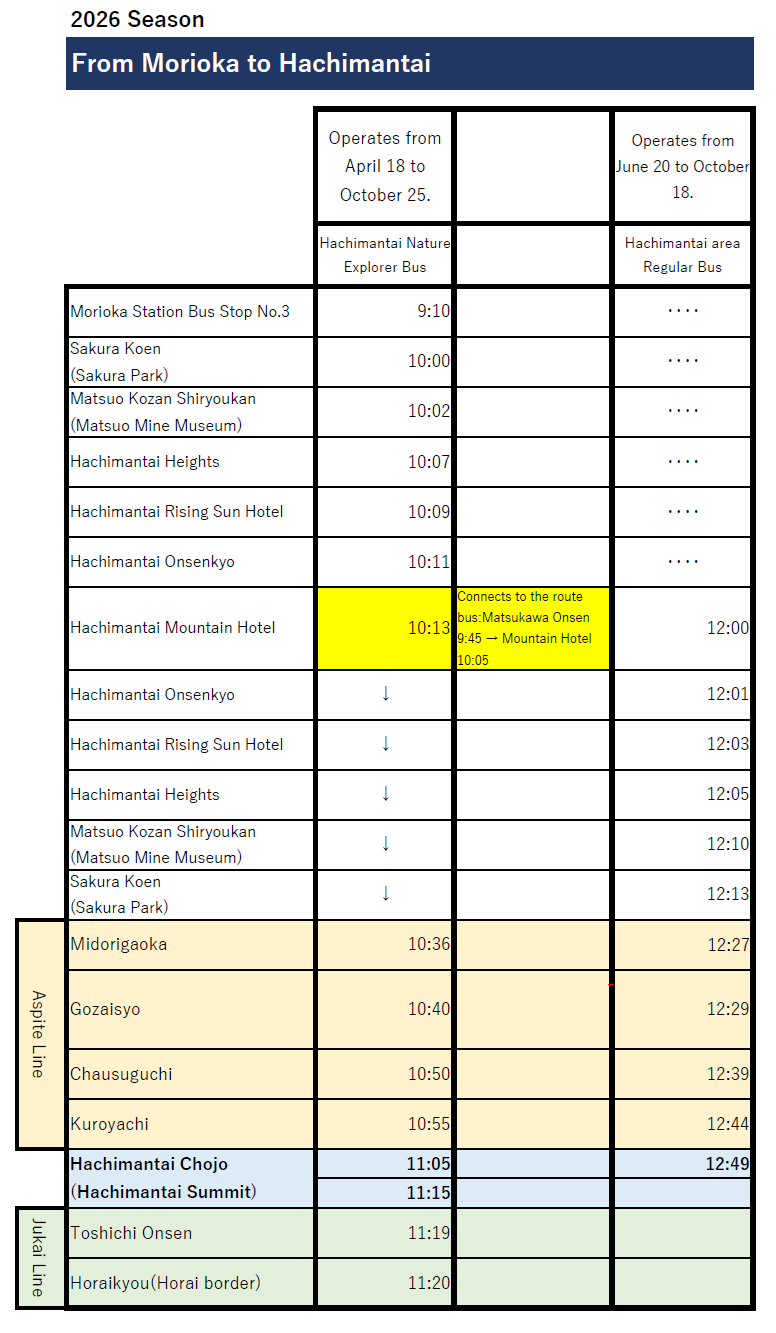
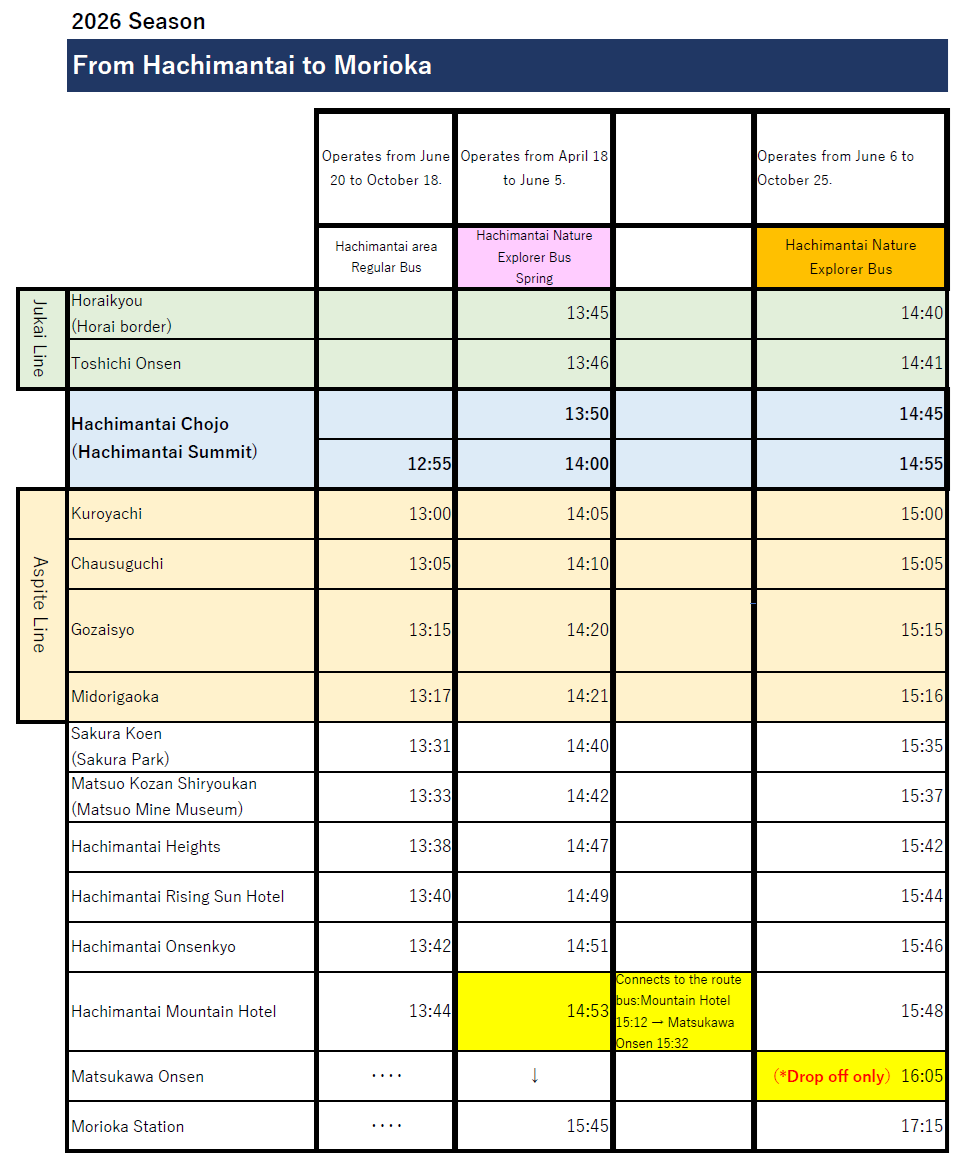
Photo credits
- The Dragon Eye at Kagami-numa, Hachimantai, June 2026. Not a current view. Photo: SAGI1955 · CC0 1.0
- The Dragon Eye at Kagami-numa, Hachimantai, with the dark "pupil" in the middle, June 2019. Not a current view. Photo: らんで · CC BY-SA 4.0
- Kagami-numa, the Dragon Eye, in fog, Hachimantai, May 2017. Not a current view. Photo: らんで · CC BY-SA 4.0
- Kagami-numa in summer, after the snow has gone, Hachimantai, August 2014. Not a current view. Photo: 掬茶 · CC BY-SA 4.0


