On white mornings,
I can say anything.
A short story of misty winter mornings in Yufuin, told by a woman who has lived in the town all her life and has never found it easy to say things to people’s faces.
Faces
I have never been good at saying things to people’s faces. At school I would sooner write an answer down than say it aloud. When something matters, I tell it to my shoes.
I was born in Yufuin, and I have lived here all my life. It is a small town in a basin, ringed by mountains of about a thousand metres, Mount Yufu among them, and it is blessed with water and hot springs. In a town this size, most of the faces I pass have known mine since I was small. That does not make it any easier.
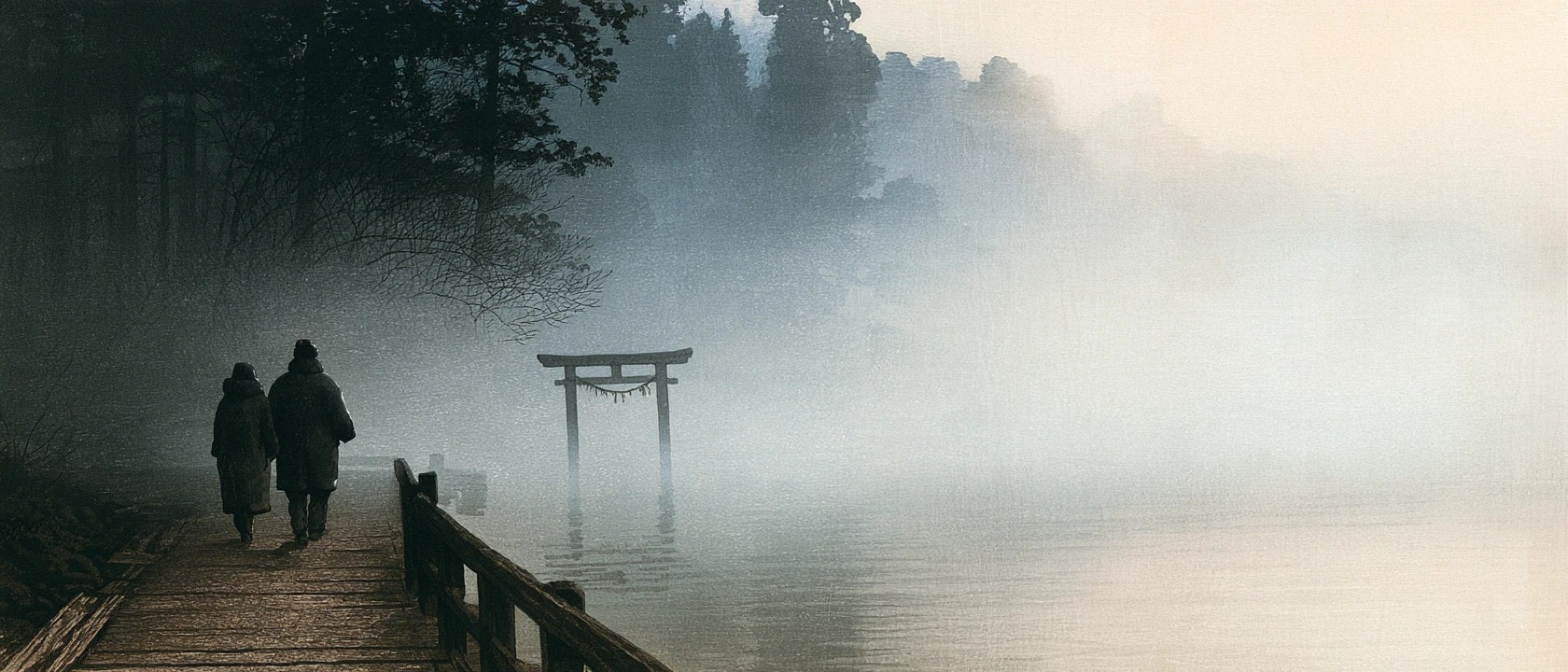
On some cold mornings from autumn into winter, white mist wraps the basin. On the thickest of them I cannot see Mount Yufu, or even the tree in front of me, let alone anybody’s face. It does not come every morning, and I have never met anyone who could promise which mornings it will. But those are the mornings when I am brave.
Clear nights
The mist is made in the night. On a clear night with little wind, the ground gives its warmth away to the sky, and the air lying just above it turns cold. Fog made like this often forms along valleys and in basins, and ours is a basin. I once read that Oita has small basins dotted along its mountain rivers that are known for morning mist, and that the thickest of all is ours. I was pleased to see it written down.
They say it needs a sunny, mild day, then a cold night, and then a clear morning with no wind. On most days in December and January it goes below freezing here, but cold alone, they say, is not enough. These days, a sky full of stars on a still night makes my heart beat a little faster, though all it means is that the white might come.
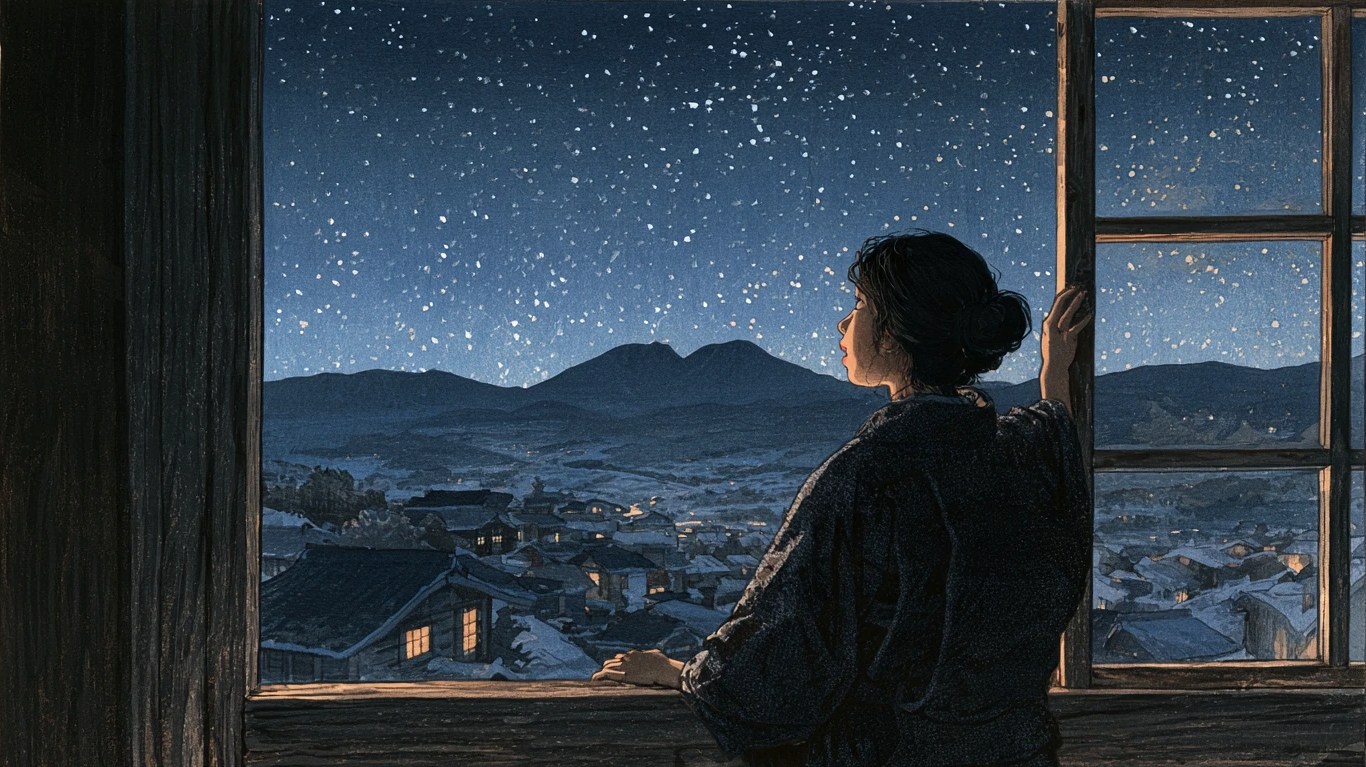
When I wake to a window full of white, I send him one word: “White.” He sends the same word back. Then I put on my coat and walk down to the lake.
The warm lake
Lake Kinrin is in the town, within walking distance of my house and of his. Spring water and hot-spring water both flow into it, so it stays warm all year. When the air turns cold, from late autumn into winter, the difference in temperature sets steam rising from its surface. On the mornings I love most, the mist lies over the town and the steam rises from the water, and to my eyes it is all one white.
Its name means golden scales. It is said that a Confucian scholar in the early Meiji era named it after the fish in the lake, whose scales shone gold in the evening sun. It was named for an evening, but for the two of us it has always been a morning lake.
A path goes all the way round, about four hundred metres. That is no distance at all, so we go round again. Before the sun is fully up, a little grebe splashes somewhere we cannot see, and a fish jumps. At one end of the lake, a torii seems to float on the water. It belongs to Tenso Shrine, which stands beside the lake. In the white, it is the only thing with edges.
What I told him
I have known him since we were seven, when his family moved to Yufuin. He is the sort of person who says everything straight to everyone’s face. For more than twenty years we were simply two people who had always known each other.
Then, one white morning two winters ago, we both happened to walk round the lake, in opposite directions, and did not see each other until we were close enough to touch. After that we went round together, and in the white I talked. I could not see his face, so I told him things. That I was the one who lost his kite when we were nine. That I cried at a film he laughed at. That I have always wanted to see the sea in winter. He listened. Sometimes he laughed. Once he took my hand, and I let him, because nobody could see.
On ordinary mornings, we talk about the weather like everyone else.
The sun
One morning last winter, the white was soft and deep, and we were on our second time round. All that winter I had been trying to say one thing to him. Above the white, the top of Mount Yufu was beginning to brighten. People call it Bungo Fuji, and it has two peaks. When the light reaches up there, I know the white has very little time left, because once the sun begins to reach it, mist like ours goes quickly.
I started to say it. The steam caught the light and began to change shape. The white thinned around us faster than I could talk, and halfway through the sentence I could see his face. He was looking straight at me. He did not look away, so neither did I. I finished the sentence.
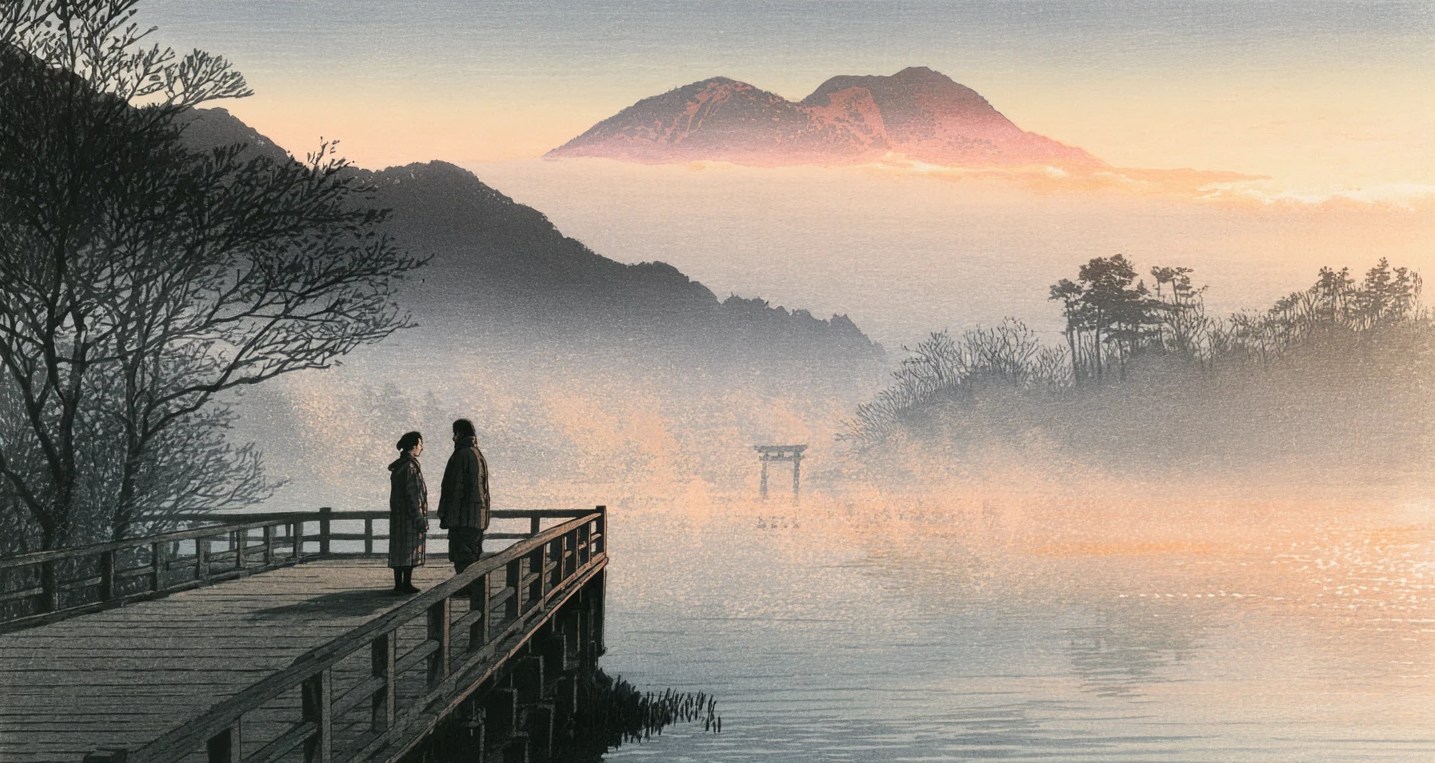
What I said was for him alone. But I said the second half of it to his face, in full sun, with the torii there on the water and, I am almost sure, a woman from my mother’s street walking past. By lunchtime my mother knew. All she said was that he had better come to dinner.
If you are in Yufuin on a cold morning when the white has come, I hope you stand by the lake with someone and say what you have been meaning to say. And when the sun comes through, as it does, quickly, I hope you finish your sentence.
Places in this story
- Lake Kinrin — A small lake fed by spring water and hot springs at the foot of Mount Yufu, where steam rises on cold mornings.
- Mount Yufu — The 1,583 m twin-peaked ‘Fuji of Bungo’ behind Yufuin, about two and a half hours’ climb.
Things to do in this area
Travel information, separate from the story: food and experiences in this area in the season of the story, from our guides. The people in the story are fictional and did not visit these places.
- Oita dango-jiru soup (Food, where: Beppu) — Ōita’s dango-jiru puts vegetables and ribbons of hand-stretched wheat dough in a miso soup. At Beppu Amami Chaya, you can order a small or large bowl or have it in a set with yaseuma, a sweet made with soybean flour.
- Beppu Jigoku Mushi (Food, where: Beppu) — In Beppu’s Kannawa district, hot-spring steam cooks vegetables, seafood, meat and eggs. You can use a steam cooker yourself at the workshop on Ideyu-zaka, or order a pudding or egg already steamed at Okamotoya in Myōban.
- Reimen in Beppu (Food, where: Beppu) — A cold noodle dish from Beppu. At Beppu Reimen Ichiban, round buckwheat-blend noodles are made to order and served with beef-and-bonito broth and cabbage kimchi.
- Beppu Toriten (Food, where: Beppu) — Ōita’s toriten is chicken seasoned before it is fried in tempura batter. At Tōyōken in Beppu, the original version comes with kabosu vinegar-soy sauce and mustard. Another version uses yuzu in its batter.