His first spring
took a month to climb the mountain.
A short story of April on Mount Yoshino, told by a young mother who has lived on the mountain all her life.
It climbs
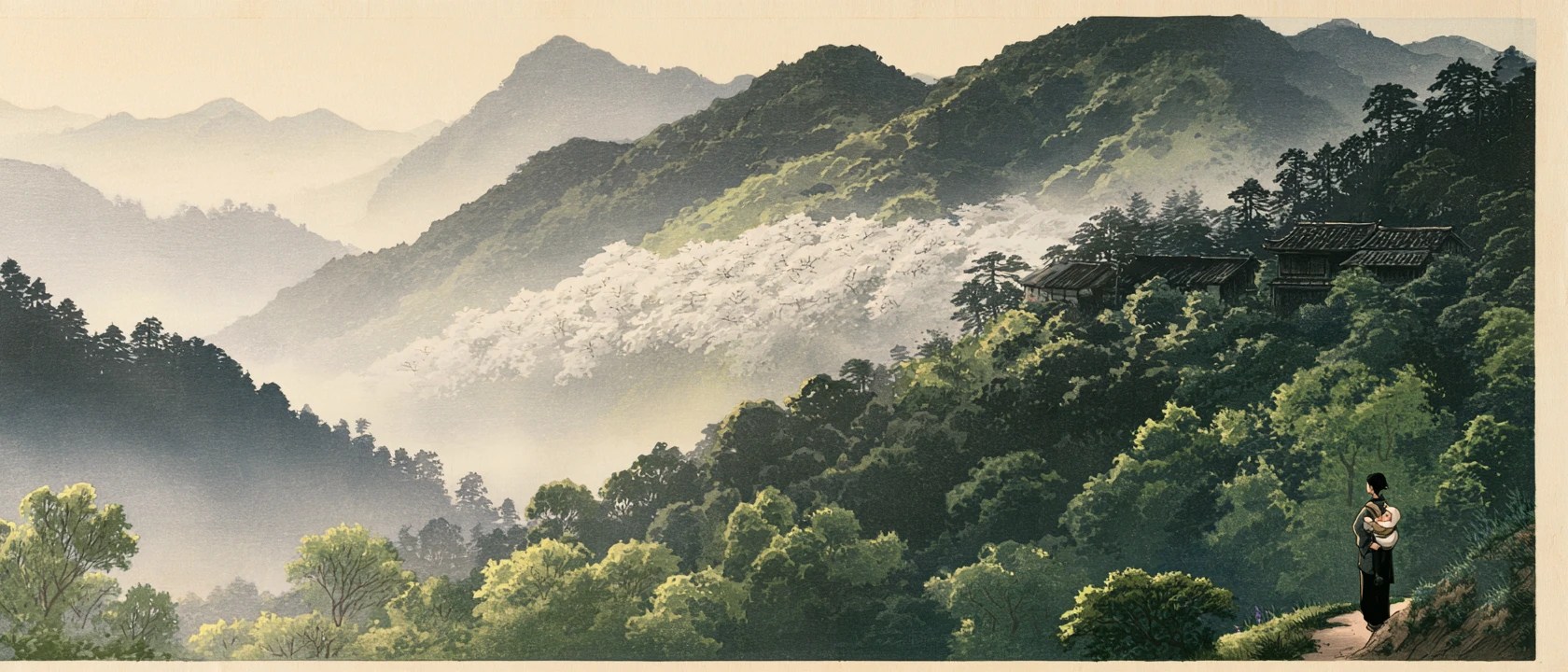
On our mountain, spring does not arrive. It climbs.
Mount Yoshino is not a single peak but a ridge, about eight kilometres long, at the northern end of the Omine mountains. About thirty thousand cherry trees grow on it, of some two hundred kinds, most of them Shiro-yamazakura, a mountain cherry with flowers a little whiter than most. They stand in four main groves, and we name them from the bottom: Shimo-senbon, Naka-senbon, Kami-senbon and Oku-senbon, the lower, middle, upper and inner thousand trees. Usually they flower in that order, from the foot of the mountain to the top, from early April to the end of the month.
I have lived partway up that ridge all my life. On ordinary days I work in an office in Nara City. For thirty-three Aprils I saw spring go past in pieces, on the way to school and then on the way to work.
Our son was born in February, and this spring I was on parental leave. For the first time, all of April was mine. Every morning, after his first feed, I put him in the sling and went out. I had a plan, which I told nobody: to follow spring up the mountain, one grove at a time, so that he would be there for all of it, even asleep.
The first white
In the first week we went down to Shimo-senbon. He slept with his cheek against my shirt, and I looked for both of us.
Most of our trees are mountain cherries, and they do not flower the way Somei-yoshino do, all blossom and no leaf. Their leaves begin to open a little before the flowers, so the white comes with new leaves in it. And they do not all open together. Even within one grove, some trees open ahead of their neighbours and some behind, so a slope looks less like one cloud than like a room full of people who have each made up their own minds.
An old woman from our street looked into the sling. “A spring baby,” she said. I said he was born in February. She waved that away.
The fierce face
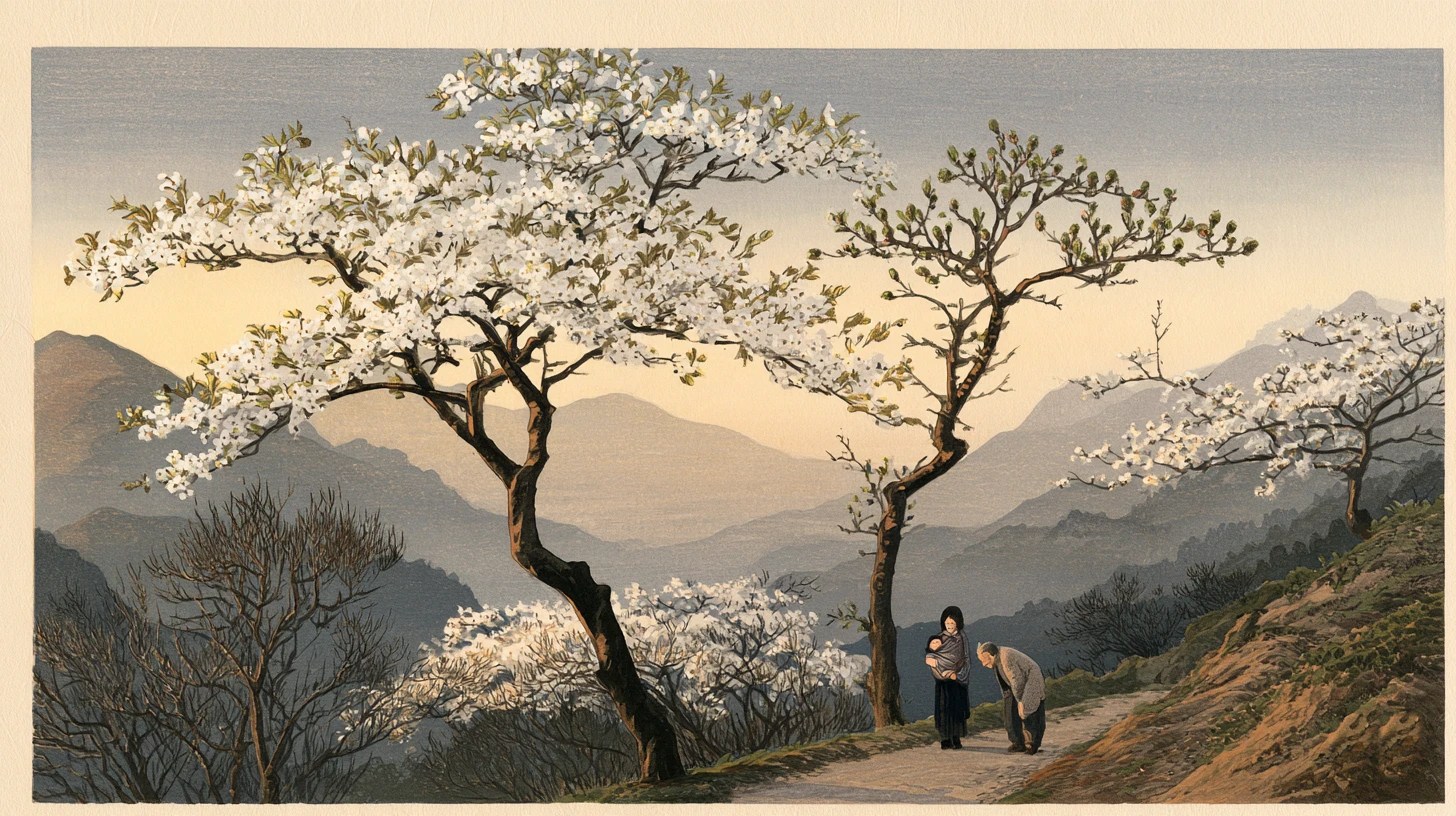
In the second week the middle of the mountain was white, and Kinpusen-ji held its Hanaku-e.
Our cherries were not planted for flower viewing. About 1,300 years ago, it is said, En no Gyoja, the founder of Shugendo, a Japanese religion of mountain practice, spent a thousand days in practice on the peak of Sanjogatake, and there saw the deity Zao Gongen appear. He carved its figure from the wood of a mountain cherry and enshrined it on that peak and here on Yoshino. That is how the temple began, and why the cherry became a sacred tree. For centuries afterwards, believers planted cherries on the mountain as offerings.
I have walked under other people’s offerings all my life and never once wondered what they asked for. This spring, with him asleep on my chest, I wondered a great deal.
Every year from the tenth to the twelfth of April, which the temple gives as the time of full bloom, it holds a rite to tell Zao Gongen that the sacred mountain cherries are in full bloom. On two of those mornings a procession sets out from Chikurin-in for the main hall: footmen at the front, then the demons of Kinpusen, children in ceremonial dress, Shugendo’s yamabushi and the monks, and last of all the head priest in a palanquin.
We stood at the side of the road. When the demons went by, my son opened his eyes and watched them with great seriousness. At five, I hid behind my father’s legs.
The pictures of Zao Gongen frightened me too: the furious face, the blue-black body. The temple says this fearsome form is full of compassion and forgiveness, something like the anger of a loving parent. Once, when I was seven, I reached up for a low branch by the road, and my father said my name in a voice I did not know. My hand stopped in the air, short of the flowers. I had never seen his face like that, and I have not forgotten it. That morning, under the trees, with my son’s weight on my chest, I thought I finally knew whose face it had been.
From small cherries
By the third week our own street had gone green, and we walked on up to Kami-senbon. People describe the cherries on this mountain as hitome senbon, a thousand trees at a glance. Looking down that week, I saw more leaf than flower. The white had moved up around us.
Despite their name, Somei-yoshino are not from here; they were bred in Edo, the old Tokyo. Our mountain cherries cannot be increased by grafting the way Somei-yoshino are, so the people who look after them still raise young trees from the small cherries they bear, and plant them out.
So, I suppose, no two of them are quite the same. I like to think that is why they never all open on the same day.
Everyone who looks into the sling tells me whose ears he has, and whose chin. I look at him and think he is his own tree.
The inner thousand
On the last Sunday of April my husband came with us, and we went slowly up to Oku-senbon, the highest of the four groves. In that grove is the site of the hut where the poet-monk Saigyo once lived. In one of his poems he says that, because he has grown used to going deep into the mountain for the flowers, he is sure to come to know even its innermost part. We had come all the way up for the flowers, and I thought I knew what he meant.
The last flowers were there, a few trees still white among the green. Behind us, all the way down, the mountain was in leaf. A petal came down and settled on my son’s forehead. None of us moved it.
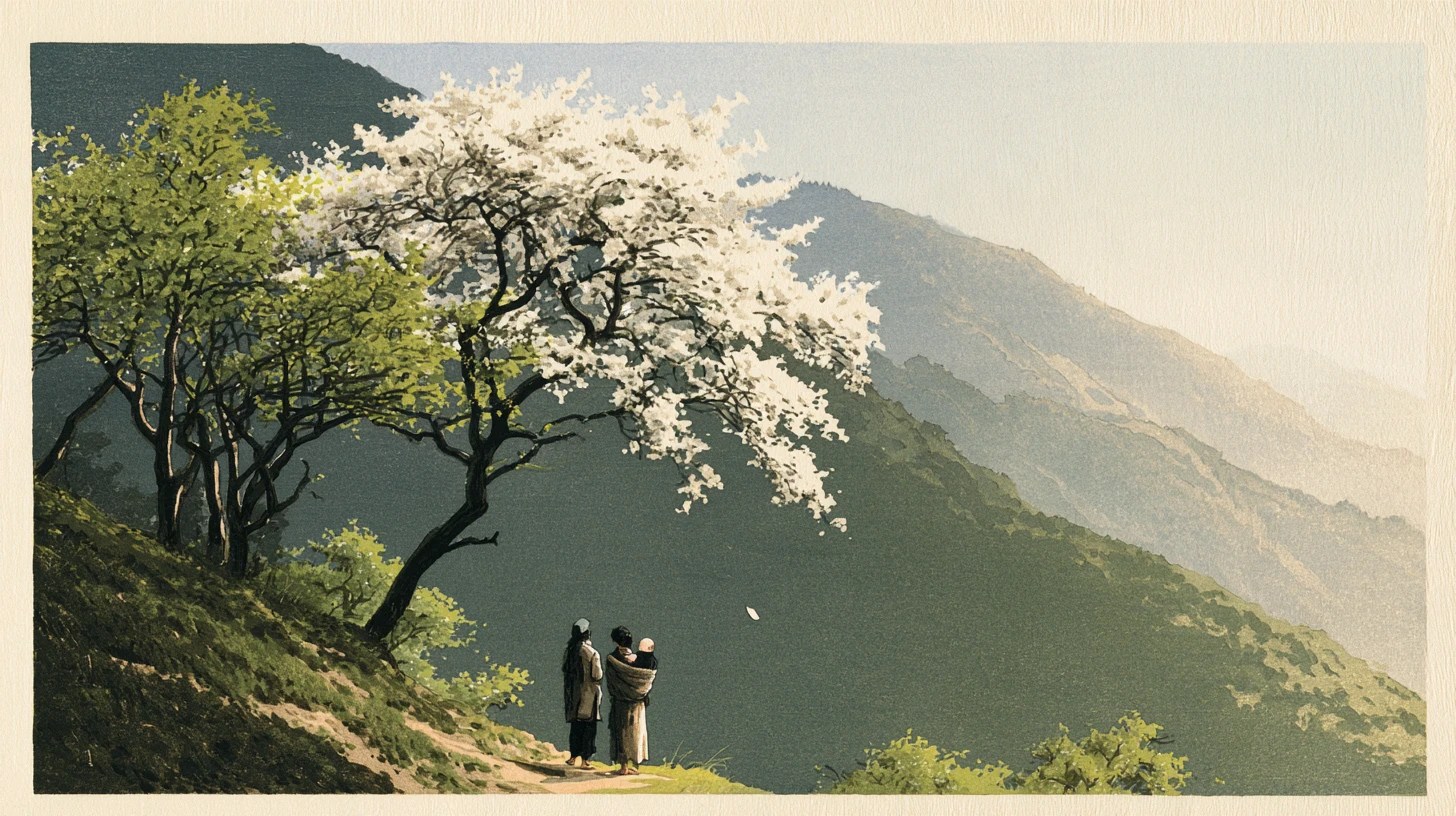
Next April the mountain will start again from the bottom, as it usually does. He will be walking by then, or nearly, and much slower than spring. That is all right. On our mountain there is usually a little more spring further up.
If you come to Yoshino in April, I hope you will look up the mountain as well as into the branches over your head. Spring is never all in one place here. For centuries, people planted these trees as offerings. I think of each one as somebody’s prayer, and I like to think that somewhere above you, one of them is just opening.