Two nights a year,
the snow calls you in.
A short story of mid-February in Yokote, told by a woman who sat inside a snow hut at six and could not say the words.
Snow first
In Yokote, winter means snow before it means anything else. In an average winter nearly eight metres of it falls on the city, two of them in February alone. In an ordinary February, the snow on the ground is more than a metre deep at its deepest. On an average February day, even the warmest hour is only a little above freezing. I have lived here all my life, and I have never had to wonder what to do with a February morning. I pick up the shovel.
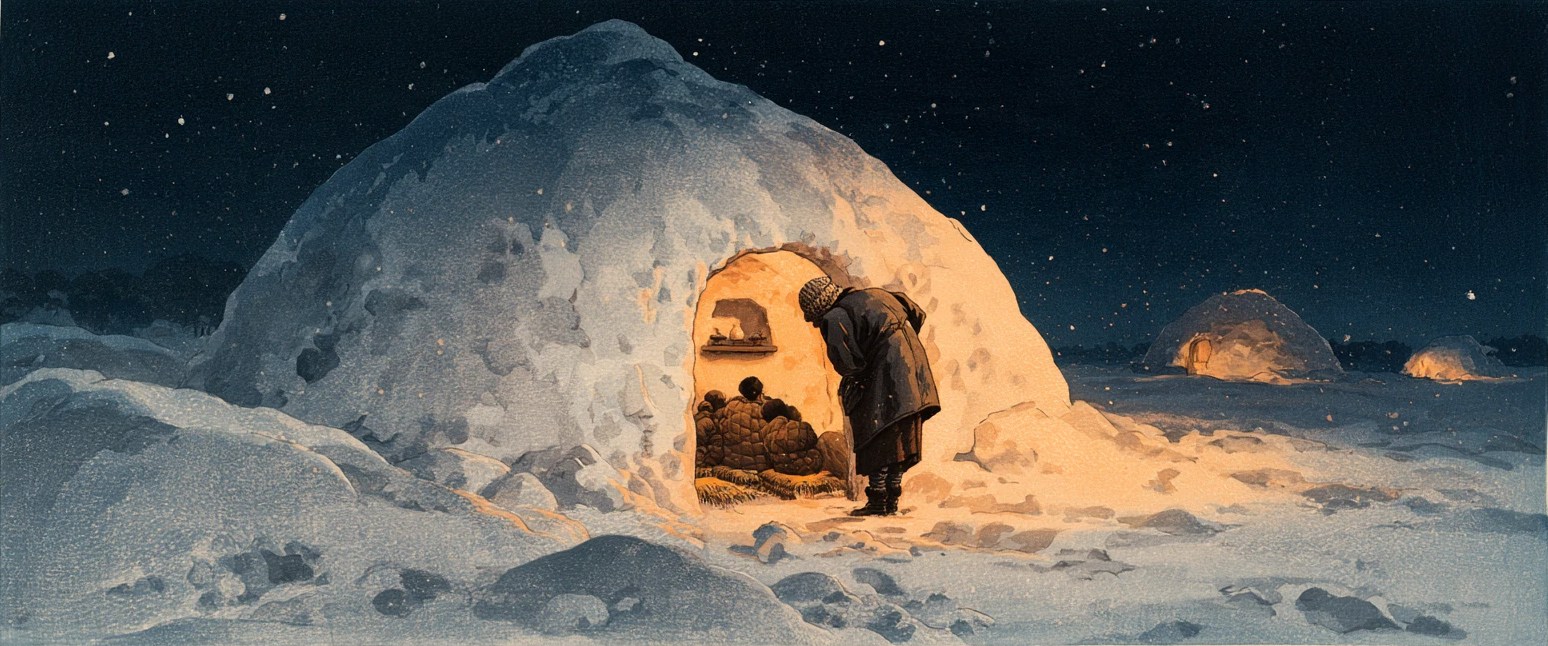
Then, every year in the middle of February, the city does something else with its snow. It makes rooms of it. They are called kamakura, and each has a small altar to the water god inside. For two nights, children sit in them and call people in. Kamakura have been made here for about four hundred and fifty years, it is said.
Beforehand, great mounds go up around the city. The snow is piled high and trodden down as it goes, and then each mound is left for two or three days to set hard before anyone digs out the inside. I like that part: even snow has to wait until it is ready to be a room.
Haitte tanse
The year I was six, I was one of those children.
There were four of us in that hut: my cousin, who was eleven and knew everything, two brothers from up the street, and me. The doorway was low. Inside, the room was round and white. On the far wall, facing the door, an altar to the water god was carved into the snow. My aunt stood just outside the door all evening, stamping her boots, and now and then put her head in to check on us.
It was warmer in there than anyone outside would believe. My cousin was in charge of the mochi and the amaeko. Amaeko is what we call amazake here, a sweet, warm drink made from rice. There is no alcohol in it. Our job was to call to the people passing in the dark: “Haitte tanse,” please come in, and “Ogande tanse,” please pray to the water god.
The others called out all evening. I could not. Every time someone went by, the words came up as far as my throat and stuck there. The kamakura came on the same two nights every February, and I spent the whole of that first night with my mouth shut.
A word too late
Late in the evening, a man and a woman stopped at our door. They were older than my parents, with snow on their shoulders, and they spoke with the accent of somewhere far to the south. My cousin called them in. They bowed their heads under the low doorway and knelt down beside us.
They put their hands together before the altar. Then the woman pulled off her gloves and said, “Why, it’s warm in here,” as if the snow had played a trick on her.
My cousin told them what she knew. Long ago, she said, people in the merchants’ part of town dug a hole in the snow beside their neighbourhood well and prayed there to the water god for good water. The man listened as if he meant to remember every word. I passed them their amaeko with both hands, and both hands shook. Nobody seemed to mind.
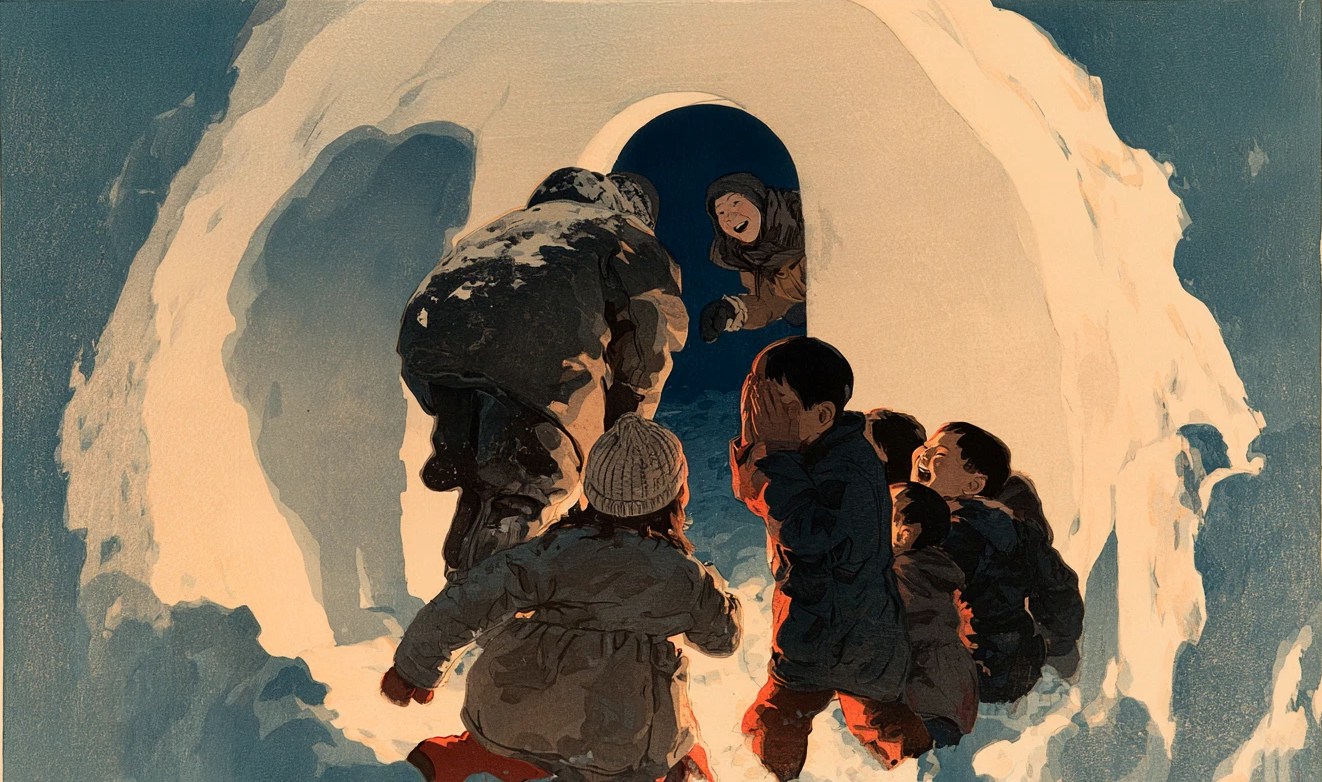
They stayed a long time. That is how it is in a kamakura: you sit and talk, eat and drink, and forget how late the night is getting. When at last they bent to go out, I still had not said a word to them. Then, to their backs, much too loud and much too late, I said it.
“Haitte tanse!”
My cousin put her face in her hands, and the brothers laughed. But the woman turned round in the doorway, laughed too, and came back in. She knelt down again and held out her cup. “Well,” she said, “since you ask.”
From the outside
That was more than fifty years ago. Every February I still go out on the nights of the kamakura. After dark, light spills from inside the huts, and down on the riverbank below Janosaki Bridge, thousands of small snow huts hold a candle each.
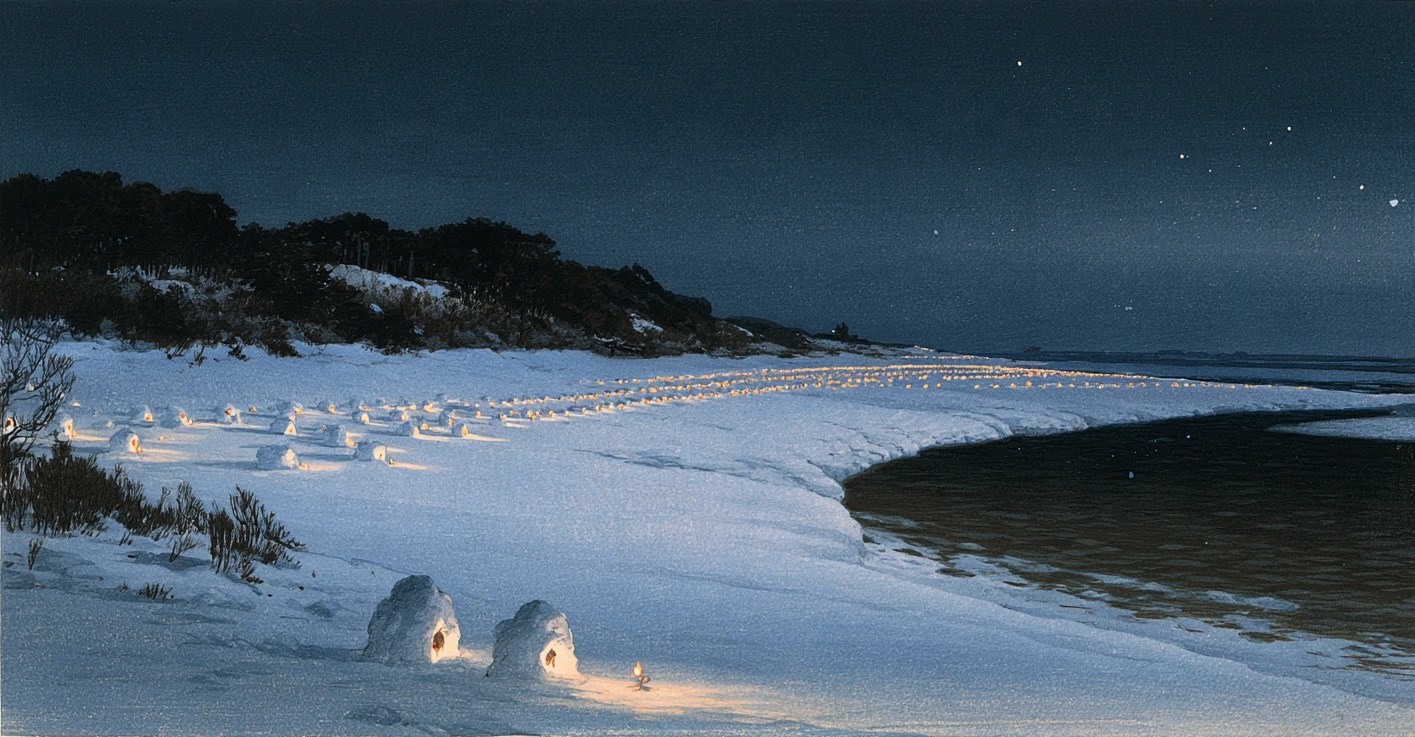
I walk from hut to hut. At each low door, when I am asked, I bow my head and go in. I put my hands together before the water god and pray for good water and for the safety of my household. People here have brought such prayers to the water god for a very long time. I was grown up before I learned that, in the old merchants’ quarter, the water god was called Oshizu no kamisan. I have loved the name ever since.
Last year, in a hut near the end of my walk, there were three children. Two girls called out to everyone, and a small boy at the back, five perhaps, held his cup in both hands and said nothing at all. His father stood outside by the door with his hands in his pockets. The girls gave me amaeko and a piece of mochi, and we talked about school and snow and whose turn it was to toast the next one. The boy watched me the whole time. When I bent to go, I heard it behind me, in a voice no bigger than a candle flame.
“Haitte tanse.”
Since you ask
I turned round. Of course I did. I went back in, knelt on the mat and held out my cup. The boy looked at me as if he had just made the snow do something it had never done before.
“Well,” I said, “since you ask.”
The big huts can stand for weeks, but in the end the snow turns back into water and runs off somewhere. I like to think the water god knows where it all goes.
I never learned the names of the man and the woman from the south. I have told their story every February since, and now I have one of my own to go with it.
If you come to Yokote in the middle of February and a child at the door of a snow hut says haitte tanse, I hope you will bow your head and go in. It is warmer than you think. And if the smallest one says it just as you are leaving, I hope you will turn round.