In September, by the river,
there is always a second pot.
A short story of September in Yamagata, told by a man who has argued with the same friend about the same stew for forty years.
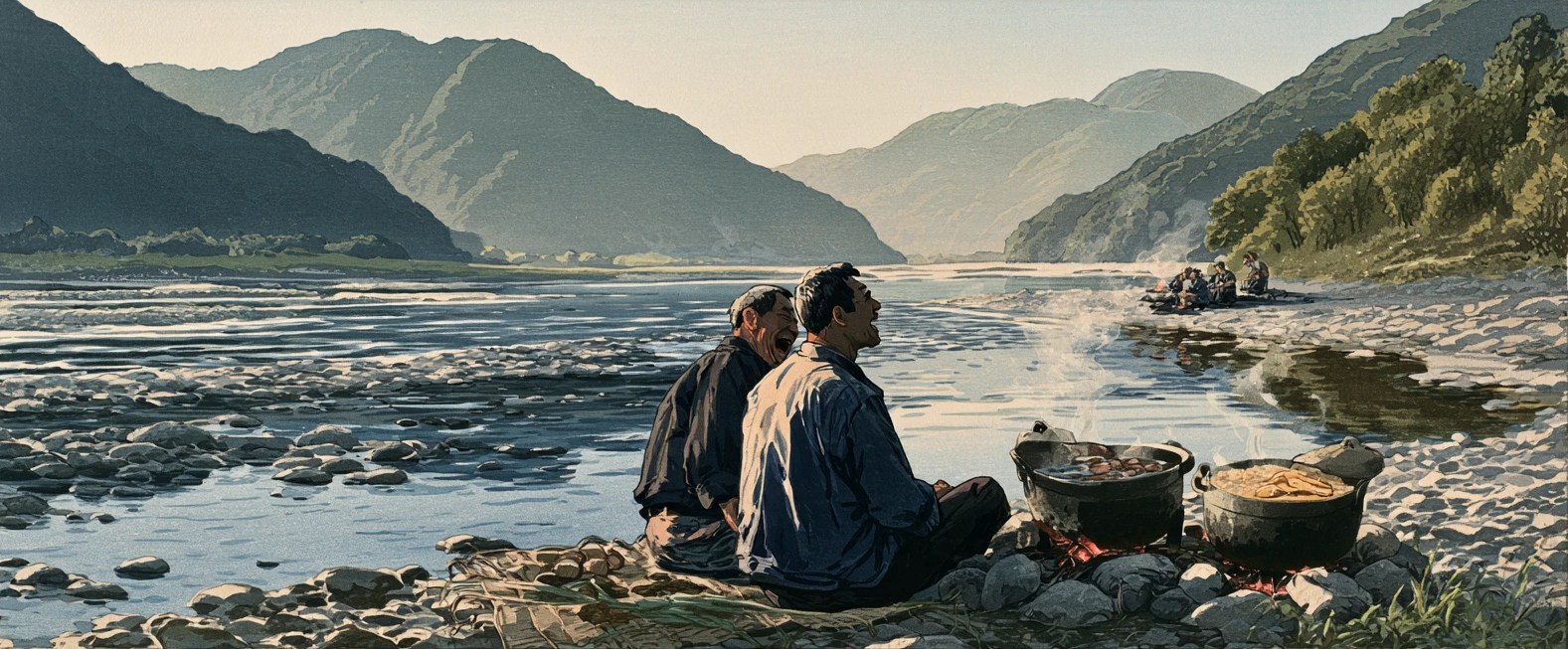
Taro after the rice
Every September, my friend and I have the same argument. We have been having it for forty-one years, and neither of us has won.
It is about imoni. The name says what it is: imo, taro, and niru, to simmer. Taro is ready to eat in autumn, once the rice has been cut, and that is when people in Yamagata take big pots out of doors and cook it together: families and friends, or neighbours after a sports day, on riverbanks, by the sea and in parks. An imoni-kai, an imoni gathering, is one of the fixed events of the year here, like the New Year party and the year-end party.
I was born in Yamagata City, a short walk from the Mamigasaki River, and I have never lived anywhere else. On autumn weekends you see families, friends and groups from work along its banks, each around its own pot. By September the worst of the summer heat has usually gone, and in the evening, by the water, a hot bowl feels right.
In this city, imoni is, at heart, taro, beef, konnyaku (a firm jelly also called konjac) and Japanese leeks in a soy-sauce broth, with a little sugar and sake. The konnyaku is torn into pieces by hand. I knew that before I could hold a ladle.
“This is sukiyaki”
I met him in my first September at work. Our office held its imoni-kai on the riverbank, and in our office the newest people carried the pots. He had come from Shonai, on the coast. He stood by our pot with his bowl and looked into it as if it had played a trick on him.
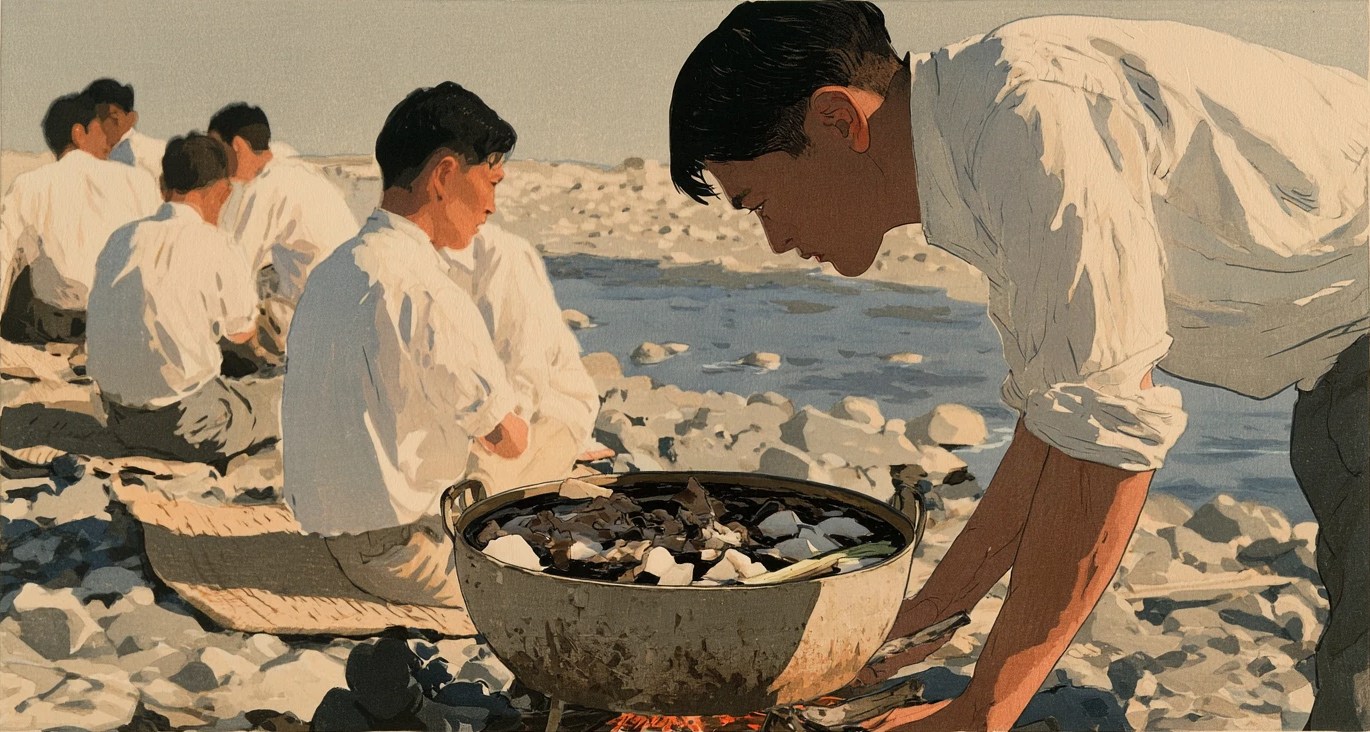
“Beef in sweet soy sauce,” he said. “At home, we call this sukiyaki.”
Somebody laughed. I did not. I sat down next to him and argued, and by the time the pot was empty we had settled nothing.
The next September he brought a pot of his own: pork and miso, with thick slices of fried tofu. He handed me a bowl. I tasted it and told him that at home, we call that pork soup. We have been friends ever since.
The trouble is that we are both right. On the coast, imoni is made with pork and miso. Inland, in the Murayama and Mogami areas, it is beef and soy sauce. In Okitama it is beef and soy sauce, in some places with a little miso. One prefecture, three answers.
From then on there were two pots at our office imoni-kai. In time it was not the office at all, only the two of us and whoever we could talk into coming. There were always two pots.
Who came first
Now the argument is mostly history.
He reminds me that the first imoni had no beef in it. It is said that in the middle of the 1600s, boatmen on the Mogami River, waiting days for their cargo to be collected, cooked local taro with dried cod from the boats. Beef came much later, around the start of the Showa era, about a hundred years ago, people say. “So your beef is the newcomer,” he says.
I remind him that imoni is said to have reached the coast from us, inland, and to have turned to pork and miso there because so many pigs are raised in Shonai. “So you copied us,” I say.
Then he lights the fire and I peel the taro, as we always have. You can hire everything for an imoni-kai now, the pot, the firewood and a mat to sit on, but he has carried the same pot for forty years. When we leave, we put the fire out, take our rubbish and leftovers home, and leave the bank as we found it. That was the first rule of our group, and it still is.
Nabetaro
Some of the city’s business people once decided that the whole country should know about Yamagata’s autumn imoni-kai, and that the way to do it was to hold one with the biggest pot in Japan. The first festival was in 1989, and its pot was 5.6 metres across. We went to see it that September, both still in our twenties. My friend looked at it for a long time and said, “Still the wrong stew.”
The pot now is the third, 6.5 metres across and four tonnes in weight, made for the thirtieth festival with help from crowdfunding. Like the others, it is called Nabetaro. Every year in the middle of September it is set up on the banks of the Mamigasaki. Early that morning the cooks put in water, taro and konnyaku and light more than six tonnes of firewood beneath it. When the stew is ready, a crane lifts the lid in a great cloud of steam.
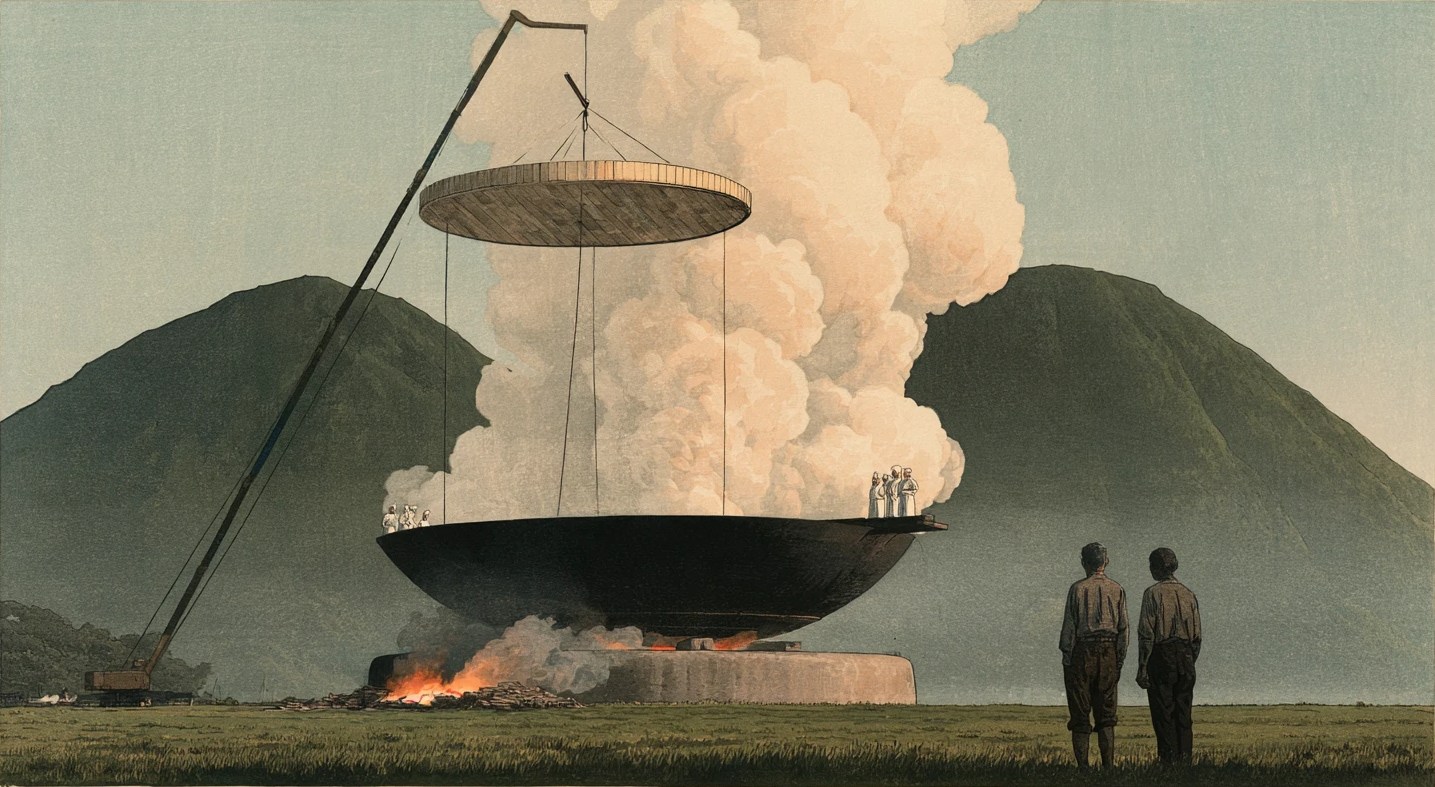
Then two backhoes, digging machines, serve it, about a hundred bowls to a scoop. They are new machines, taken apart and washed, and their moving parts are rubbed with butter, by hand. “That digger,” my friend says every year, “gets better care than my pot.”
These days the festival has a second pot as well, three metres across, for salt-flavoured imoni made with pork. He looks at it the way you look at a door left ajar. “Pork has its own pot now,” he says. “Miso is next.”
The year the pots changed places
Last September, the argument went the other way round.
He lit the fire. I set my pot down on one side and he set his down on the other, and when the lids came off, his was beef and soy sauce and mine was pork and miso, with thick fried tofu. Neither of us had said a word. We laughed until the group at the next fire looked over.
Then we tasted. “Too much miso,” he said. “But it’s imoni.” I tried his, and it was very good.
“You’ve made sukiyaki,” I told him.
You cannot argue with someone about a taste for forty years without learning it. Somewhere along the way he had learned mine by heart, and I had learned his.
When both pots were nearly empty, we did what we have done for years and put in udon, and lately a little curry roux as well. By then nobody could have told you whose pot was whose.
If you come to Yamagata in September, I hope you eat a bowl from the big pot, and that on the walk along the river afterwards you smell woodsmoke and soy sauce. If you go on to the coast, I hope you taste theirs too. Then you will have an opinion of your own. Mine, forty-one Septembers ago, got me a friend for life.