Every May,
the first tea crosses the valley.
A short story of May in Wazuka, told by a man from a tea-growing family who has worked the same hillside all his life.
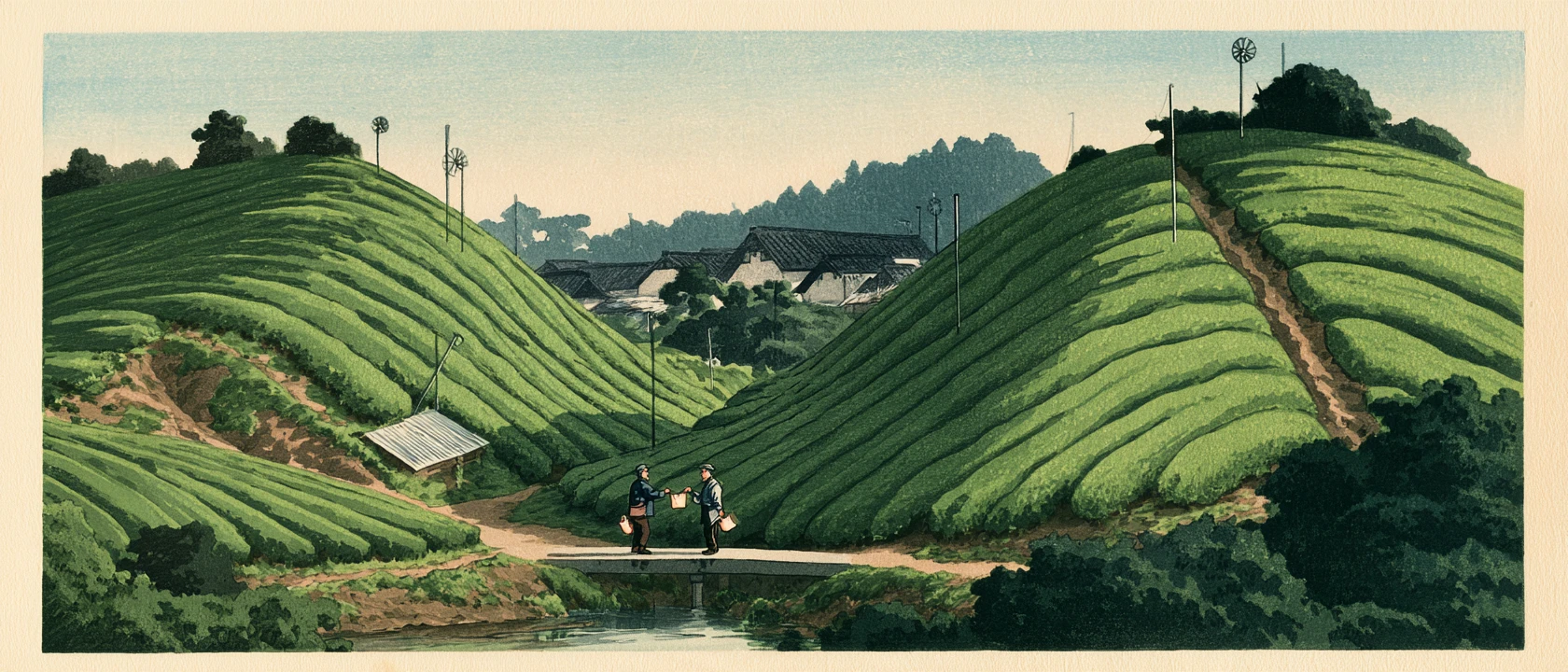
The far slope
From the top of our tea field, I can see his.
Our rows run down one side of a narrow valley, and his run down the other, facing mine. Between them there is a stream, a narrow road and a great deal of air. We were born in the same year, in houses on opposite slopes, and we walked to school together for nine years. Since then, we have spent most of our lives watching each other work.
Wazuka is a tea-growing town in the hills of southern Kyoto Prefecture. The bushes grow in neat rows that follow the shape of the land, and in places the fields reach almost to the ridgelines. A guide to the town says tea growing here probably began in the early thirteenth century. Because Wazuka is near Uji, a better-known tea district, its tea was often sold as Uji tea.
In the cold months the tea rests, and snow can turn the rows into long white mounds. Then, as spring warms, new buds push out among the leaves that have come through the winter. Every year about then, I start looking across the valley more often than I need to.
April
In early spring, a cold spell can bring frost that damages the new buds. Among the bushes stand tall poles with fans on top, which move the air to keep the frost from harming the leaves. On cold spring nights I lie awake and listen for ours. Once, standing at the end of the field, I heard his as well, faint, across the valley.
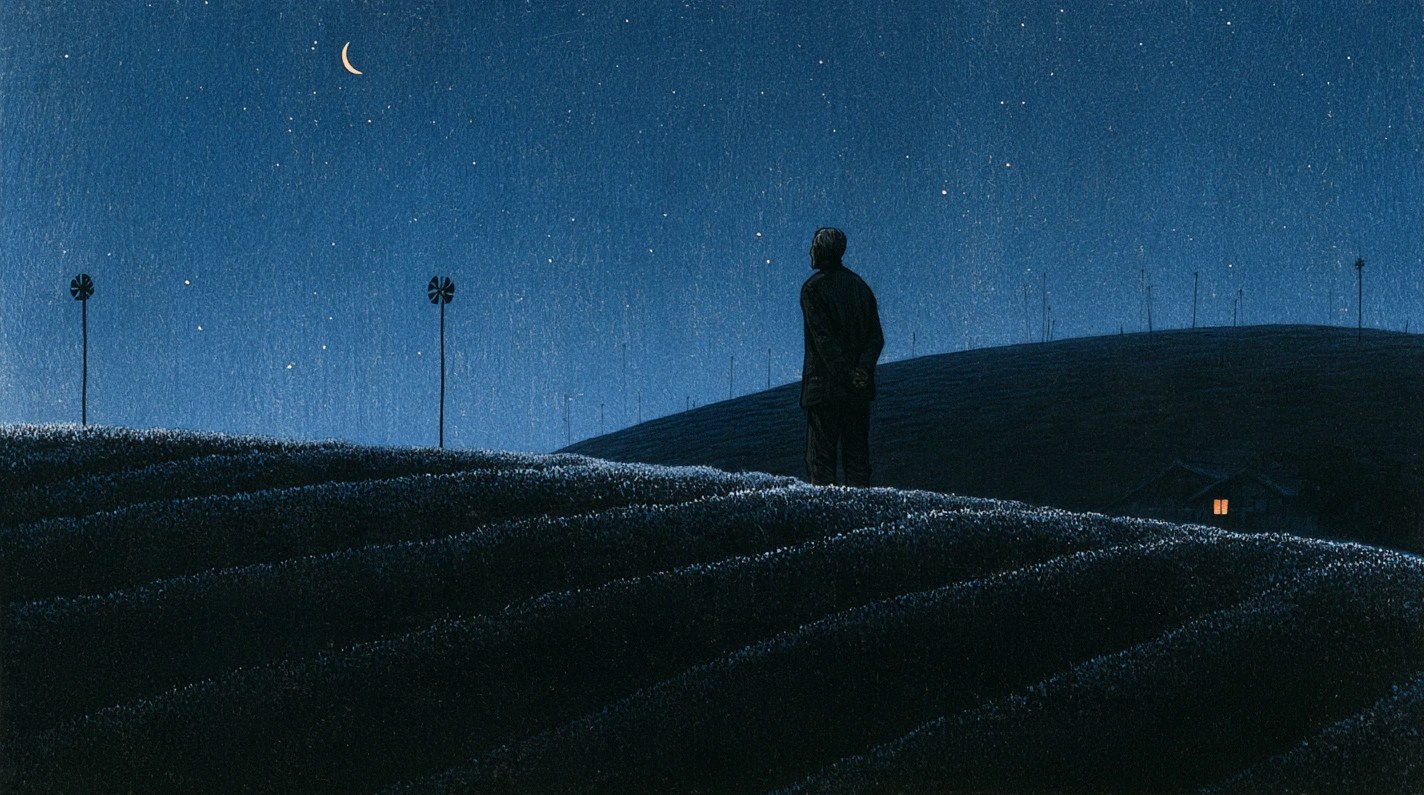
Neither of us mentions it. But in the morning I see him out among his rows, bending over the buds, and I know he has seen me doing the same.
Some mornings, the far slope is not there at all. The days and nights here differ a great deal in warmth, and with the Wazuka River running through the low ground, morning mist gathers over the fields. The same guide says the mist keeps too much sun off the bushes and the leaves soft. I stand with my tea and watch his rows come back, a few at a time, as it lifts.
Late in April, before the first picking, we spread black cloth over many of our rows to shade the leaves from direct sun. For a while, here and there across the hills, the green goes dark.
Every year he covers his rows before I cover mine, and every year he telephones to tell me so.
“You’re late,” he says.
“I’m careful,” I say.
We have had the same conversation for thirty years.
My wife says that from our side, his slope under its black cloth looks like a man in his good suit, waiting for a wedding to begin. She is right, and I have never told him.
The first picking
May brings the new-tea season, the height of the year’s work for tea farmers. In our house, nobody eats supper at a proper hour until it is over.
We pick with a machine that takes two people. One of us goes on each side of the row, and we walk along together, setting the height of the blade between us. My wife and I have walked many rows like that, talking across the bushes. Across the valley, two small figures move along a green line in the same way: he and his wife.
My fingers still know the older way, picking by hand. You take the stem between thumb and forefinger, without using your nails, and snap it off, so that you have one bud and the two leaves below it. In the holidays around the start of May, visitors have sometimes been shown here how to pick one bud and two leaves by hand. Once, from the road, I watched a young woman hold her first sprig up to the light as if she had found something. I suppose she had.
From the field, the leaves are taken to be steamed, quickly, then cooled, rolled by machines that do the work hands once did, and dried until almost no water is left in them. By evening in May, my clothes smell of green leaves.
The bridge
When our first tea of the year is made, I put some in a small bag and walk down to the bridge over the stream. He comes down his side with a bag of his own. Whoever gets there first waits. We have done this every May since we were twenty-five. It is not a custom of the town. It belongs to the two of us.
We do not open the bags there. We talk about frost and cloth and whose knees are worse, and each of us climbs home with the other’s tea.
That evening I make his first. I pour the boiling water into the cups to let it cool, then into the pot, and when the tea is ready I pour out every last drop. In the cup it is a light golden green. Tea from Wazuka is said to have a fresh fragrance. His, to me, always smells of the far slope in the morning.
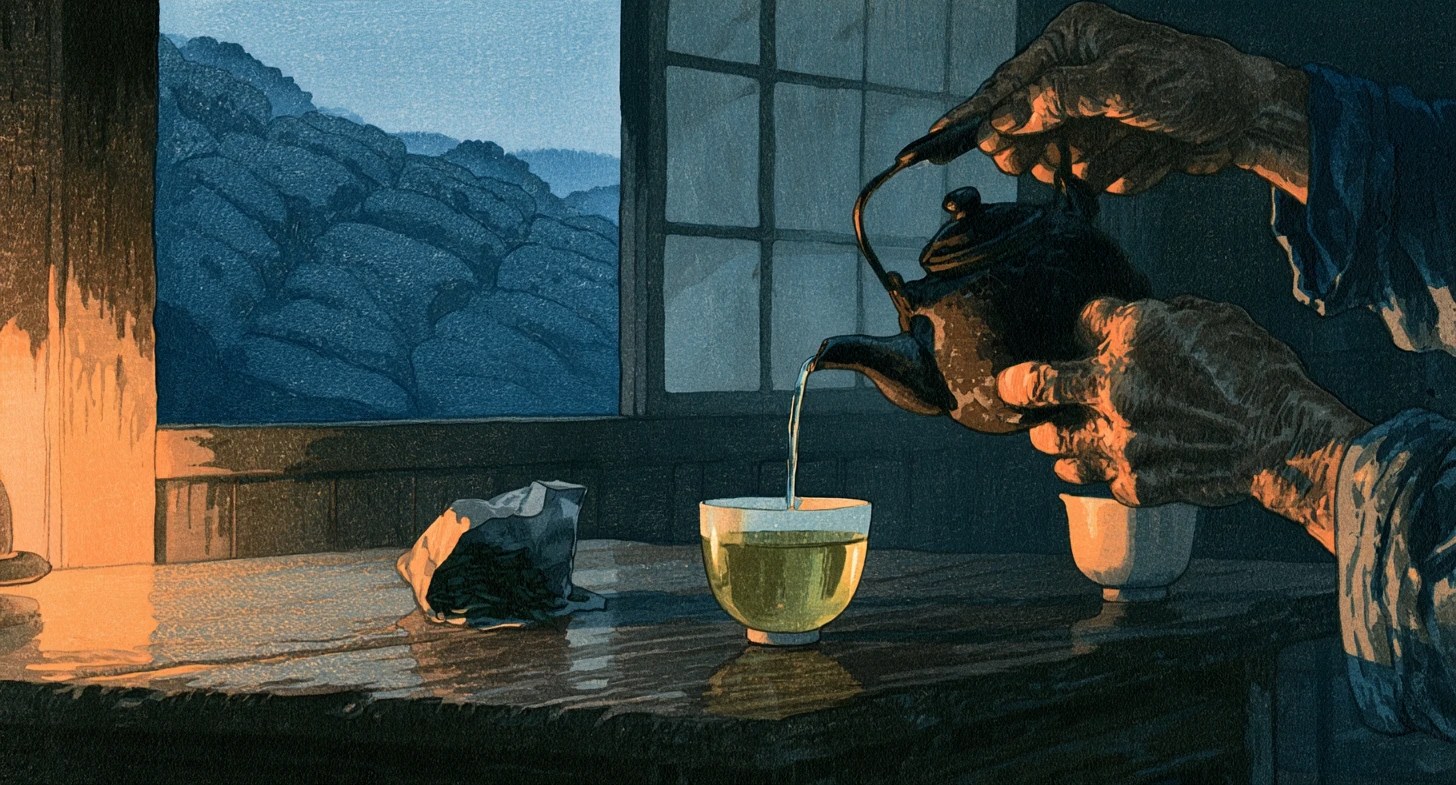
His rows catch the morning sun, and mine the afternoon. I have always believed you can taste the difference. He says that is nonsense.
Then I telephone him.
“Well?” he asks.
“Not bad,” I say.
He says the same about mine. We have been saying “not bad” to each other for forty years.
The second leaves
About thirty to forty days after the first picking, new shoots have grown to the same size again. They are picked too, but nobody calls them new tea; they are the second tea. By summer the hills are a patchwork, some rows under cloth, some trimmed, some waiting to be picked. Nothing crosses the valley for the second tea. Only the first one does.
This spring, on the bridge, I finally asked him which tea he drinks first that evening, his or mine. He looked at me as if I had asked which way was downhill.
“Yours,” he said. “I already know what mine tastes like.”
I have never told him that I do the same. I still have not.
If you come to Wazuka in May, I hope you will look at the tea from the road. The fields are private land, and the people in them are working. And if you find a place where you can see across a valley, I hope you will watch the far slope for a while. You may see two small figures walking a machine along a green row. Somewhere on this side, I like to think, someone is watching them too.