Every July,
the river opens again.
A short story of July in Tokyo, told by a woman who grew up a few lanes back from the Sumida River, a short walk from Senso-ji.
Forty-six thousand days
On the evening of the ninth of July, I put on a cotton yukata, lock the front door and walk to Senso-ji. I was born a few lanes back from the Sumida River, in a narrow house with a narrow staircase, and I have never lived anywhere else.
The tenth of July is the temple’s greatest day of merit. A visit on that day, Senso-ji says, brings the merit of forty-six thousand days, about a hundred and twenty-six years: a whole lifetime’s worth at once. There are several ideas about where the number came from. One, which the temple passes on and then calls uncertain, is that a sho, a traditional measure of rice, holds about forty-six thousand grains, and that issho, one sho, sounds the same as issho, a lifetime.
My mother has always liked that story, true or not. She likes even more that, in the Edo period, people were so eager to be first that they began coming the day before, and that is why the ninth and the tenth are both kept now. “A lifetime on offer,” she says, “and still nobody could wait one more day.” In our house, we have always gone on the ninth. We have never been any good at waiting either.
Wind and thunder
On those two days the temple grounds fill with stalls of ground-cherries, about a hundred of them. Sellers in dashing outfits call out their wares, and many people stroll between the stalls in yukata. In English, ground-cherries are sometimes called Japanese lantern plants, for their shape. Wind chimes are sold there too, to add a little coolness, and somewhere one is always ringing.
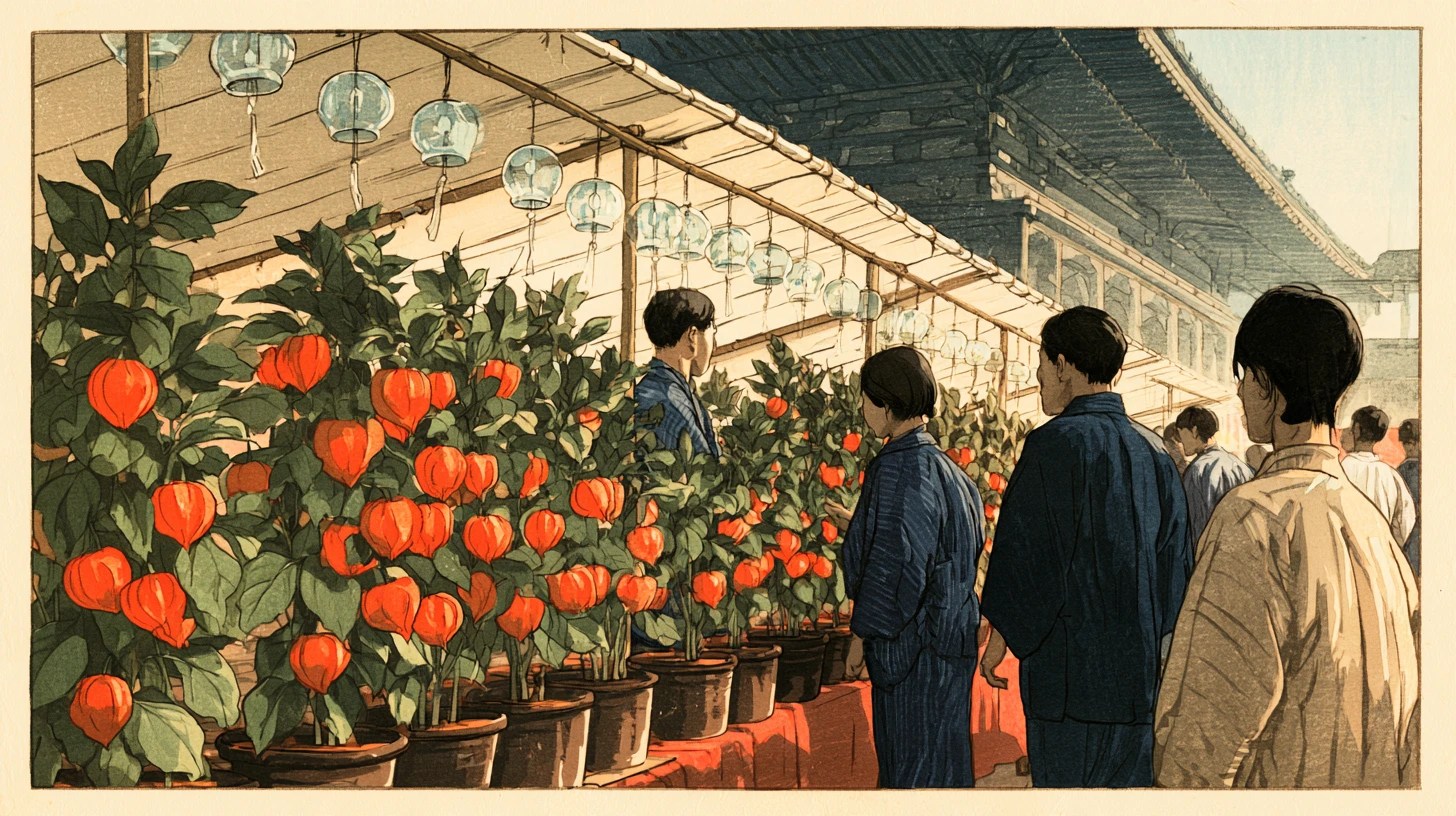
Every year my mother bought one ground-cherry plant for the front step. She bought a new wind chime for the upstairs window only when the old one cracked. It is the season of Obon as well, the temple notes, and in our house the ground-cherries always ended up on the Obon shelf.
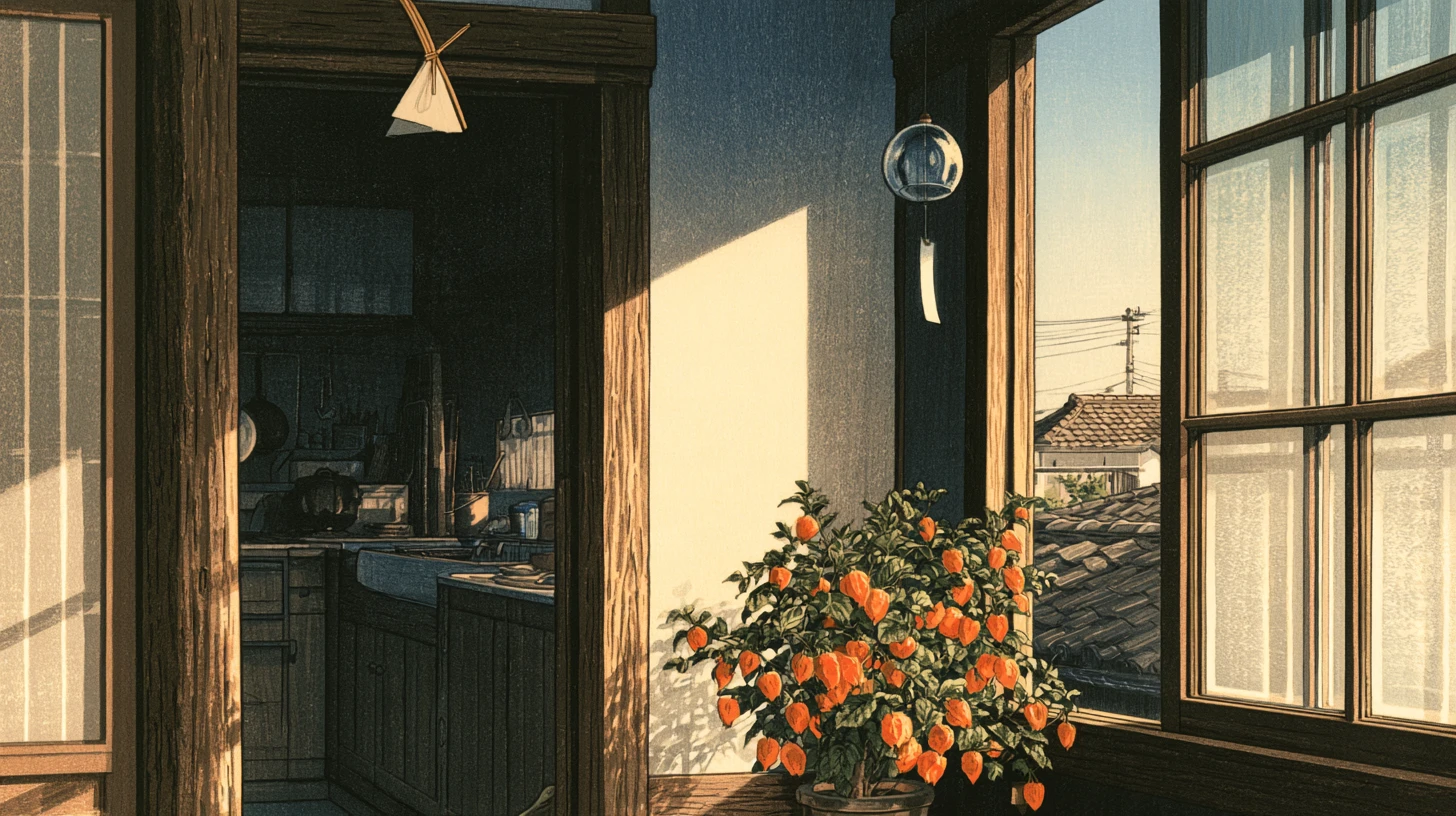
For those two days only, the temple also gives out a charm against lightning, small and triangular, held in a bamboo stick. My grandmother, who lived with us, tucked ours above the kitchen door. When summer thunder rolled over the roofs, she would glance up at it, as if to check it was still on duty.
The temple’s main gate is called Kaminarimon, the Thunder Gate, but its proper name is the Gate of the Wind God and the Thunder God. The two gods who govern wind and rain stand on either side of it. “Wind and thunder,” my grandmother would say of the chime and the charm. “The gate has its two, and we have ours.”
The big river
My grandmother never called it the Sumida. To her it was the Okawa, the big river, a name it also went by in the Edo period; some of the old rakugo stories still call it that.
The temple’s own story begins in the river. Early one morning in 628, by its tradition, two brothers fishing there found a sacred image in their net. Each time they put it back and cast again somewhere else, the image came up and the fish did not, until at last they took it home.
In an average year, the rainy season here is still with us at the ground-cherry fair, and it leaves around the nineteenth. Then the heat moves in. By the end of the month an average afternoon is past thirty degrees, and at night, to me, it hardly cools at all. That is when the wind chime earns its keep. A breeze comes up from the river, the chime rings, and the room feels cooler, though nothing has changed but the sound.
Kawabiraki
My grandmother remembered the fireworks from long before I was born. In her day they were called the Ryogoku no Kawabiraki, the opening of the river at Ryogoku, and they were set off upstream of Ryogoku Bridge. After 1961 they stopped, when worsening traffic, among other things, made them impossible. For years, she said, the summers went by without them.
In 1978 they came back with a new name, the Sumida River Fireworks, on a river by then surrounded by buildings. The launch sites had moved further upstream, towards us, and there were now two of them. I was five that summer. It is my first clear memory: the window glass trembling at every bang, and my grandmother at the upstairs window, saying to no one in particular, “The river’s open again.”
Over the roofs
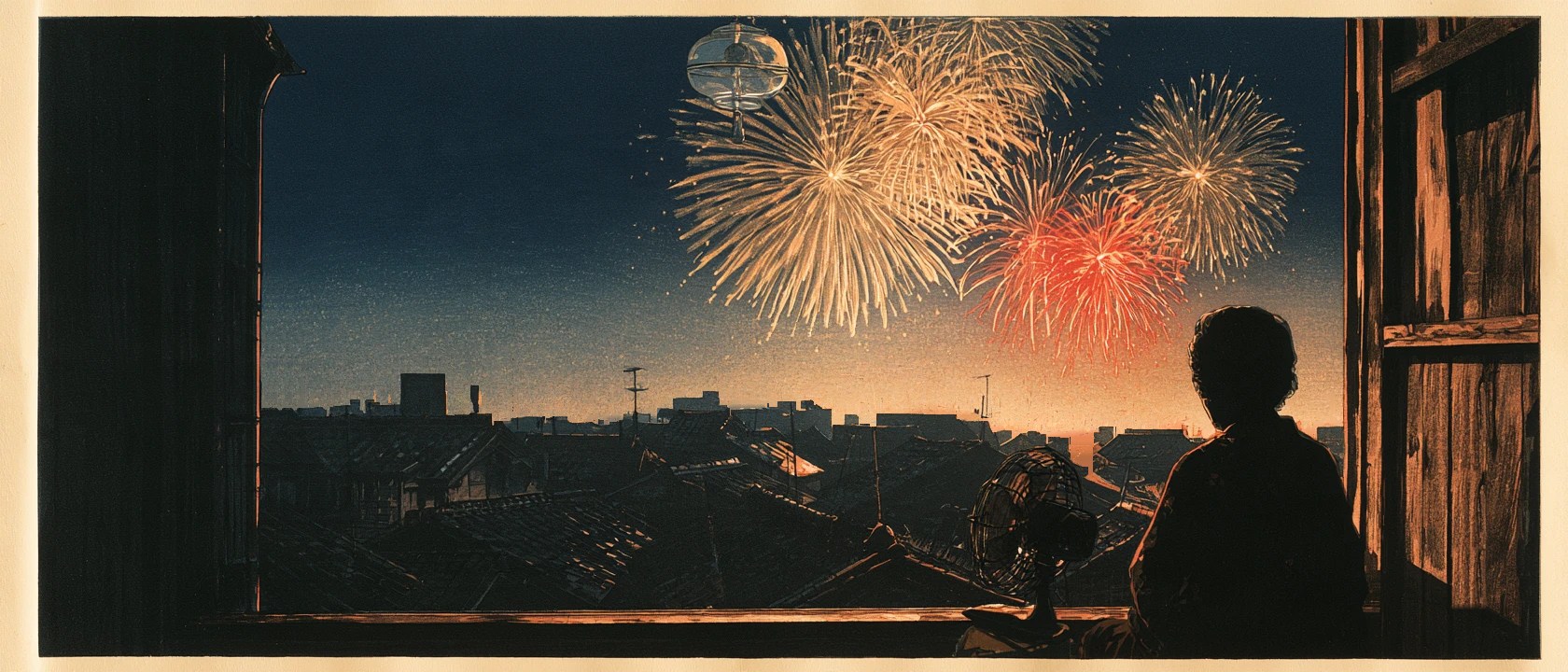
The fireworks usually fall on the last Saturday of July. We have always watched them from home, from the upstairs room, with the lights off and the fan turning.
You cannot see the river from our window. You see roofs and aerials, and above them the sky where the big shells open. At the first of the two sites, my father liked to explain, they burst about two hundred metres up, which is why they clear the roofs. The ones that open into round chrysanthemums are called warimono, and Japanese warimono, he told us every year, are said to be the most finely made fireworks in the world. He always said “are said to be”. He did not like to boast.
First the light, then the sound, rolling in over the roofs a moment later. My father counted the seconds between them every year, and the count never changed. “The river hasn’t moved,” he said.
My father and my grandmother are gone now. My mother is eighty-six and no longer walks to the fair, so on the ninth I bring the ground-cherry plant home to her and tell her who was there. On the night of the fireworks she sits in my father’s place by the window and does the counting. My son has lived far away for years. When the first shells go up, he rings, and I hold the phone to the open window so he can hear the summer coming in over the roofs.
A lifetime’s worth in one day, my mother says, and a whole summer in one night.
If you come to Tokyo in July, I hope you will walk among the ground-cherries on one of those two days and listen for the wind chimes. And on the night of the fireworks, wherever you are, I hope you will look up over the roofs and count the seconds between the light and the sound. Not far from the river, at an open window, an old woman is counting too.
Places in this story
Things to do in this area
Travel information, separate from the story: food and experiences in this area in the season of the story, from our guides. The people in the story are fictional and did not visit these places.
- Asakusa ningyoyaki moulded cakes (Food) — Ningyoyaki are small cakes baked in cast-metal moulds from flour, eggs and sugar. On Asakusa’s Nakamise shopping street, you’ll find cakes in the shape of pigeons or thunder gods, plain cakes without bean paste and a version fried on a skewer.
- Sukiyaki (Food) — Beef cooked at the table with leeks, tofu and other ingredients in a sauce of soy sauce, sugar and sake, then dipped in beaten egg. Japan’s farm ministry says Tokyo’s gyunabe shops took the Kansai name, sukiyaki, after the 1923 earthquake.
- Tokyo chanko nabe hot pot (Food) — Chanko nabe grew out of the meals made in sumo stables. The pot can hold chicken, meatballs, napa cabbage and tofu. In Ryogoku one restaurant serves individual paper pots at lunch, while a venue in Asakusa combines soy-sauce chanko with a sumo demonstration.
- Dojo nabe in Tokyo (Food) — Loach simmered in a shallow pan and served with chopped scallions. Komagata Dozeu lists the whole-loach pot, Yanagawa pot and loach soup as separate choices.