Spring is kept
in a tall storehouse.
A short story of April in Takayama, told by a man who has waited out the mountain winters in its old town all his life.
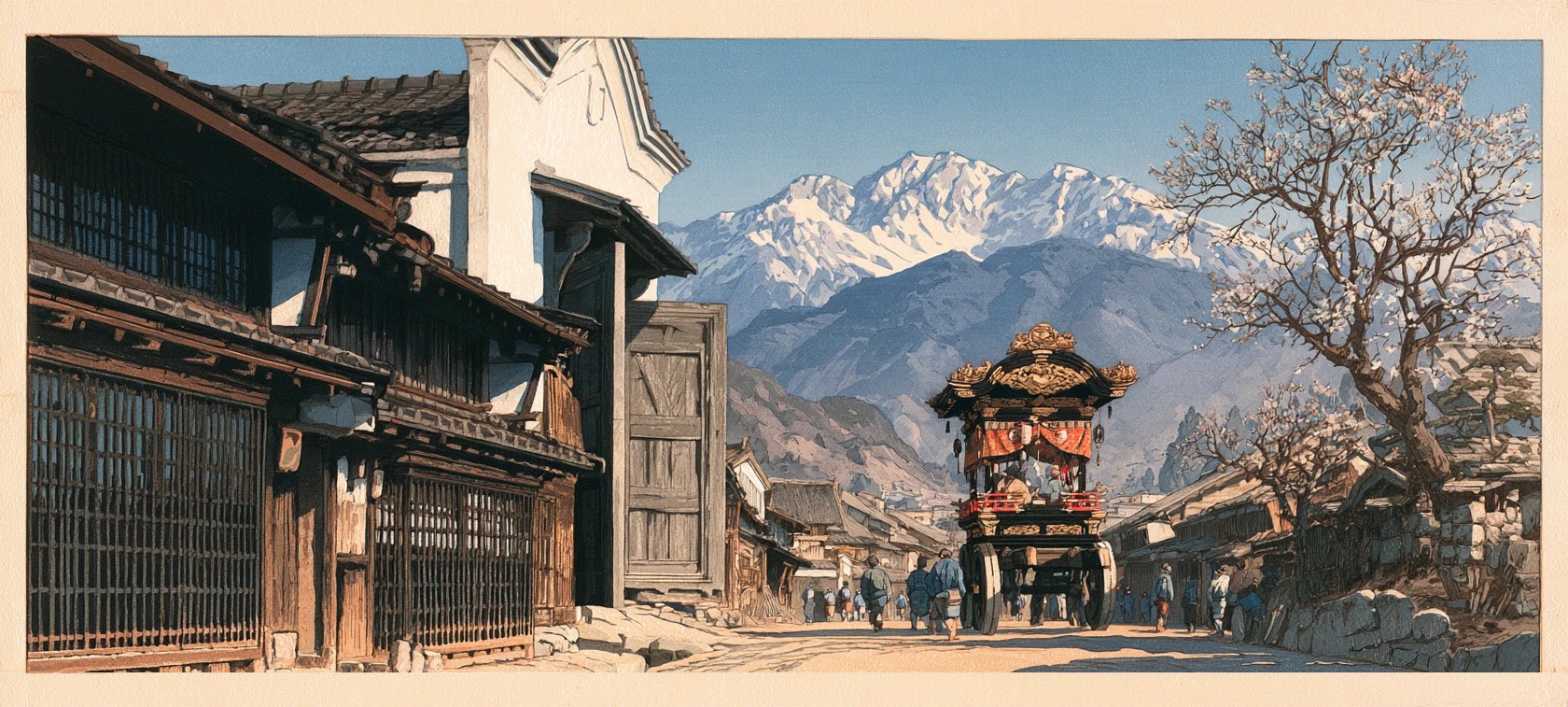
Snow in March
In Takayama, March is not spring. It still snows on many days of the month, and even April usually brings a little. When I was a boy, my grandmother would stand at the window in March and watch it come down. “Winter in the mountains,” she said, “is a guest who never knows when to leave.”
I was born in the southern half of the old castle town, in a lattice-fronted house where I still live. Hie Shrine watches over this half of town, and every year on the fourteenth and fifteenth of April, whatever day of the week they fall on, it holds its festival. It is called the spring Takayama Festival; its proper name is the Sanno Matsuri. In autumn a different shrine holds its own festival, in a different part of town, with different floats.
It is a shrine’s rite. In our house it was also how we knew that spring had truly come.
The first sign I trust comes while the snow is still flying. Walking home past a community hall on a cold evening, I catch the sounds of practice behind the fogged windows: the lion dance has started rehearsing. Spring still feels a long way off. They practise anyway.
Eyes, not hands
Not far from our house stands a tall storehouse, one of the buildings where the floats are kept. For most of the year I walk past its closed doors without a thought.
As the festival comes near, gongs and small drums start up in the evenings. Children join in the practice every night for tokeiraku, which marches in the procession, and people here call it kan-kako-kan, after its sound. I have heard it every April of my life, and still, on the first evening, I stop in the street to listen.
On the morning of the fourteenth, my grandmother opened the window before she did anything else and studied the sky. If there is any chance of even a drizzle, the floats stay in their storehouses. “You don’t take precious old things out in the rain,” she said. “Spring is kept in there with them. It comes out when the sky is kind.”
When the sky held, the storehouse doors opened and the floats came out, twelve of them, pulled out and lined up in the old streets. I wanted to touch the carvings. My grandmother had one rule for that day: look with your eyes, and keep your hands in your pockets. I thought it was only her rule. Much later I learned why. The oil from people’s skin harms the floats, and everyone is asked never to touch them.
The child and the old man
At the crossroads in front of the Jinya, the old government house, three of the floats perform karakuri, mechanical puppets. I loved one above all. A small child dances out along a long beam with a bell and a fan, and bows its face down into a box. When it lifts its head again, it is wearing the mask of an old man. Inside the float, six people work it from behind, with cord after cord.
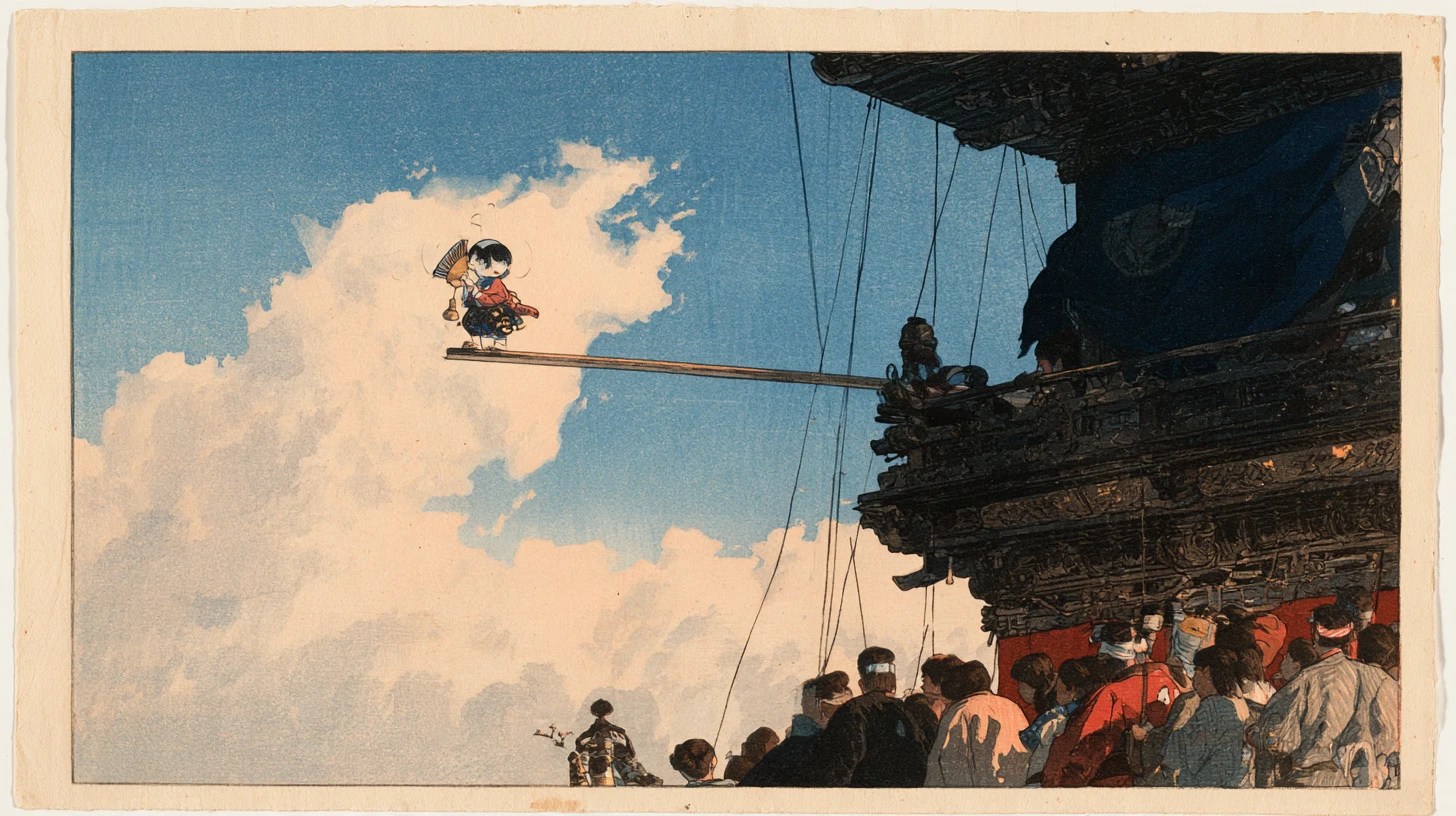
The first time I saw it, I was five, and I burst into tears. Where had the child gone? My grandmother crouched beside me in the crowd. “Still there,” she said. “Under the old man. Where else would it go?”
That afternoon the procession set out from Hie Shrine, hundreds of people around the portable shrine, with the lion dance at its head and the gongs of the tokeiraku ringing high and carrying far. By the time it had passed, I had forgotten I was crying.
A hundred lanterns
In spring the night festival comes only once, on the fourteenth. As it grows dark, each float is lit with about a hundred lanterns and moves slowly through the town. The April nights here are still cold, and I have always thought the light looks warmer for it.
In the festival streets, houses hang a lantern and a paper umbrella by the door, and at night a candle is lit in each lantern. In our house it was my grandmother who lit ours. When she grew old, she stopped going out on the festival night. She had seen enough of them, she said; she would stay in and keep the candle company.
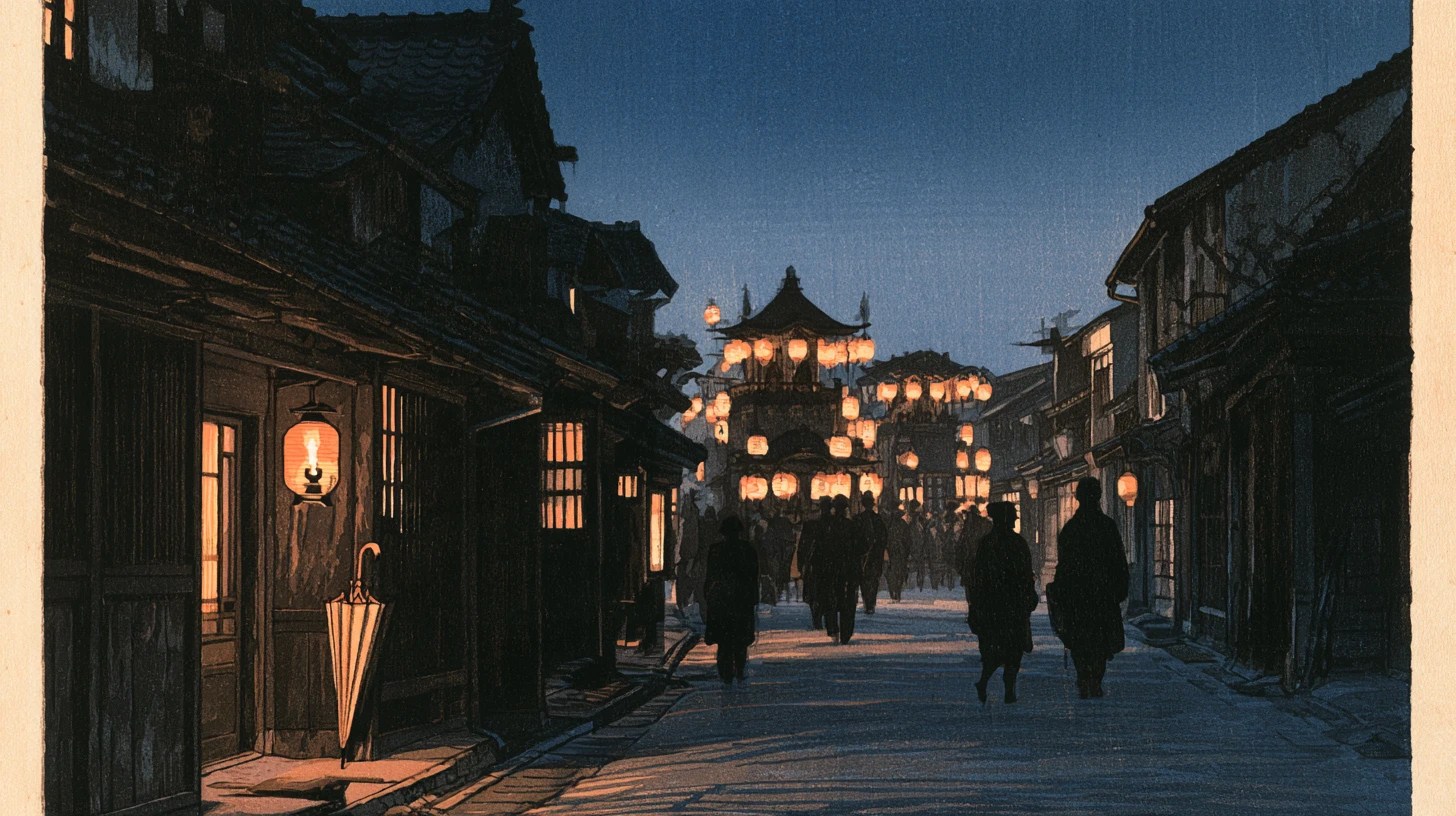
At the end of the night, the floats go home. They make their way back to their storehouses singing a parting song called “Takai Yama”, “High Mountain”. When I came in, cold to the bone, she would ask, “Did they sing?” I would say yes, and she would nod, as if that settled something.
Still there
In town, the cherries are usually at their best from the middle of April to the end of it. I remember years when they were at their best in time for the festival, and years when the floats were back in their storehouses before the trees were in full flower.
Either way, by then snowmelt is running into the Miyagawa, and the first mountain vegetables are appearing at the morning market along its bank: tara-no-me, koshiabura, udo. There are cherry trees along the river too, and when they are in full flower you can do your shopping and see the blossom at the same time. My grandmother bought hers from the women at the stalls, talking with them in Hida dialect faster than I could follow. In our house the first tara-no-me of the year became tempura that same night. That was her rule, and now it is mine.
My grandson turned five this spring, the age I was. At the karakuri he did not cry. He only asked, very seriously, where the child had gone, and I heard my grandmother’s answer come out of my own mouth. “Still there. Under the old man.” He was satisfied. I was the one who had to look away.
If you come to Takayama in April, bring something warm for the night, and keep your hands in your pockets near the floats. In the old streets, look for the tall storehouses. I like to think my grandmother was right, and that spring is kept in there all year, waiting for a morning when the sky is kind.
Places in this story
- Takayama and Shirakawa-go — destination guide
- Miyagawa Morning Market — A morning market held every day on the east bank of the Miyagawa river, between the Kaji-bashi and Yayoi-bashi bridges. Local farmers and makers sell vegetables, fruit, homemade pickles, mochi and folk crafts until noon.
- Takayama Festival Floats Exhibition Hall — A hall in the grounds of Sakurayama Hachimangu where four of the autumn Takayama Festival’s eleven floats are on show all year, changed three times a year. On the many days without a festival, you can see real floats here up close.
- Takayama Old Town (Sanmachi) — Three streets of lattice-fronted merchant houses in central Takayama, with water channels under the eaves and seven sake breweries. A national preservation district since 1979, about 15 minutes on foot from JR Takayama Station.
Things to do in this area
Travel information, separate from the story: food and experiences in this area in the season of the story, from our guides. The people in the story are fictional and did not visit these places.
- Hida Beef in Takayama (Food) — Hida beef is a designation for beef that meets rules on its time reared in Gifu, fattening, breed and grading. At Ajikura Tengoku just south of JR Takayama Station, there is a solo platter of short rib, lean beef and cubed steak, alongside hot pots with a two-serving minimum.
- Gohei mochi grilled rice skewers (Food) — Gohei mochi is cooked rice lightly pounded with some grains left intact, shaped around a skewer and grilled with sauce. In Takayama, some shops put perilla seeds, known locally as aburae, in the glaze.
- Takayama ramen (Food) — Takayama chūka soba typically pairs thin, curly noodles with a soy-seasoned broth. At Mametengu on Yasukawa-dōri, the menu lists noodles in broth alongside tsukemen, with the dipping broth served separately.