From up there,
we are the sea.
A short story of autumn in Takahashi, told by a tofu maker who has lived all his life on a lane below the castle mountain.
Before light
In my shop, tofu is made before light.
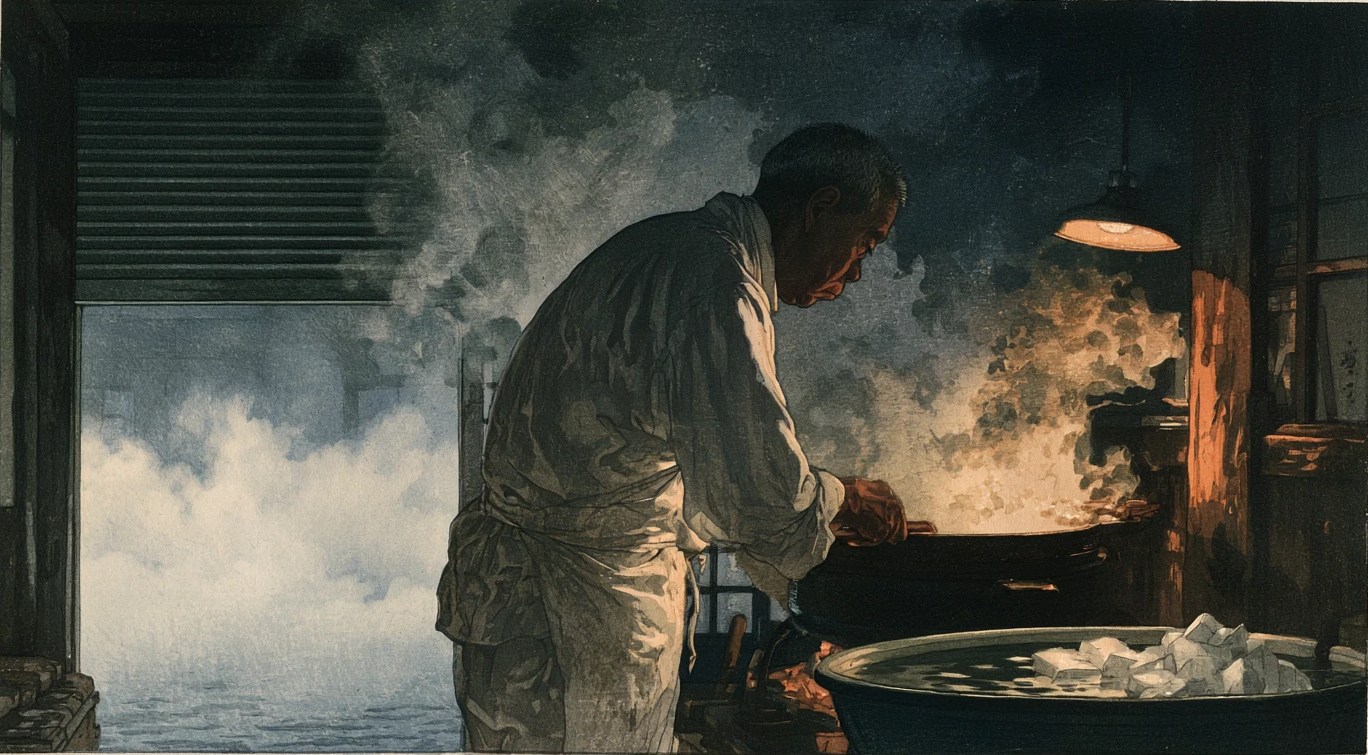
The soybeans go into water the night before. In the dark I grind them, boil them and strain them, and the soy milk runs off warm while the okara stays behind. Then a little nigari, and the soy milk sets. I have done this on the same lane for more than forty years, and my hands do most of it now without asking me.
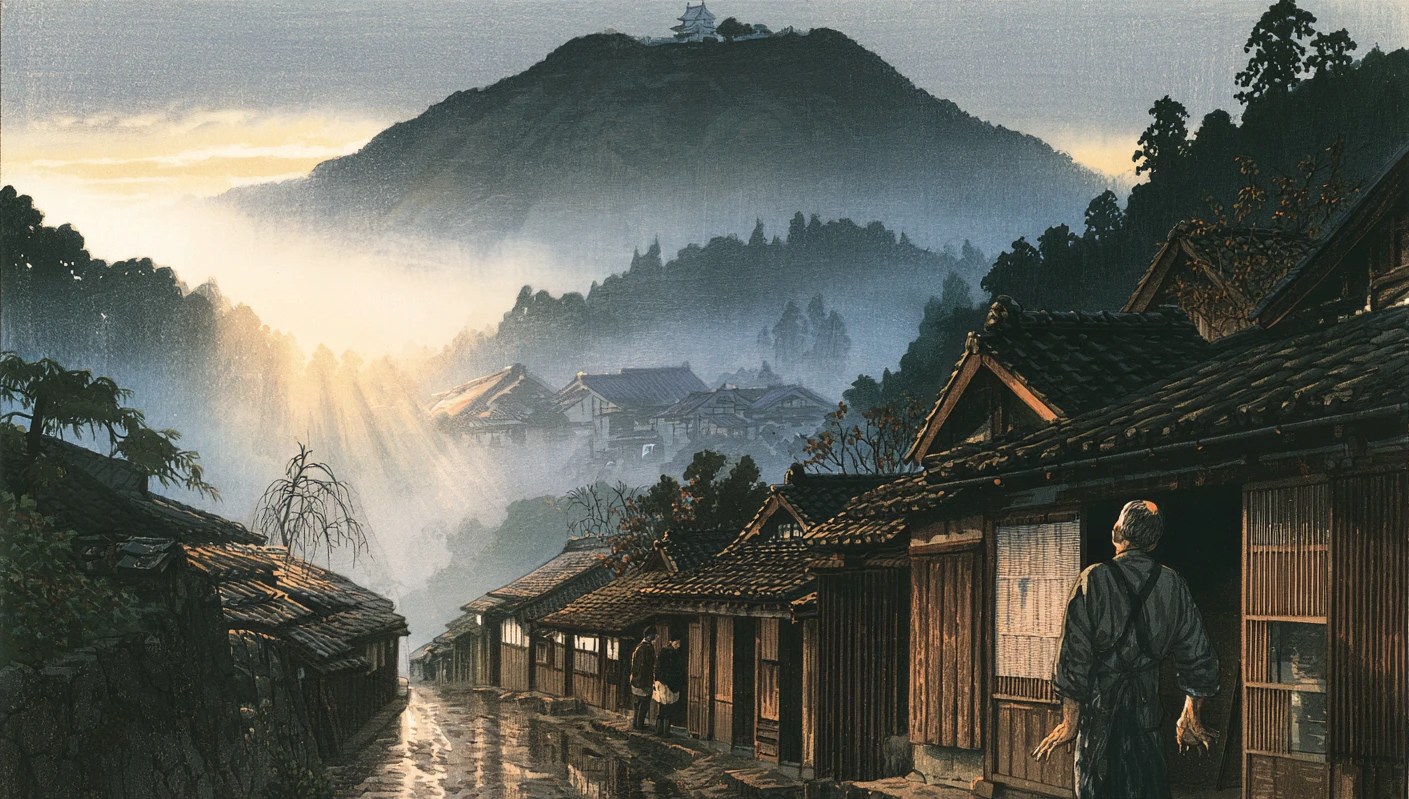
Our lane is in the old castle town of Takahashi, at the southern foot of Mount Gagyu. Its forest has a fond name in town: oshiroyama, the castle mountain. While the first tofu of the day is setting, I lift the shutter and look up, the way other people look at a clock. The castle stands near the top, about 430 metres up. From our lane the keep looks small, and it is small: two storeys, about eleven metres high. But it has stood up there since the Edo period. It is one of only twelve castles in Japan whose old keep still stands, and the only mountain castle among them.
On some autumn mornings, when I lift the shutter, there is no castle. There is no mountain either, and no house across the lane. There is only white, standing in the doorway like a guest who has not decided whether to come in.
The castle in the sky
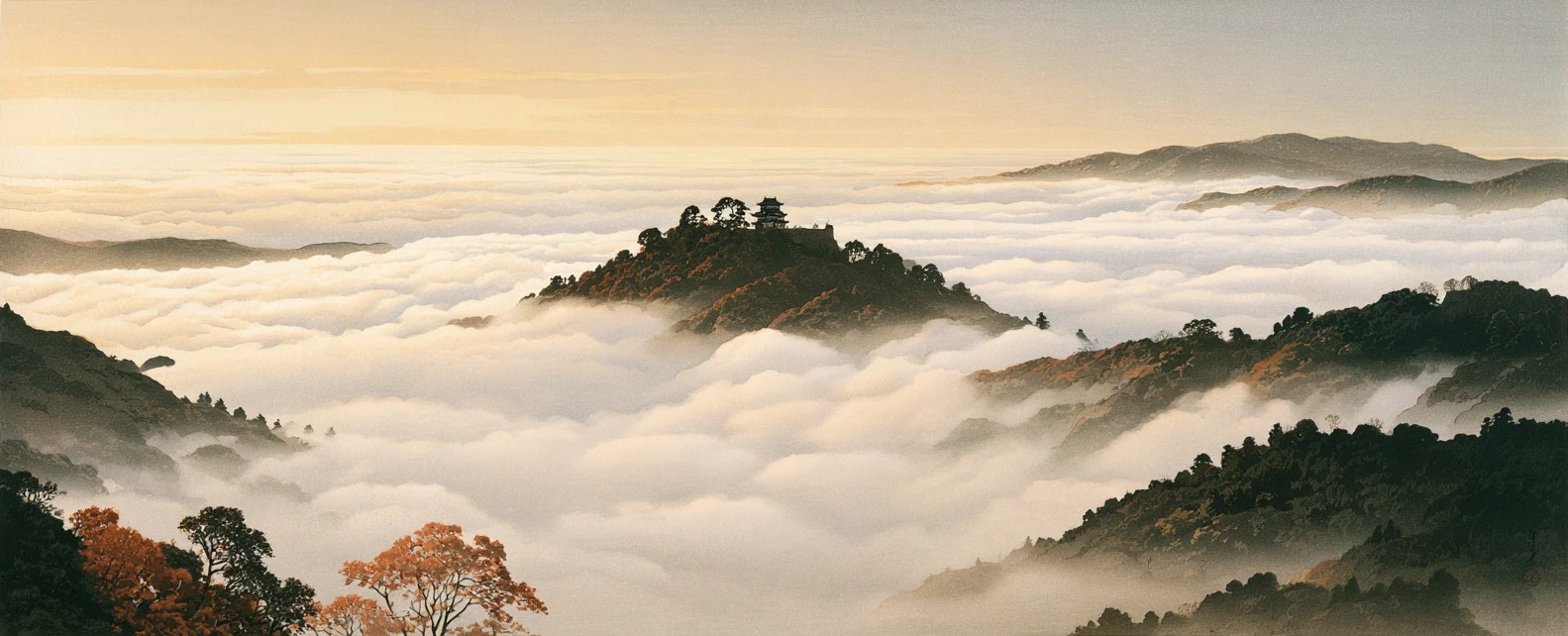
Those are the mornings people come from far away for. On a separate peak along the ridge to the east of the castle, there is a viewpoint. On some mornings in autumn and early winter, a sea of clouds wraps round the castle, and from up there the castle seems to float on it. It is called the castle in the sky. In Japanese, a sea of clouds seen from above is called unkai.
I have never seen it. The sea of clouds belongs to the dawn, and at dawn I am standing over a pan of soy milk. More than forty autumns, and at the right hour I have always been down here. People are surprised that I do not mind more.
Inside the white
Down here it is not a sea. It is fog, and I know it the way I know my own kitchen.
It comes most readily after a warm day, on a cold morning, when the forecast says fine. On a rainy morning, there is no sea of clouds. Some people believe that rain two or three days before makes it more likely. Thick fog is especially likely from late October into early December. In the evening, when I put the beans in to soak, I step out into the lane and feel the air, and I make my guess. I am wrong about as often as I am right.
Inside it, the town turns into sounds. The river, somewhere. A train I can hear but cannot see. A bicycle bell, then the bicycle, then nobody. My customers come out of the white one at a time, already talking. The first every morning is the woman from three doors down, and on fog mornings she says the same thing before she even says good morning: “It’s gone again.” She means the castle.
In our house, the washing waits on those mornings. My wife will not hang anything out until she can see the castle. She has never said why, and I have never asked.
A circle in the white
The boy from the corner house is thirty-four now, and he still lives there. He has bought tofu from me since he was too small to see over the counter. A few autumns ago he took up photography, and in the season he goes up to the viewpoint on his days off.
One morning, after the fog had gone, he came into the shop and held his phone out over the counter. “Look,” he said. “This is us.”
The castle was there, small and dark on its mountain, and all round it lay the white sea, perfectly still. Where the town should have been, there was nothing but white.
He had drawn a little circle on it with his finger. “The shop’s about here,” he said. “You were in there.”
I looked at that circle for a long time. At the hour he took the picture, I had been standing in my own steam, with the shutter half up and the white at the door, and the woman from three doors down telling me it was gone again. All that time, from the ridge, we had been the sea.
“It looks very calm,” I said.
“It is,” he said. “From up there.”
When it comes back
Then, at some point in the morning, the white begins to thin. First it goes bright, as if someone had lit a lamp behind it. The house across the lane comes back, and the lane, and the trees on the lower slopes. Then, high up and in the sun, the castle, as though it had been away somewhere and has come home.
I always go out for that, with my hands still wet. I am not the only one. I see a few of my neighbours at their doors, looking up. Nobody says anything. Then my wife goes to hang out the washing.
One of these autumns, perhaps, on a morning when someone else is making the tofu, I will go up and see it from the other side. I am in no hurry. I think I have the better half of it already.
If you are up on the ridge some autumn morning and the sea is there, I hope you look down into it for a moment as well as across at the castle. It is not empty. There is a whole town in there, with its river and its trains and its bicycle bells. And somewhere about where my neighbour drew his circle, there is steam rising from a pan, and our washing, waiting for the castle to come back.