Somewhere on our slope,
a kokyu is practising.
A short story of Owara Kaze no Bon in Yatsuo, told by a retired watchmender who has listened to the town’s music from the same upstairs room all her life.
After Obon
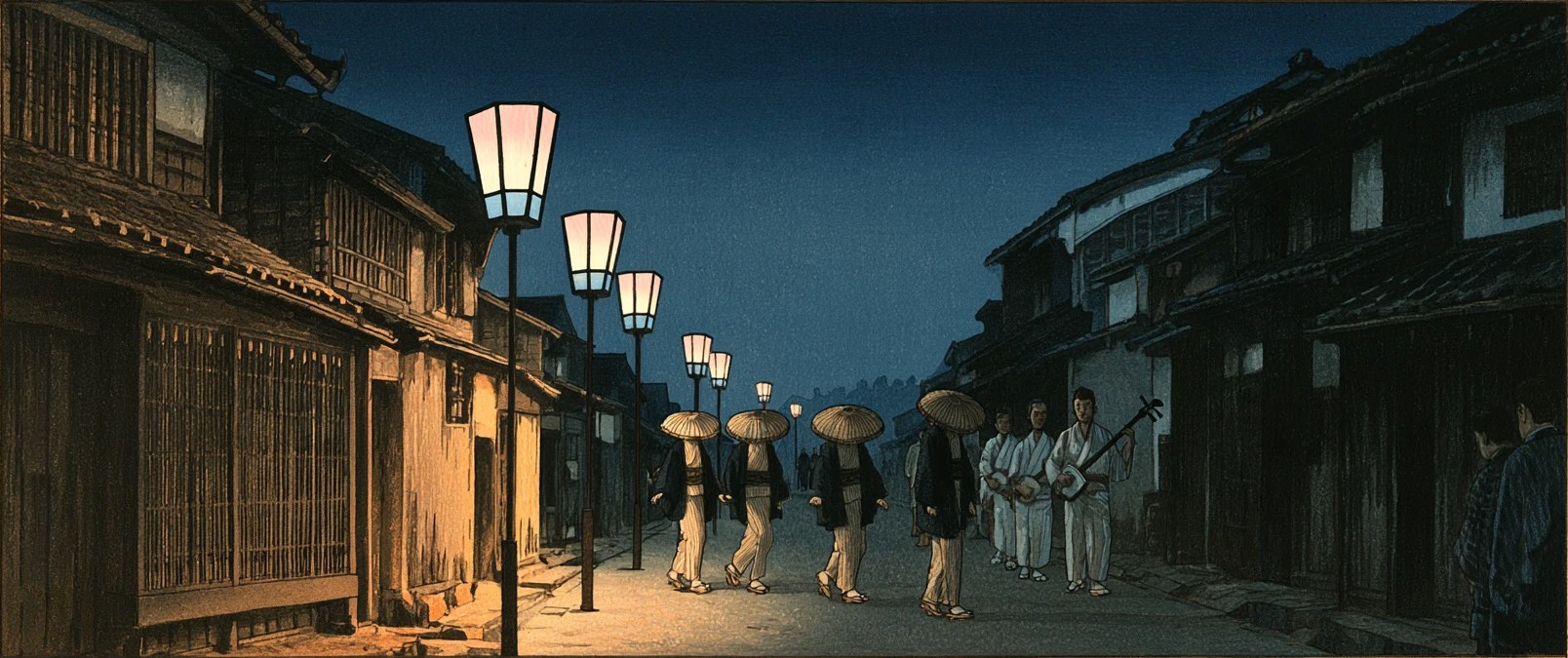
Every year, once Obon is over, the lanterns go up along our street.
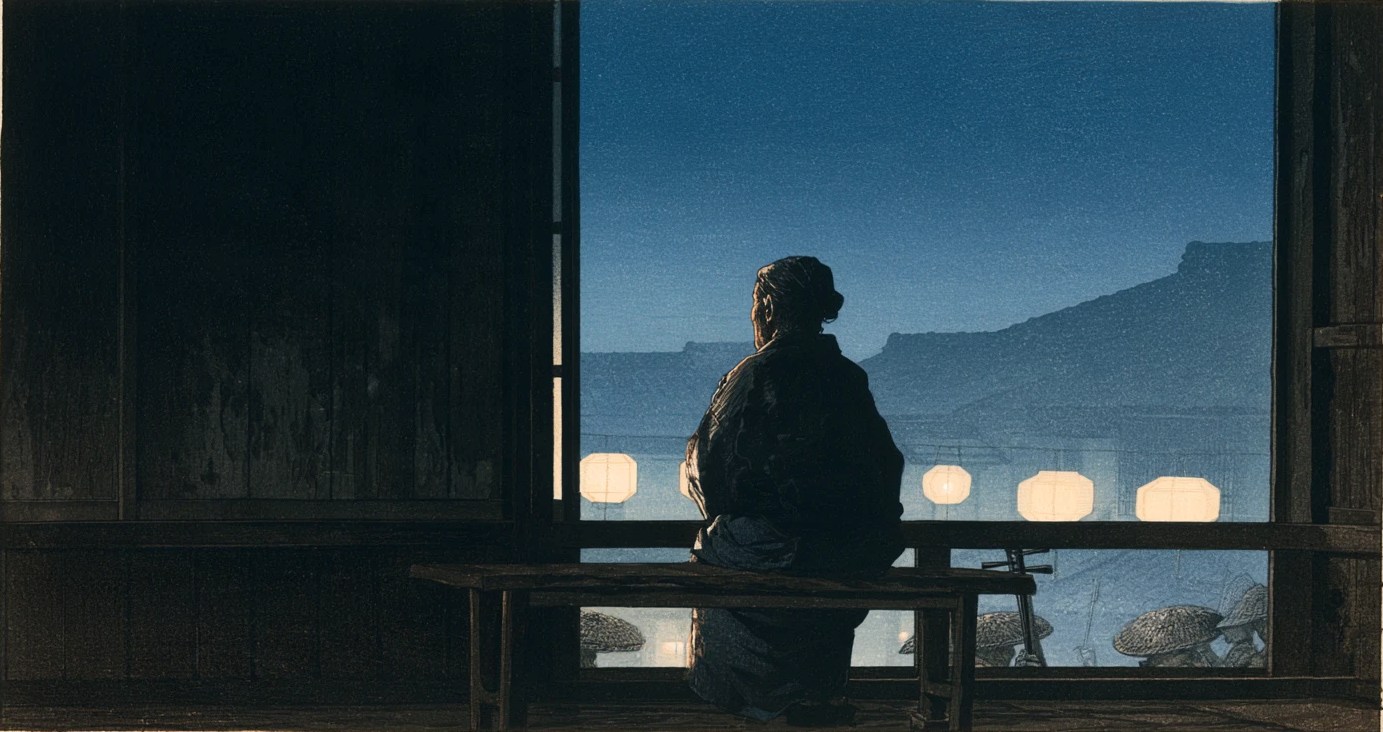
They are paper lanterns called bonbori. After Obon in August, people of the town set them up along the houses, and they stay until the festival ends. I have watched them go up from the same upstairs room for almost seventy years. When I was a girl, it was my bedroom. For forty years after that, it was where I mended watches and clocks, at a bench by the window, because the light is best up there. I am retired now. The bench is still there, and so am I.
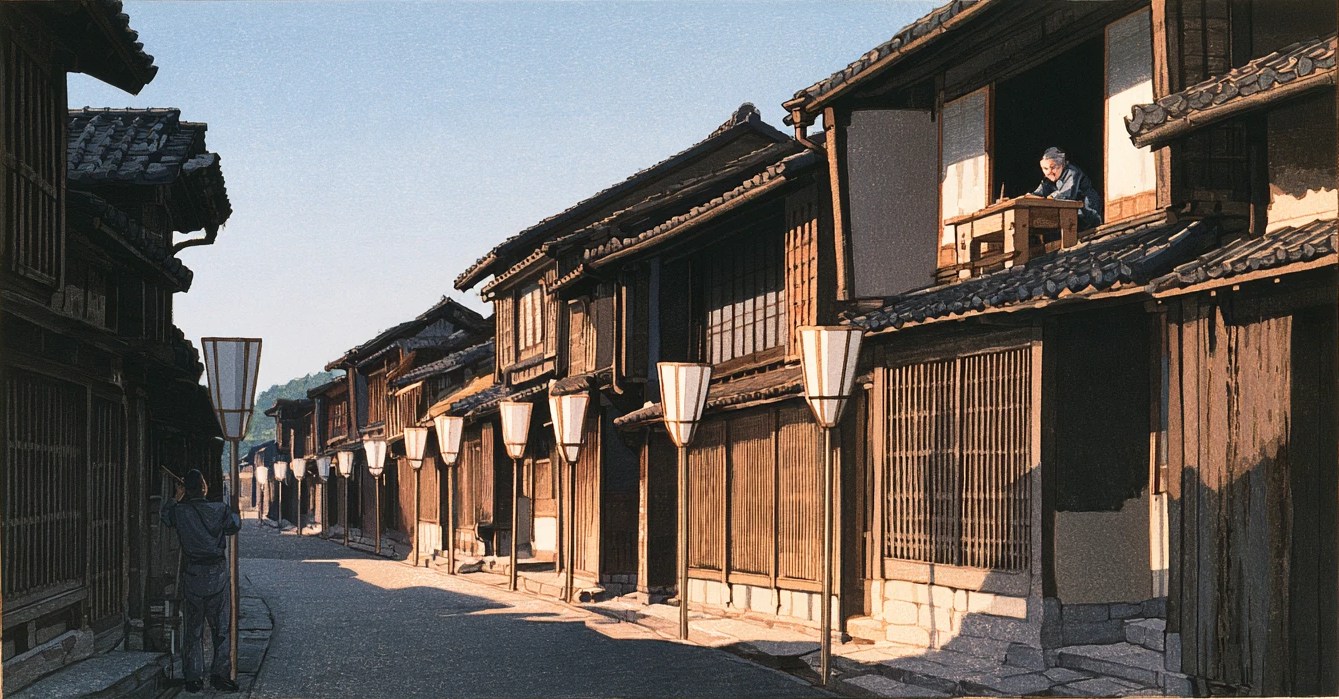
Yatsuo is a town of slopes, and our street is one of them. On the first three days of September every year, the town holds Owara Kaze no Bon. Kaze means wind, and nobody can say for certain how the festival got its name. One explanation is that, counting from risshun, the traditional start of spring, the days around the two hundred and tenth day fall in the typhoon season, and that long ago people prayed to calm the god of the wind, so that it would not harm the rice before the harvest. But in ancient Japan and China, I have read, the word for wind could also mean song, especially the folk songs of a place. I have always liked that one better. A wind you can only hear: that is owara to me.
A bow that catches
A watchmender learns to listen for the tick that comes a fraction late.
One summer a few years ago, early in August, before the lanterns were up, I began to hear a kokyu from somewhere behind the houses across the street. The kokyu is a Japanese bowed string instrument, said to have come into owara late in the Meiji era, more than a hundred years ago. In owara the shamisen carries the tune and the kokyu follows it, with a long, sorrowful sound that has always seemed to me like someone calling from the next street.
This kokyu was alone, and it was not good yet. It never got far. A few bars, then the bow caught, at the same place every time, and there was a silence while, I imagined, someone frowned at it. Then it started again from the beginning. Evening after evening I sat at my bench with nothing to mend and listened to it catch, the way I used to listen to a tired watch.
“Someone’s learning,” said the woman across the street. She is eight years older than I am and has never once let me forget it. “Dancers here stop at about twenty-five and go over to the jikata, to the singing or the instruments. That’ll be someone who was dancing last year.” She said she had a fair idea who it was.
I asked her not to tell me. I never danced owara myself. I was too shy, even under a hat. People say the hats began that way: when the dancing through the town first started, the dancers were shy and hid their faces, first with hand towels and later with woven hats. Whoever was practising, I thought, had the same right to learn unseen.
Late August
In late August, the dancers and the jikata of each district gather. The jikata are the singers, those who help bring in the song, and the players of shamisen, drum and kokyu. They practise for the nights the whole year has been leading to, outdoors when the weather allows, and the sound fills the streets around them.
It is my favourite part of the year. Perhaps that is because nothing is finished yet.
I listened for my learner among the others. A watchmender can pick out one watch ticking across a room, but I could not pick out one kokyu from a street full of music, and I was glad. Whoever it was, they were in there somewhere, and not alone any more.
Three nights
On each of the three evenings, at dusk, the lanterns are lit, and their light along the houses is faint and soft. The dancers come along the street in matching yukata or happi coats, their woven hats pulled low, and the singing and the music move with them. Behind them, people fall in, one and then another. What to sing in the street, and how, the singers decide on the spot, so even on my own street I never quite know what I am going to hear.
Strangers stand along our street on those three nights, and they are quieter than you might expect. Everyone is asked not to talk loudly or cheer, so that the shamisen, the kokyu and the songs can be heard. I am grateful to them every year.
Owara does not do well in rain, the organisers say, and if it rains, the dancing in the streets stops. By my bench hangs an old barometer I once mended, and for those three days I tap its glass far more often than I need to. A festival for the wind, and I spend it worrying about rain.
One night the music came up the slope beneath my window. I sat at the bench with the window open. The shamisen carried the tune, the kokyu followed, and when it reached the place where my learner’s bow used to catch, it did not catch. It went over as smoothly as a second hand passing twelve. It may not have been my learner at all. I did not lean out to look.
When the lanterns come down
When the festival is over, the lanterns are taken down, and the evenings go back to their everyday sounds: a bicycle on the slope, someone’s television, a dog two doors along.
A few days later, the woman across the street asked whether I wanted to know now.
“No,” I said.
“Good,” she said. “I was never sure.”
Somewhere on our slope, someone is dancing under a hat now. In a few years they will put the hat away, and one evening in early August something behind the houses will catch at the same place and start again. I hope I will be at my bench to hear it.
If you come to Yatsuo for those three nights in September, I hope you will let the music reach you first. These streets are where people live, and under the hats and behind the lanterns are people who have practised for months. I mended watches for forty years, and I learned that you can tell a good one by its sound before you ever look at its face. I think owara is like that too.