For fifty summers,
I tied everyone else’s.
A short story of July in Osaka, told by a woman who has tied her neighbours’ obi for the Tenjin Matsuri every summer for fifty years, a few streets from Osaka Tenmangu.
Starch and barley tea
On the afternoon of the twenty-fifth of July, my sitting room smells of starch and barley tea. My neighbours sit along the wall in their yukata with their obi, the long sashes, rolled up in their laps, waiting for me. A few of the young men come too, wanting their narrow ones tied properly.
I have lived all my life a few streets from Osaka Tenmangu. The shrine’s festival, the Tenjin Matsuri, falls on the twenty-fourth and twenty-fifth of July every year. The twenty-fifth of every month is Tenjin’s day, and the shrine holds many of its rites on that day, the festival among them. Tenjin was once a scholar called Sugawara no Michizane.
By the afternoon of the twenty-fifth, the heat has settled in. On an average twenty-fifth of July here, the day reaches thirty-three degrees, and even the coolest hour stays above twenty-five. In my sitting room the fan turns, and nobody goes out of the door without a glass of barley tea. That is my rule.
I have tied my neighbours’ obi for the festival for fifty summers. I am not a teacher of anything, and nobody pays me. It is just what my hands do on the twenty-fifth.
Nobody taught me
Before me, it was Mrs Ueda across the lane. The summer I was nineteen, she let me sit beside her and hold the cords and the clips. She never gave me a lesson. She tied, I watched her hands, and the next summer she handed me a sash and went to make the tea.
There is one thing I do that she never did. When the bow is finished, I fold the last end under twice, so that nothing works loose by the river. I do not know where it came from. One year my hands began doing it, and they kept on.
Emi from two doors down was six when I tied her first obi. Every other child watched the mirror. Emi watched my hands.
Sit down
This spring my fingers began to argue with me in the mornings. By July they had mostly come round, but I was slower, and I knew it.
On the twenty-fifth, Emi came before anyone else. She is thirty-one now and still lives two doors down. She put a glass of barley tea in my hand and said, “Sit.”
I sat. She stood behind me with my own sash, and I felt the cords go round, firm but not tight, the way I like them. She made the bow. Then she folded the last end under, twice.
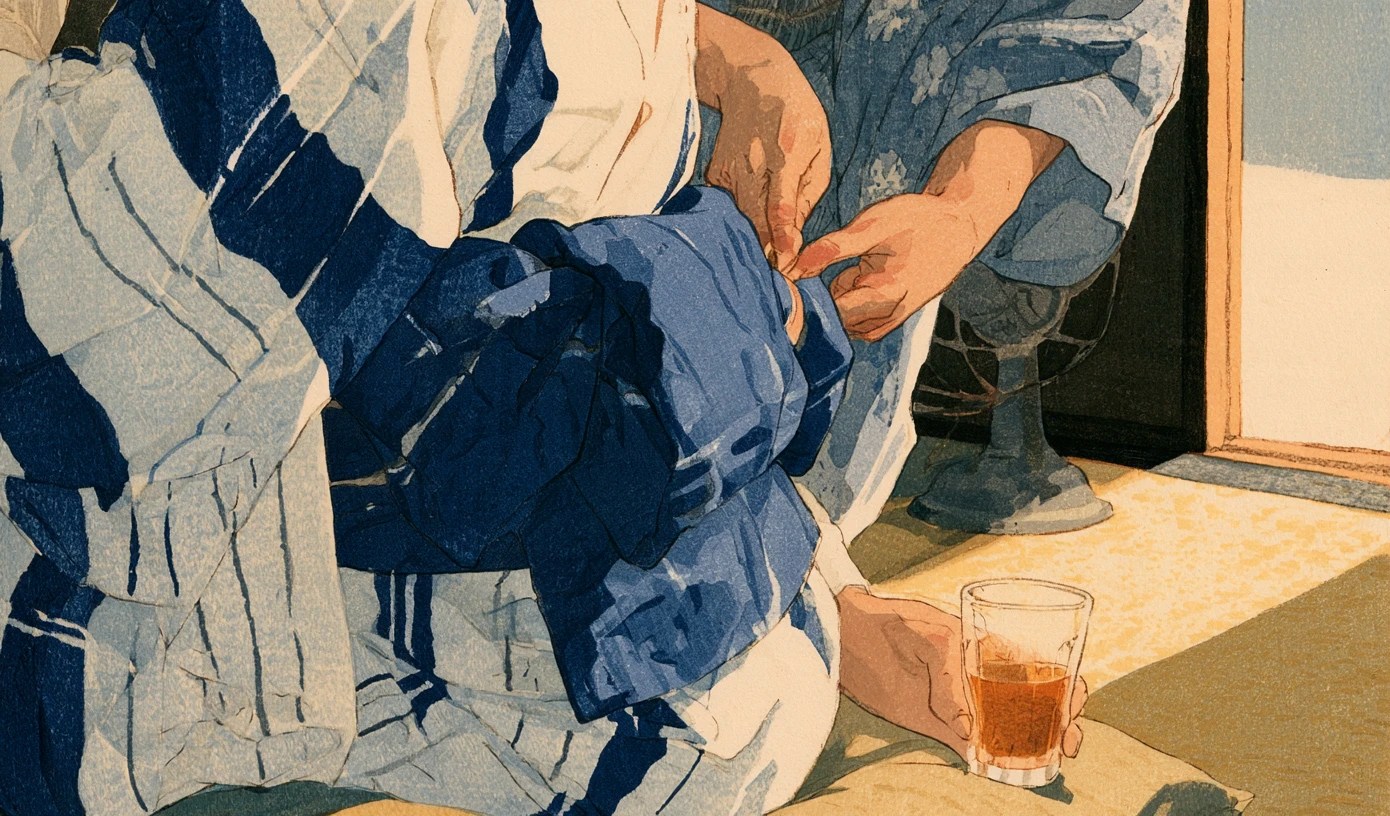
“Who taught you that?” I said.
“Nobody,” she said. “I’ve been watching for twenty-five years.”
For fifty summers I had tied mine last, alone in front of the hall mirror, in a hurry. That afternoon we tied everyone else’s together, Emi at the bow and me at the cords. Somewhere beyond the lanes, the procession had already left the shrine for the river, where the boats were waiting.
Fire and water
The festival began, the shrine says, in 951. A sacred halberd was set adrift from the shore in front of the shrine. Where it came to land, a place was made ready for a rite of purification, and the people of the shrine’s lands fitted out boats to welcome the god. I like that it began with a welcome.
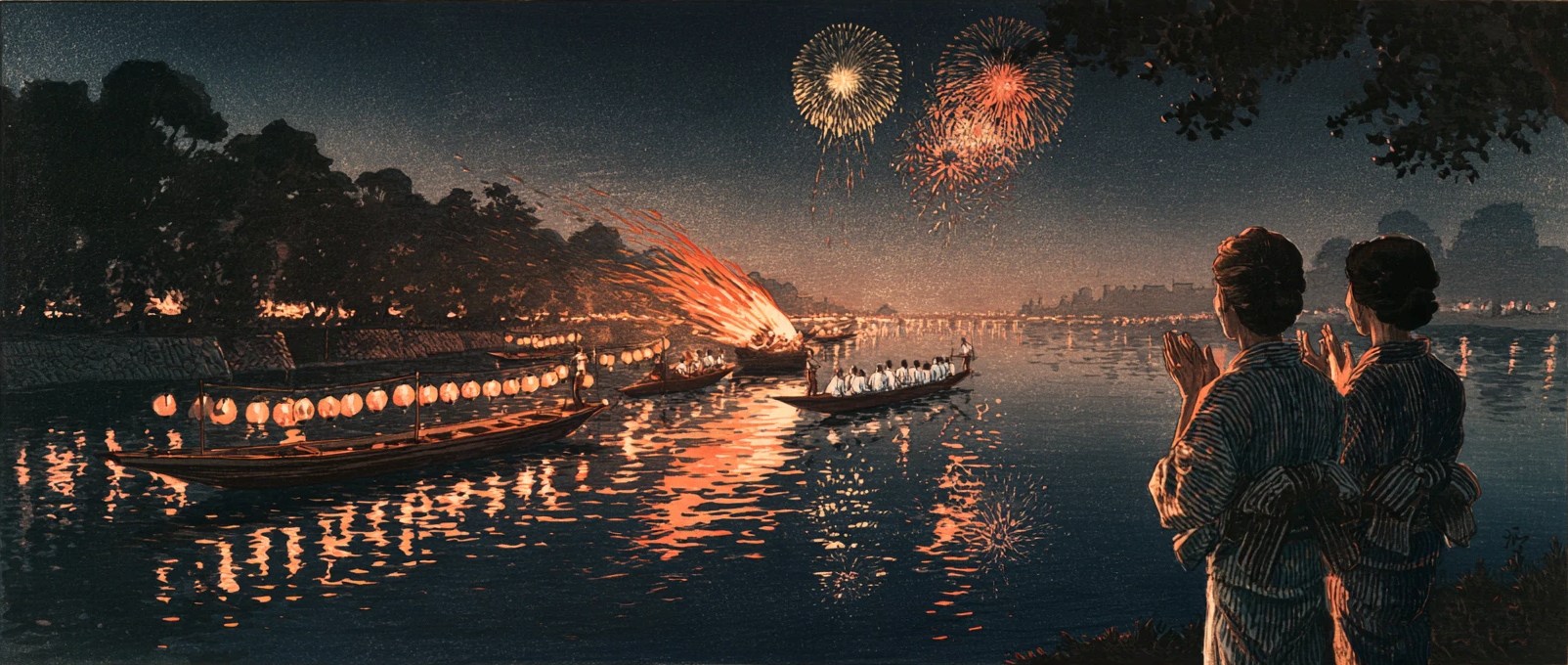
Now, on the evening of the twenty-fifth, about a hundred boats are out on the Okawa River. The god’s boat goes up the river, and the boats of worshippers come down to welcome it. Bonfires and lanterns colour the water, and later the fireworks do too. That is why it is also called a festival of fire and water.
We stood on the bank, at the back, where there was air. Each time boats passed one another, someone called out, “Uchimasho!” and two claps went up. “Mo hitotsu se!” Two more. “Iwote sando!” That means “to celebrate, three times”, and the last three came with a catch in the middle: a quick one, one more, a breath, and the last. The festival’s own guide invites everyone to join in, and on the bank we did. In the Kansai region, it says, the same claps are used at the stock exchange and at business gatherings. I have never been to the stock exchange. I do mine at the river.
The claps are called Osaka Jime. To my ear, the jime has always sounded like the word we use for tying an obi tight. I think of the claps as a knot tied in the air.
Beside me, Emi’s hands found the catch in the last three exactly. Nobody taught her that either.
Then the fireworks went up. They are offered for the god to see, the guide says, and we are allowed to watch alongside. I have always liked being a guest at something so large.
Tied off
We walked home slowly. The lanes were still warm, and so was the night.
In my sitting room we untied each other’s obi, and Emi rolled the sashes while I sat. Late, in the full dark, we heard the claps start again from the shrine. When the boats are done, the portable shrines come back to Tenmangu one after another, and those arriving clap with those who got there first and are waiting. The guide says that people linger in the grounds, reluctant to leave, and that this is where the first step towards next year’s festival begins.
The two of us clapped along with them in my sitting room. Two, two, and then three.
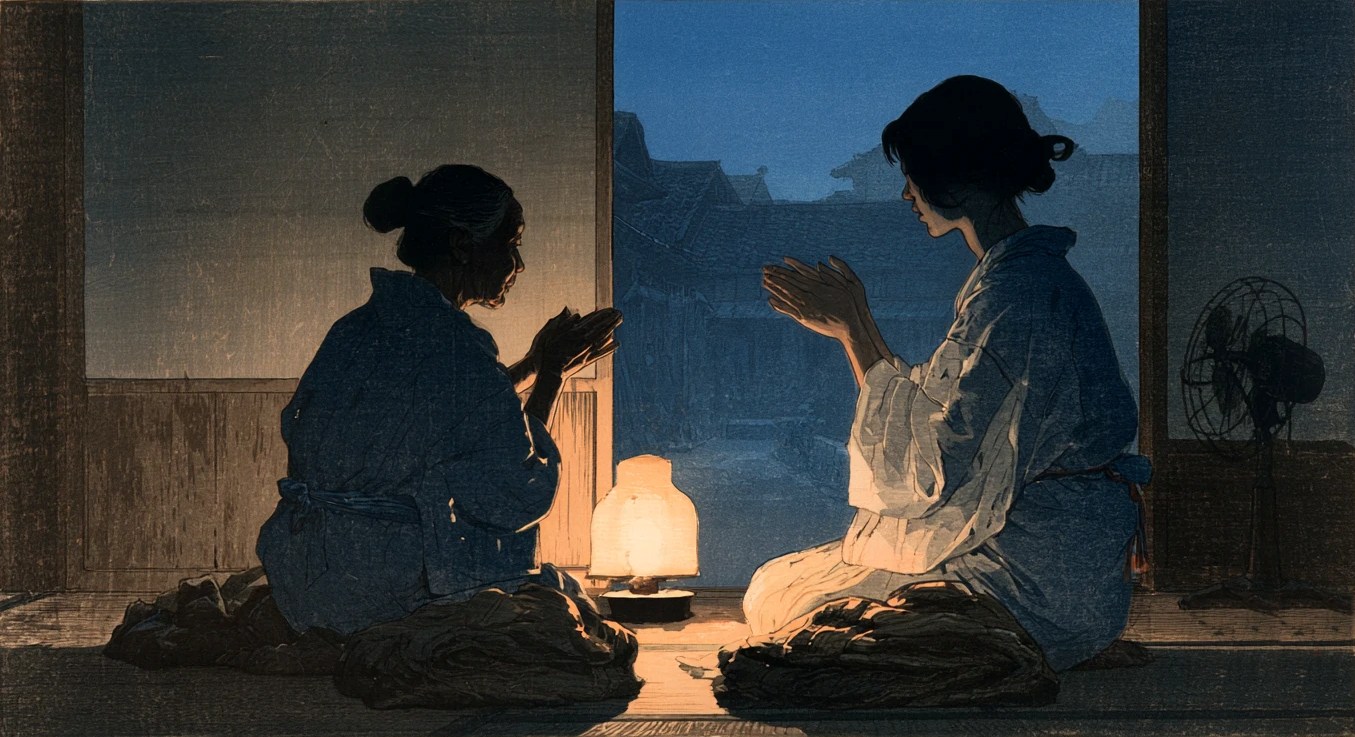
“Next year,” Emi said, “I’ll do yours first again. Then you can do mine.”
“With these fingers?”
“You do the fold,” she said. “I’ll do the rest.”
If you come to Osaka in July, I hope that when the boats pass one another and someone calls out, you will let your hands go with ours. That is all Emi and I ever did.
Places in this story
- Osaka Tenmangu — A shrine of more than a thousand years to the scholar Sugawara no Michizane, known as Tenjin. It is the home of the Tenjin Matsuri festival in July, just off a long shopping street.
Things to do in this area
Travel information, separate from the story: food and experiences in this area in the season of the story, from our guides. The people in the story are fictional and did not visit these places.
- Kitsune udon (Food, where: Minami (Namba)) — Udon in a broth of kombu and dried-fish dashi, topped with fried tofu simmered sweet and salty. One account traces it to an udon shop in Semba, Osaka, in 1893.
- Kushikatsu (Food, where: Minami (Namba) and more) — Skewers of meat, vegetables or seafood, breadcrumbed and deep-fried, then dipped in sauce. One theory traces them to Shinsekai in Osaka.
- Okonomiyaki (Food, where: Minami (Namba) and more) — A batter of flour and dashi with shredded cabbage, meat, squid and more, cooked flat on both sides on an iron plate. With takoyaki, it stands for Osaka's konamon, or flour-food, culture.
- Butaman in Osaka (Food, where: Minami (Namba)) — At Horai Honkan on Namba’s Ebisubashi-suji, the kitchen steams pork-and-onion buns to order. The building has a takeaway counter and a restaurant.