The sea turns
where fast water meets slow.
A short story of spring in Naruto, told by a woman who has lived beside the strait all her life and, since last autumn, has shared her house with her son’s wife.
Two speeds
Rina does everything faster than I do.
She married my son last autumn, and the two of them live upstairs now. By the time I have tied my apron, she has washed the rice. She finishes her tea while mine is still too hot to hold. She answers my questions before I have finished asking them. In our house we have always been slow people, my son included, and that first autumn it felt as if someone had opened all the windows on a windy day.
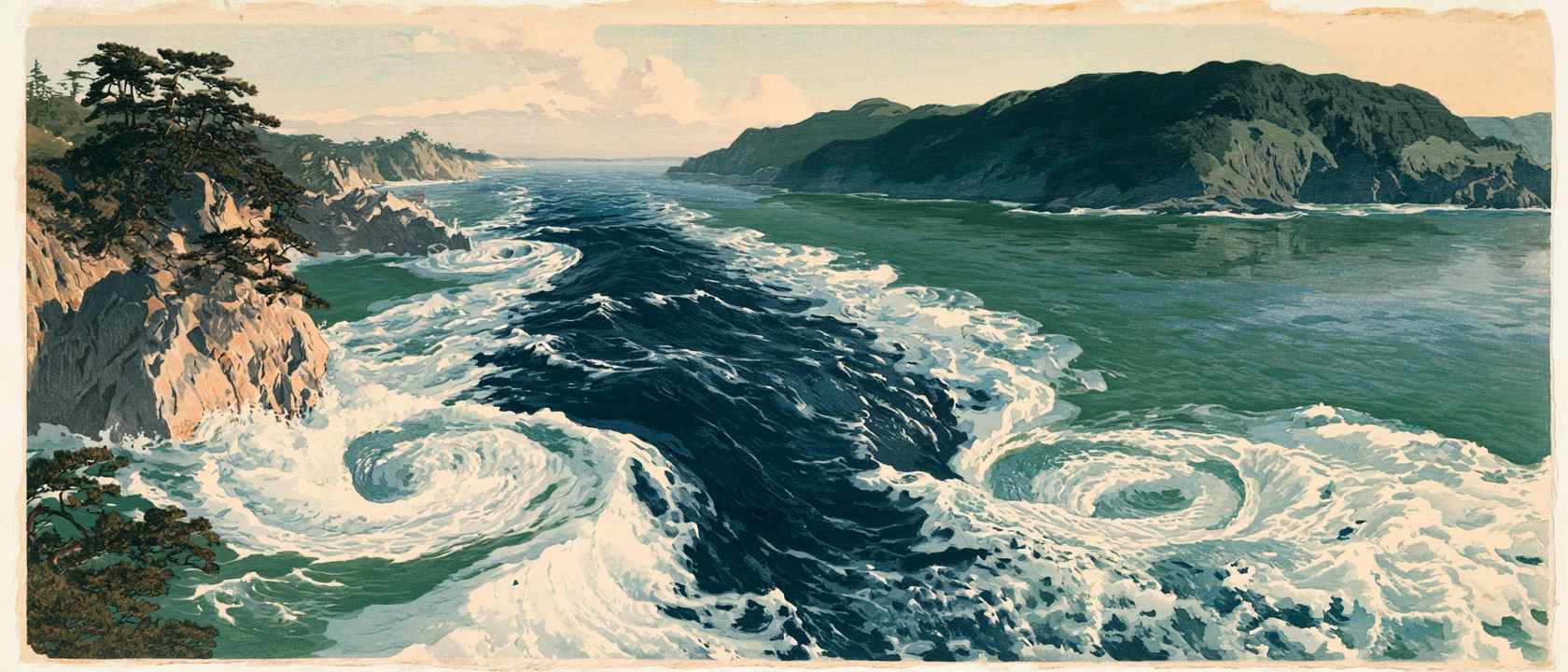
I have lived all my life beside the Naruto Strait, between Naruto and Awaji Island, and until Rina came, it was the fastest thing I knew. The tide comes up from the Pacific and splits in two. Part of it comes straight to the south side of the strait. The rest goes the long way round, through Osaka Bay and around Awaji Island, and reaches the north side some hours later. By then the sea on one side stands higher than on the other, and at its fastest the water pours through the narrow gap at around twenty kilometres an hour: one way, and then, later, the other.
That winter Rina and I had small quarrels that started up and were over before either of us knew what they were about. Which way to fold the towels, for instance. They spun up between us and were gone. I did not know how to be anybody’s mother-in-law. Nobody teaches you.
Big tides
The whirlpools come all year round, but they are strongest in spring and autumn, and especially strong at the new moon and the full moon, when the tides are biggest. Those days are called ōshio, big tides. In our house we have always watched the moon more than the calendar. When it is full, or gone altogether, I know it is time to go and look.
One evening in March, Rina found me at the kitchen window, looking at a full moon.
“Big tides this week,” I said.
She had her phone out before I had finished. “But those come twice a month,” she said. “Every month.”
“They do. But in spring the whirlpools are bigger.”
She looked at the screen. “It says so here,” she said, a little surprised. “The biggest whirlpools of the year, in the few days around the equinoxes.” I was more pleased than I let her see.
Then she asked me where the whirlpools come from, and for once she waited for the answer. In the middle of the strait, I told her, the water has little in its way and runs fast. Near the shores, shallows and the like hold it back, and it runs more slowly. Where the fast water meets the slow, the difference sets the sea turning. Each whirlpool usually lasts twenty or thirty seconds. I had never once thought about any of it in my own kitchen.
Brown, then green
As winter turns to spring, the wakame comes in. A family further along our street grows it in the strait’s fast water, and every year they bring us a bundle.
This year Rina answered the door. She came into the kitchen holding it out at arm’s length, dark and slippery and dripping, the leaves longer than I am tall.
“It’s brown,” she said. She had only ever seen wakame green, out of a packet.
I cut off a piece, put water on to boil and handed her the long cooking chopsticks. “Dip it in,” I said. “Only for a moment.”
She dipped it, and in that moment the brown turned bright green, as if someone had switched on a light inside it. Rina made a sound I had never heard her make.
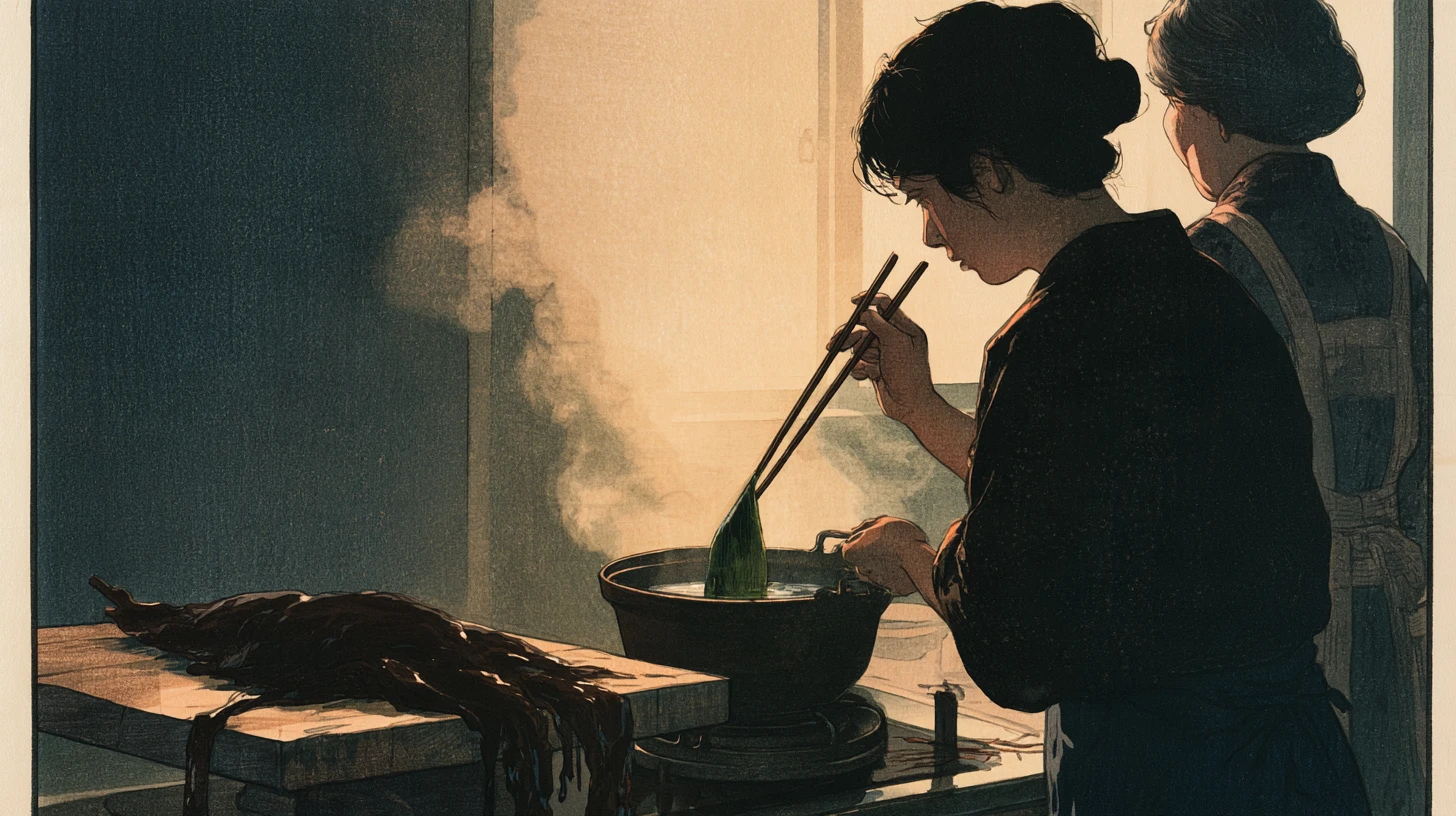
We put it in the miso soup, and I told her what I had been told all my life: out there the currents keep the wakame moving as it grows, which is why it stays firm even when it is cooked. Rina chewed, thinking.
“So the fast water is good for something,” she said, and gave me a sideways look.
I laughed before I could stop myself, and so did she. It was the first time we had laughed at the same thing.
Forty-five metres
Every spring, on one of the big-tide days near the equinox, I walk out over the strait. This year Rina asked if she could come. She had already found the time of the fastest current on her phone.
The Onaruto Bridge runs from Naruto to Awaji Island, and inside it, under the road, a walkway called Uzu-no-Michi, the whirlpool path, goes 450 metres out over the sea. Its sides are wire mesh, and the sea wind comes straight through, with the sound of the water below.
Rina went ahead, as she always does. Then, at the first of the glass panels in the floor, she stopped. Forty-five metres under the glass, the sea was racing past.
I caught her up in my own time. “You can stand on it,” I said.
“I know,” she said, and did not move.
So I held out my arm, and she took it, and we stepped onto the glass together, at my speed.
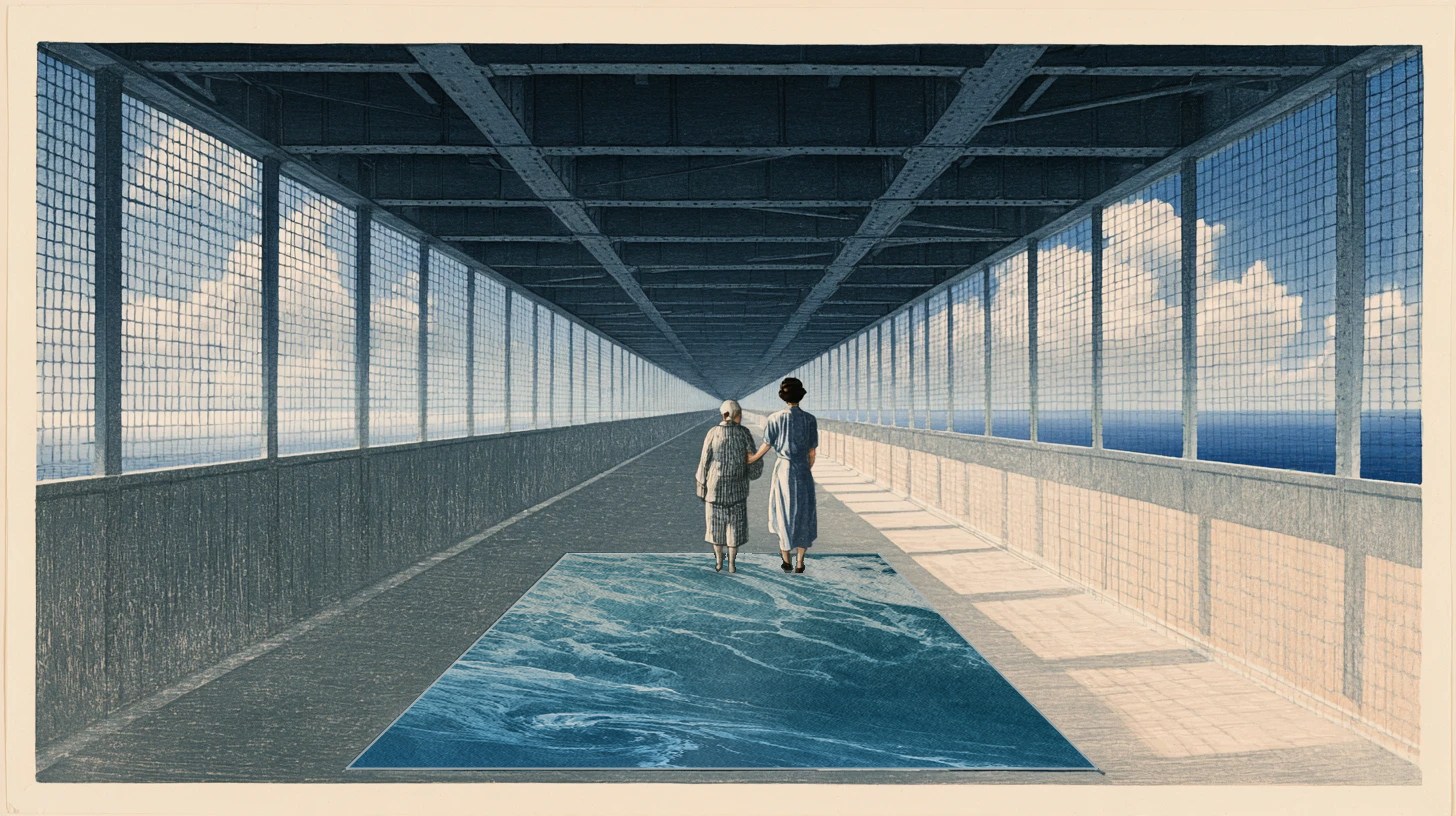
Below us the fast water ran through the strait, and at its edges the sea began to turn. A whirlpool opened, spun and closed, and before it had quite gone, another was turning beside it. Rina held on to my arm and said nothing for a long time. Neither did I.
Where the waters meet
On the way home she said, “They don’t last, do they?”
“No,” I said. “But there’s always another.”
I have known all my life how the whirlpools are made, but it took Rina to show me what it means. They do not come from the fast water alone, or from the slow water by the shore. They come from the two meeting in a narrow place, where neither can get out of the other’s way. A house is a narrow place too.
Rina is still faster than I am. She still has the rice washed before I have tied my apron. But the other evening, when I came in late to supper, I found my tea already poured and left to cool, and Rina waiting to start until I sat down. I have begun folding the towels her way. I think she has noticed.
If you come to Naruto in spring, I hope you stand for a while above the strait and look down at the place where the fast water meets the slow. Nothing there lasts long, but before anything has quite gone, something new is beginning to turn. To me it is the most beautiful part of the sea.