By first light,
the hill is black.
A short story of late January in Nara, told by a man who delivers the morning paper on a round at the edge of the park.
The end of the night
My working day ends before most of Nara’s begins. While the city sleeps, I am out on my motorbike with the morning paper, on the same round at the edge of the park that I have ridden for nineteen years. I go to bed soon after supper, while my daughter is still doing her homework, and I am home again before she wakes.
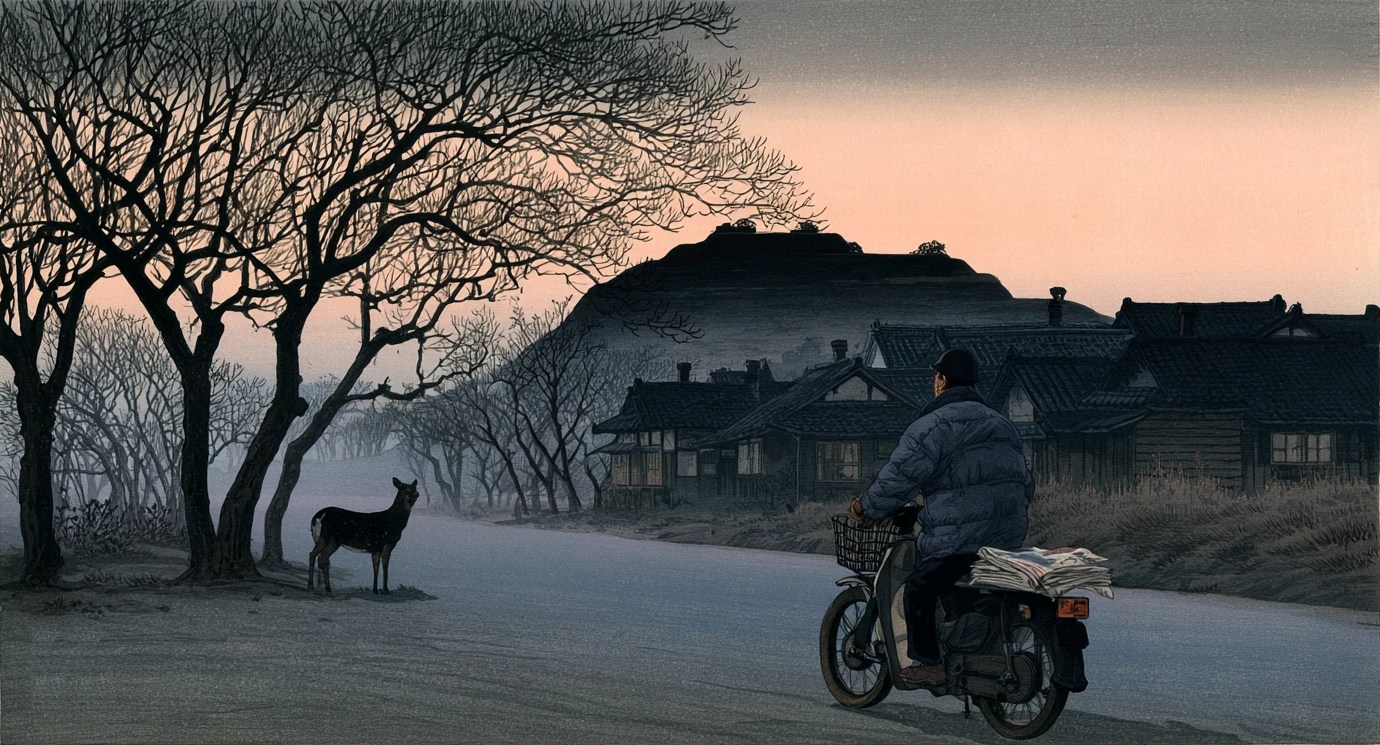
January is the coldest month here, and before dawn the air is close to freezing. Along the park, deer step out of the dark without warning. They are wild animals, and cars hit them here, so I ride slowly. I would rather be late with the paper.
In winter my round ends as the sky goes grey, and the last thing to come out of the dark is always the same: three round humps of grass, one above another, rising over the houses. That is Mount Wakakusa. For as long as I can remember, it has been there at the end of the night.
Why we burn it
On the fourth Saturday of every January, the whole of that hill is set on fire.
On its top there is a burial mound, a huge old tomb. The story goes that ghosts came out of it to frighten people, that burning the hill kept them away, and that something bad would happen if it was not burned by around January. So, it is said, people crossing the hill began to set fires on their own. Again and again the fires came close to Todai-ji, and in 1738 Nara’s magistrate’s office put up a sign forbidding them. The fires went on anyway. Towards the end of the Edo period, the hill was being burned under the eyes of Todai-ji, Kofuku-ji and the magistrate’s office.
I like that the story starts with frightened people and ends with careful ones. Today Kasuga Taisha, Kofuku-ji and Todai-ji pray together at the burning: for those who came before us, for the safety of all Nara from fire, and for peace in the world. A fire that prays against fire. I think about that on my round sometimes, riding past old wooden houses in the dark.
From the landing
In our house, on the afternoon of the burning, my wife goes to the great bonfire in the grounds of Kasuga Taisha, where old charms and New Year decorations are burned, and she takes ours. Later, the fire for the hill is received from that bonfire and carried to the foot of the hill in a procession. I like to think a little of our front door goes up there every year.
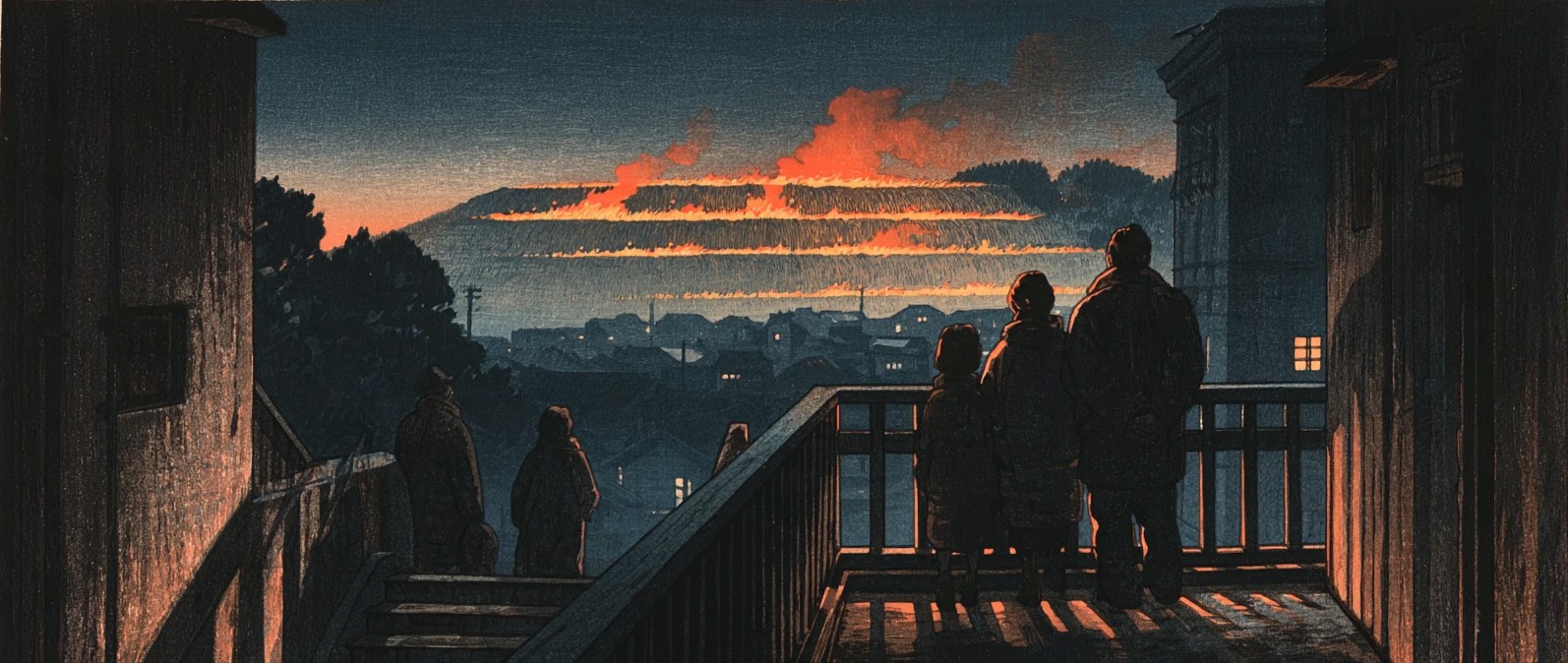
That evening I stay up later than usual. Our block of flats has open stairs on the outside, and from our landing the hill fills the gap between two taller buildings. The organisers say the burning can be watched from anywhere in the city where the hill is in view. Our neighbours come out in their coats and stand on the stairs with us.
The fireworks come first, more than five hundred in about a quarter of an hour, so close together that the whole sky flickers. My daughter calls out the colours. Then the last one fades, and everything goes dark.
That dark is the moment I wait for all year. For a few breaths the hill is only a shape again. Down at its foot, about three hundred volunteer firefighters are carrying fire from the bonfire there to the face of the hill. There is a signal, conch shells and bugles, though we are much too far away to hear it. Then the grass is lit all at once, the flames run up the slopes, and the whole hill glows red above the city.
My daughter is ten. Every year, in that dark, she turns round to make sure I am still there.
The note
I can only stay for the first of it. The fire is at its fiercest for about half an hour, and then I go to bed, with the glow still on the curtains.
My daughter stays out on the landing with her mother until the end. About an hour after the lighting, most of the fire has burned out and can no longer be seen from outside. In our house, when the last of it has gone, my daughter writes me a note and leaves it on the kitchen table.
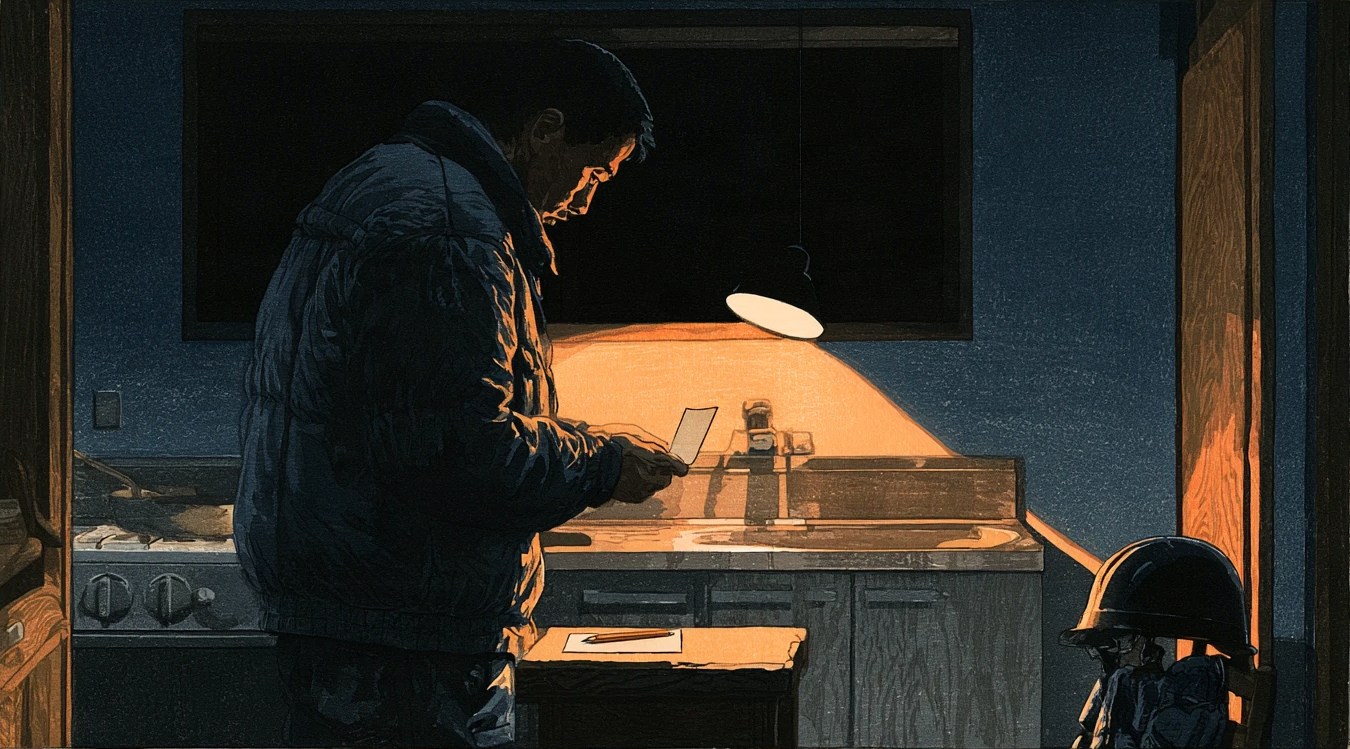
I read it by the light over the stove while the flat is asleep. “Last bit at the very top. Then nothing.” “They went out one by one, like candles.” One year, only: “Sleep well. It was good.”
Then I go out into the cold. On that Sunday morning the air along the park smells of burnt grass, and the papers in my basket have last night’s fire in them. Some years the photograph shows the fireworks and the burning hill together. They are never in the sky together. The hill is lit only after the last firework, and a picture like that is made by leaving the shutter open a long time. My daughter knows. She wrote it on a note once and underlined it twice.
The rest of it
As the light comes at the end of my round, the hill comes out of the dark again. This morning it is black from bottom to top, as if the night had been left on it.
I write my own note under hers. Mine is always short: “Black. All of it.” Some years, because of the weather or because the grass is not dry enough, the slopes do not burn well, and I write “Patches.” Then the hill may be burned again by day in early February, to look after the park. And heavy rain or snow, strong wind or an official warning about forest fires can call the burning off altogether. There is no other date, and no notes.
The organisers call the burning a traditional event that heralds early spring. At that hour, with the air near freezing, it does not feel like spring to me. But from then on, I notice, the sky goes grey a little earlier every week, and by the end of February the sun is up before I am home.
Last January, when I came up the stairs at first light, my daughter was out on the landing with a blanket round her shoulders, looking at the black hill. “I wanted to see the rest of it,” she said.
If you come to Nara at the end of January, I hope you watch the fire until it is gone, the way she does. And if you are awake early the next morning, wherever you are, I hope you look for the hill. That is the rest of it.
Places in this story
- Kasuga Taisha — A Shinto shrine at the foot of sacred Mount Mikasa. Its main halls were built in 768. About 3,000 stone and hanging lanterns line its approach and its vermilion halls.
- Kofuku-ji — The Fujiwara clan’s temple, moved to Nara in 710. Its halls and museum hold Buddhist statues such as the Ashura figure. The five-storey pagoda is under repair, planned to end in March 2034.
- Mount Wakakusa — A hill of three rounded, grass-covered tiers in Nara Park. Climb it for wide views over the Nara Basin; in January its grass is burned at night.
Things to do in this area
Travel information, separate from the story: food and experiences in this area in the season of the story, from our guides. The people in the story are fictional and did not visit these places.
- Nara chagayu tea porridge (Food) — Nara’s chagayu is a loose rice porridge cooked in brewed tea, also called okai-san. The home version often uses hojicha and leftover cooked rice. Some restaurants use different teas.
- Kakinoha-zushi (Persimmon Leaf Sushi) (Food, where: Naramachi and the palace site) — Nara’s kakinoha-zushi is pressed sushi: salt-cured fish such as mackerel and vinegared rice are wrapped in persimmon leaves one piece at a time. At Hiraso’s Nara Main Building, it comes as a sushi assortment or with tea porridge or Miwa somen.
- Miwa Somen and Nyumen (Food, where: Naramachi and the palace site) — Miwa’s thin hand-stretched noodles can be served cold as somen or warm in broth as nyumen.
- Narazuke (Sake Lees Pickles) (Food, where: Naramachi and the palace site) — Narazuke are vegetables such as white gourd, salted and then repeatedly transferred to fresh sake lees. Yamazakiya in Nara sells whole pickled gourds and ready-cut portions.