Spring comes
after the fire.
A short story of early March in Nara, told by a man who has stood below the torches of Nigatsu-do almost every year of his life.
Not yet spring
On the first evening of March, I take my heaviest coat down from its hook, and my granddaughter asks whether tonight we are going to see the fire.
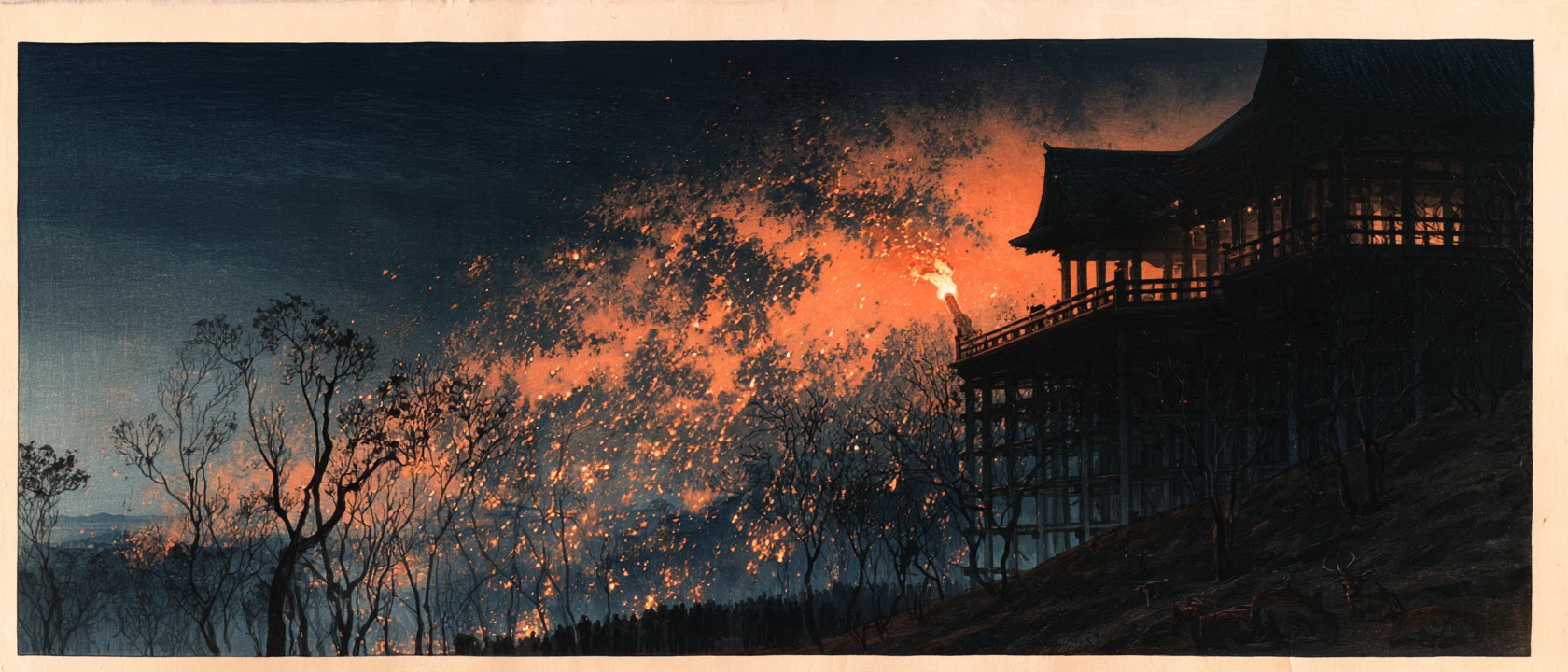
Up on the hillside at Todai-ji, the Shuni-e has begun at Nigatsu-do. It is better known as Omizutori, after the taking of the water. For two weeks the monks keep their rite, and for two weeks my family waits, as it always has.
People here say that spring does not come to Nara until Omizutori is over. My grandmother said it every March as though she were reading out the weather forecast, and she would not put away the winter quilts a day sooner.
I was born in Naramachi, among the old townhouses and narrow lanes, and I still live in the same house. Early March nights here are still cold. The cold comes up through the floorboards after dark, and below Nigatsu-do, standing still in the crowd, it finds its way into your bones.
On my father’s shoulders
When I was small, my father took me to the torches on an ordinary weeknight. Never on the twelfth. Plenty of people think that is the only night with torches, he said, and even the temple warns that it will be very crowded. We walked up through the park in the dusk, past deer lying folded under the trees. The one time I reached out to touch one, my father caught my hand. “They’re wild,” he said. “They live here. That doesn’t make them ours.”
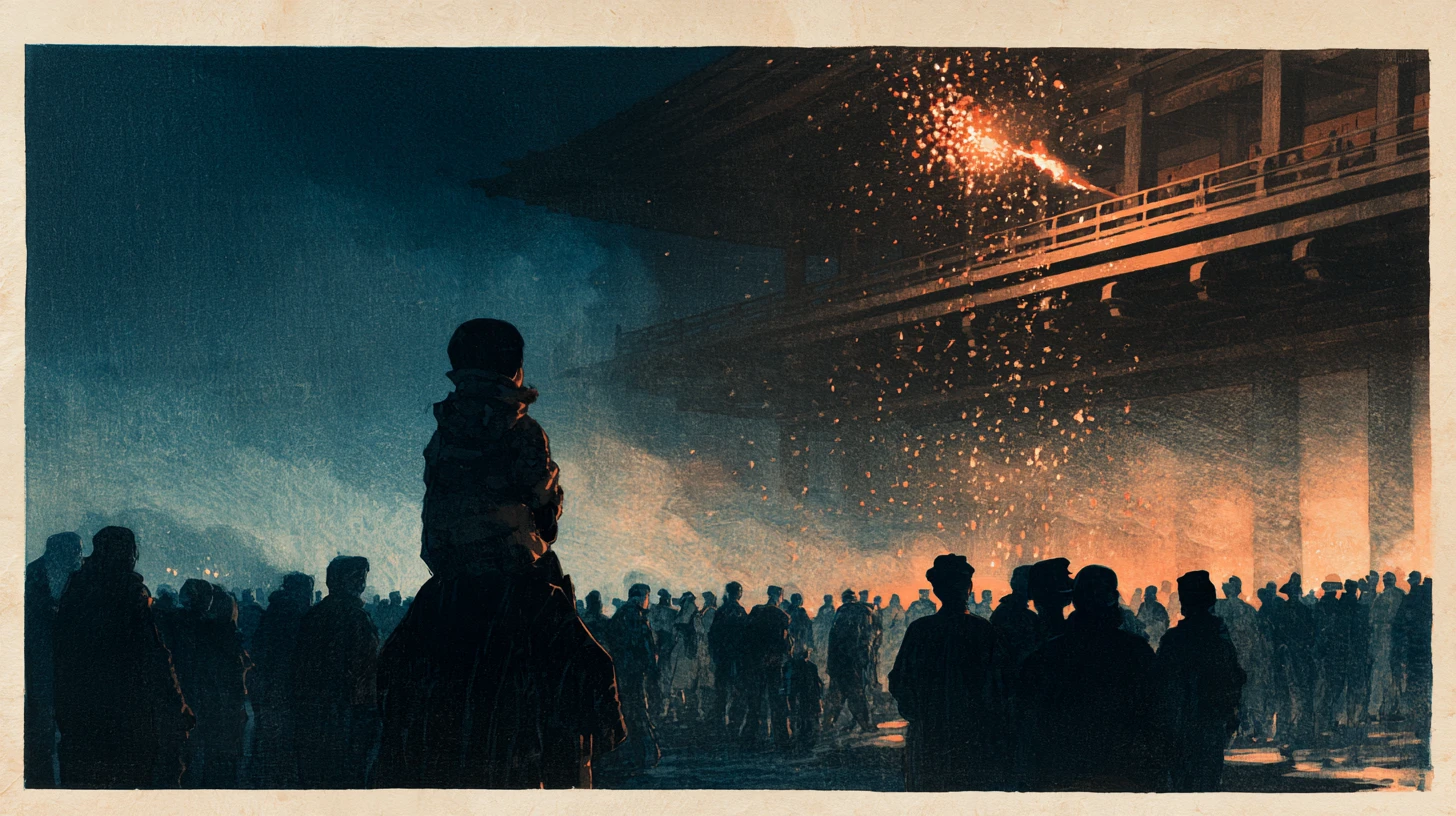
Below the hall, the crowd grew quiet. Then a light began to climb towards Nigatsu-do.
The torch was huge. Six metres long, my father told me afterwards, and carried on one person’s shoulder. When it reached the balcony, its bearer took it along the railing, and sparks swirled up into the dark and drifted down over our heads. A sound went through the crowd that was not quite a word.
One spark landed on my sleeve and burned a small black hole. I was very proud of it. My mother was not.
On an ordinary night there are ten torches, one after another, each one carried up to the hall and along the balcony in a storm of sparks. I sat on my father’s shoulders through all ten and did not feel the cold at all.
The light is for the way
On the walk home I asked my father what the fire was for. He thought for a long time before he answered. That was his way.
“It’s a lamp,” he said. “The monks go up into the hall at night, and the torches light their way. What matters happens inside, after the fire is finished.”
He told me there were eleven of them. Inside the hall, before the Kannon, they confessed the wrongs of the world on behalf of everyone else and prayed for peace in the land and for good harvests. It had been done every year since 752, he said, without a single break. I was seven. I tried to imagine twelve hundred years of anything, and could not.
“So it isn’t a show,” I said.
“No. It isn’t a show. We are allowed to watch the lamp.”
I have thought about that answer more than almost anything else he told me. Even now, when the fire comes and the crowd catches its breath, I find myself lowering my voice. Somewhere above the sparks, people are at work in the cold for the rest of us, and all we see is the light on their way in.
Tea rice and camellias
At home, the first night of the rite meant chameshi. My mother roasted soybeans until their skins split, rubbed the skins away, and cooked the beans with rice in roasted tea, and the whole house smelled of it. She told me it went back to the meals of the monks at Omizutori, long ago. Making it that night was her own custom, not the town’s. I have never met anyone else who keeps it.
From February into the middle of March, sweet shops in Nara set out fresh sweets shaped like camellias, and my mother would bring home one for each of us in a paper box. The flower they copy grows by the founder’s hall at Todai-ji and blooms around the time of the rite, red with white flecks, as if someone had spilled paste across the petals. During the rite, handmade camellias decorate the inside of Nigatsu-do as well. My mother loved that. “Up there they make flowers,” she said, “and down here we eat them.”
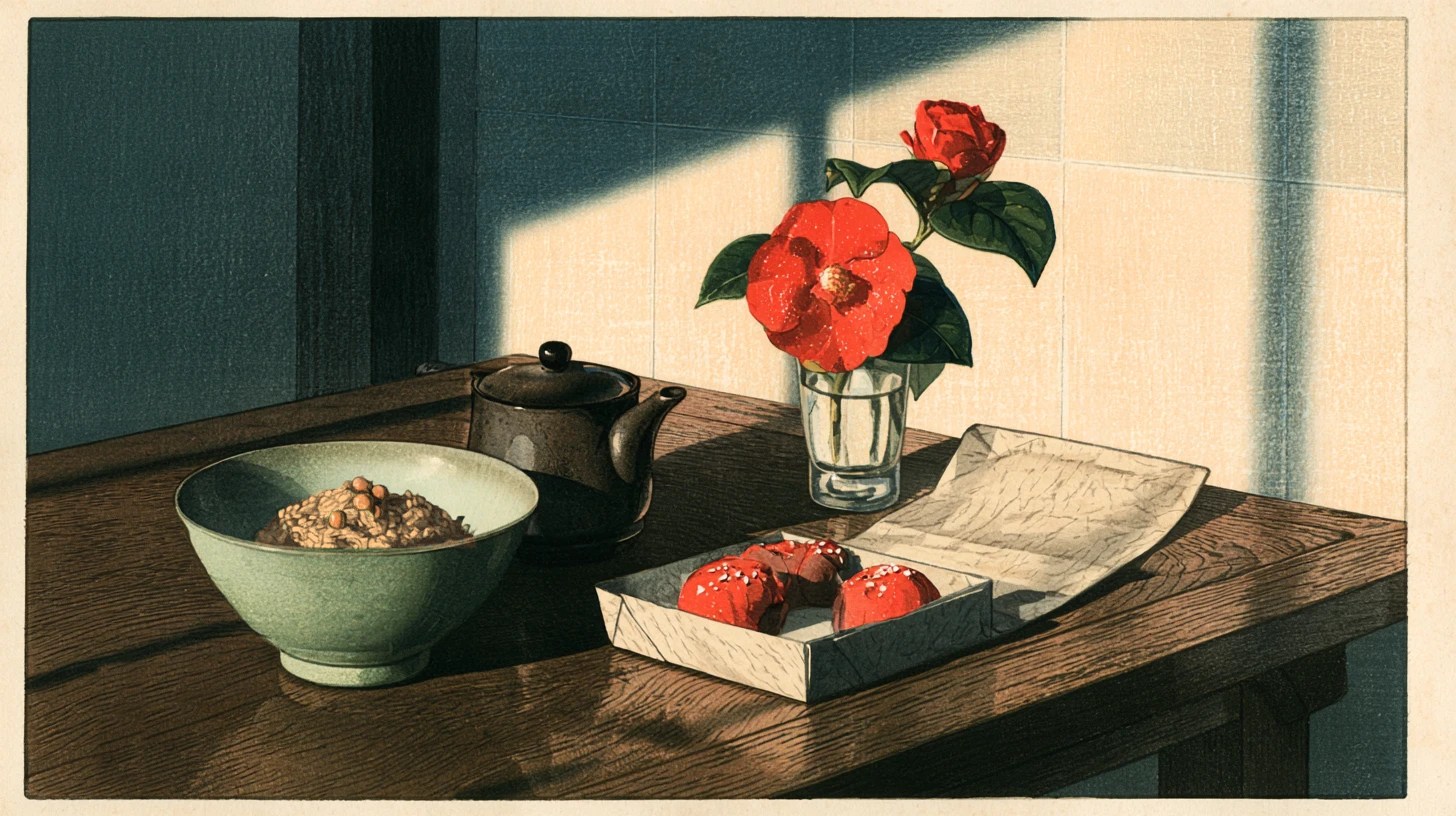
I buy the sweets for my granddaughter now. She eats the camellia first and the chameshi under protest.
The water, and then spring
On the night of the twelfth, in the small hours of the thirteenth, water is drawn from Wakasa-i, a well below the hall, and offered to the Kannon. That is the taking of the water that gave the rite its popular name. I have never seen it, and I have never wanted to. I like knowing it is happening while I lie awake in the cold house.
My father said the water comes from far away. Every year on the second of March, a temple in Wakasa, a long way to the north, sends it on its way, and it is said to take about ten days to rise in the well. He never told me whether he believed it. He only liked that it arrived in time.
On the last night the torches come up one after another, very quickly, until ten of them stand in a line along the railing, all burning at once. I have not missed that night in years. When I was a boy, my father’s hand held my knee. Now my granddaughter’s hand is in mine, and her coat is buttoned to the chin. I have not forgotten my mother’s face.
Then it is over, and we wait. Some years the warmth comes quickly. Some years the cold hangs on, and my grandmother used to say only that spring was running late. The morning after the rite ends, I like to climb up to the hall, where you can see across the whole Nara basin, and look for the first soft colour on the hills.
If you come to Nara in early March, bring the warmest coat you own; I always do. Stand below the hall with everyone else, and when the fire comes, keep your voice low. The light is only a lamp on the way in. Everything else happens where you cannot see it, for you as well as for us. And when it is done, I like to think, spring is allowed to come.
Places in this story
- Nara — destination guide
- Nigatsu-do and Hokke-do — Two Todai-ji halls on the hillside east of the Great Buddha Hall: Nigatsu-do, home of the Shuni-e rite each March for over 1,250 years, and Hokke-do, the temple's oldest building, full of Nara-period statues.
Things to do in this area
Travel information, separate from the story: food and experiences in this area in the season of the story, from our guides. The people in the story are fictional and did not visit these places.
- Nara chagayu tea porridge (Food) — Nara’s chagayu is a loose rice porridge cooked in brewed tea, also called okai-san. The home version often uses hojicha and leftover cooked rice. Some restaurants use different teas.
- Kakinoha-zushi (Persimmon Leaf Sushi) (Food, where: Naramachi and the palace site) — Nara’s kakinoha-zushi is pressed sushi: salt-cured fish such as mackerel and vinegared rice are wrapped in persimmon leaves one piece at a time. At Hiraso’s Nara Main Building, it comes as a sushi assortment or with tea porridge or Miwa somen.
- Miwa Somen and Nyumen (Food, where: Naramachi and the palace site) — Miwa’s thin hand-stretched noodles can be served cold as somen or warm in broth as nyumen.
- Narazuke (Sake Lees Pickles) (Food, where: Naramachi and the palace site) — Narazuke are vegetables such as white gourd, salted and then repeatedly transferred to fresh sake lees. Yamazakiya in Nara sells whole pickled gourds and ready-cut portions.