That January,
I had nothing to fix.
A short story of January in Nago, told by a man who puts in air-conditioners for a living and, in his first January working for himself, spent his mornings on the castle hill.
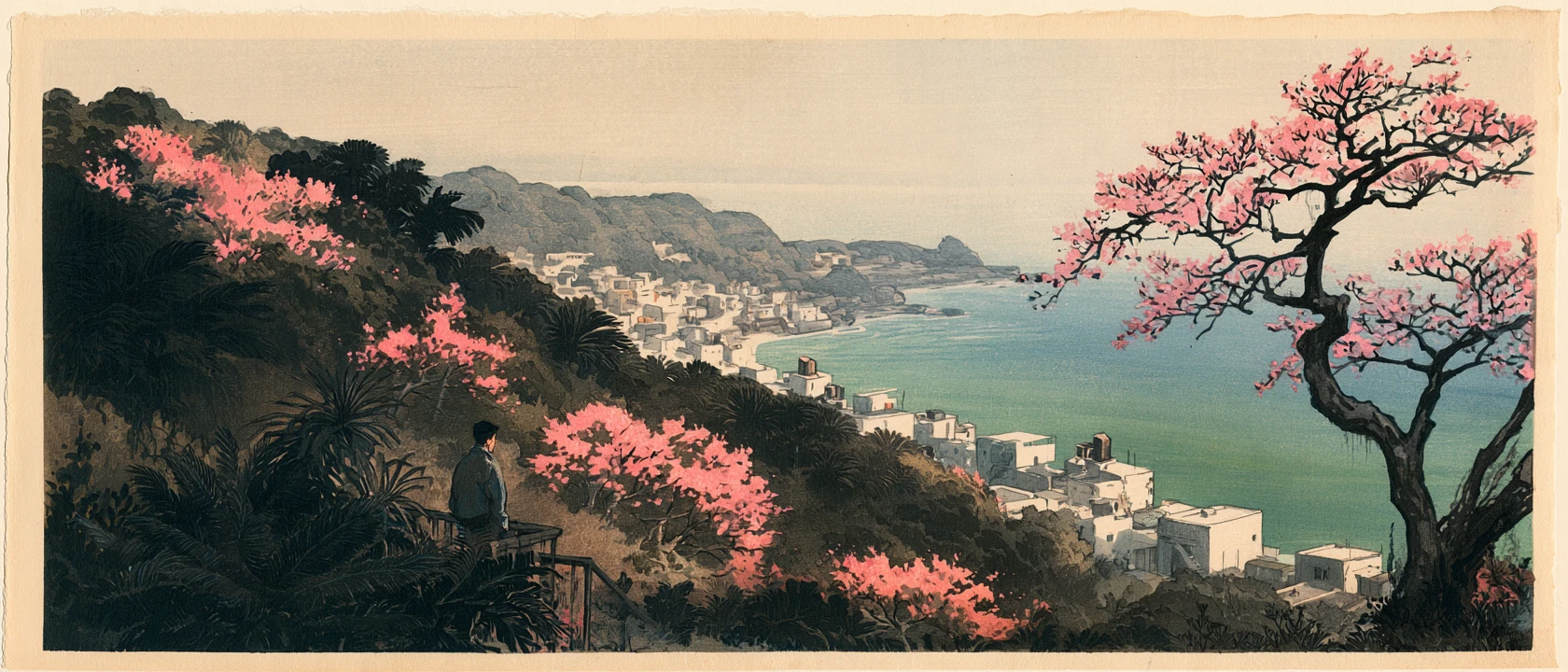
The quiet month
In my trade, the phone tells you what season it is.
I put in and repair air-conditioners in Nago, in the north of Okinawa Main Island. In high summer, when the afternoons usually climb past thirty degrees, my phone rings from before breakfast until after dark. January is our coolest month. The mornings are usually around fourteen degrees, the wind blows most often from the north, and for days at a time nobody calls at all.
For ten years I worked for someone else, and every January he had us wash the vans and sort the screws. Then, one spring, I went out on my own: one van, two ladders and my own phone number painted on the door. All summer I was up on roofs and inside ceilings, and I was happy. Then January came, the phone went quiet, and I was frightened.
I checked it a hundred times a day. Once I took it apart to see whether it was broken. In the middle of the month, my wife took it out of my hand. “Go and look at something,” she said, “that isn’t this.”
So I walked up the hill.
Up the hill
I was born in Nago and have lived here ever since. Our flat is near the foot of Nago-dake, the hill that rises right beside the town. The whole hill is a park, and the ruins of Nago Castle, Nangusuku, are up there too, one of the best-known places for cherry blossom in Okinawa. A road lined with cherry trees runs for about two kilometres, and at the top there is a cherry garden with a path beneath the branches.
When I was a boy, most of the cherry blossom I saw on television was almost white. Ours is dark pink. Our trees are kanhizakura, and their flowers are shaped like small bells and hang down from the branches, as if they were looking at the ground. For years I thought the television had the colour wrong.
In Okinawa these cherries usually flower from the middle of January to the middle of February, before anywhere else in Japan. Nago has a slogan for it: Japan’s spring starts here. An unusually warm or cold December can make them early or late, and there is nothing anyone can do about it.
That first morning, only a few flowers were open, on a tree beside the path. I stood and looked at them for a long time. For the first time since spring, I was looking at something I could not fix, fit or hurry. After that I went up every morning, and every morning there was more pink on the hill than the day before.
White-eyes
A week or so later, I began to notice the birds.
They were mejiro, Japanese white-eyes: small olive-green birds with a ring of white round each eye, and they are very fond of cherry nectar. Bees and butterflies come for it too, but the birds are the ones you hear. One morning a tree beside the path was busy with them. They went from flower to flower, putting their beaks into the pink bells, never still and never quiet.
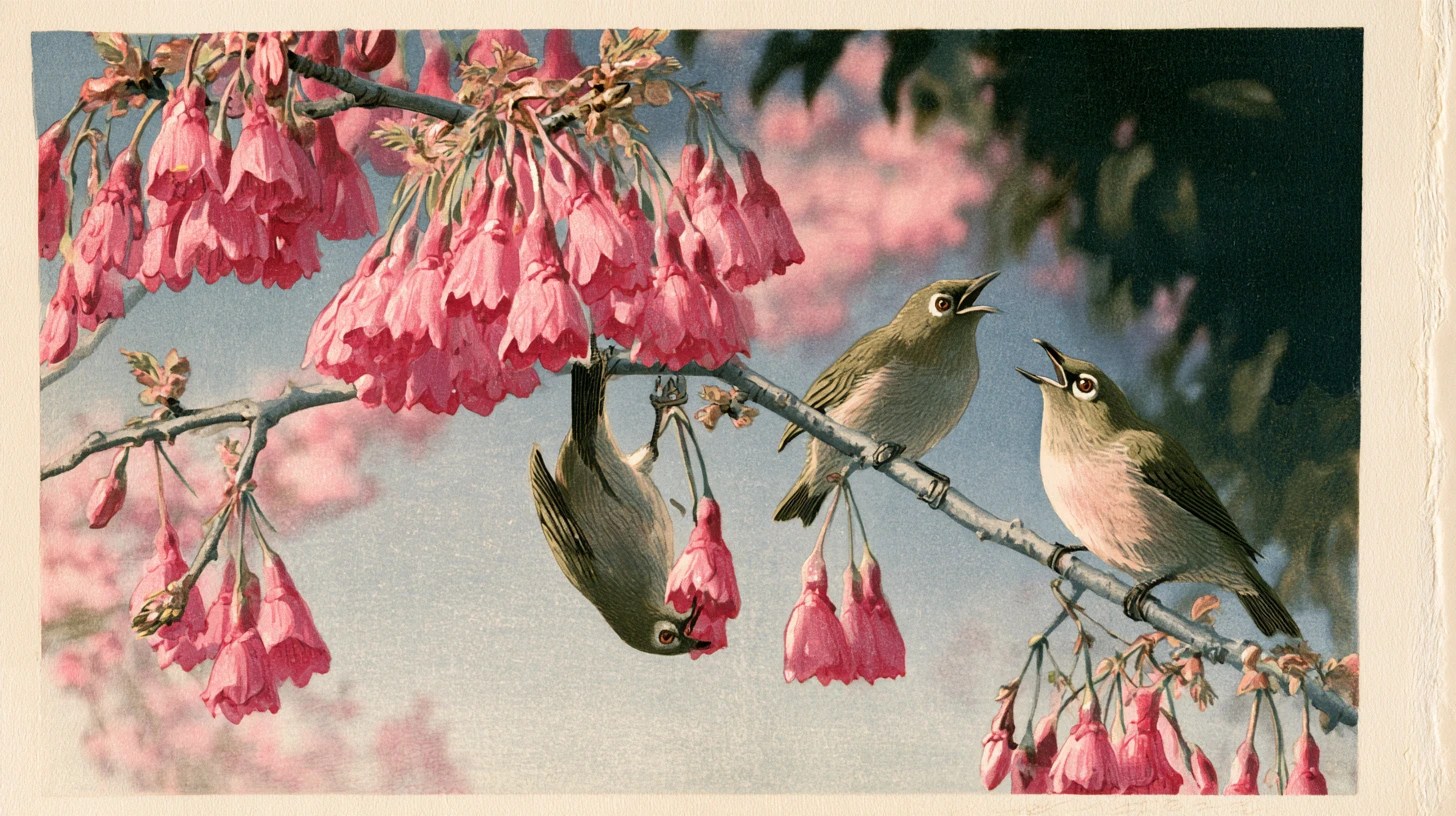
I stopped where I was, so as not to frighten them, and watched. They were the only ones on the hill with too much work, and not one of them looked worried about it.
When I got home, my wife asked how long I had been out. I didn’t know. I had not looked at my phone once.
Flowers on the path
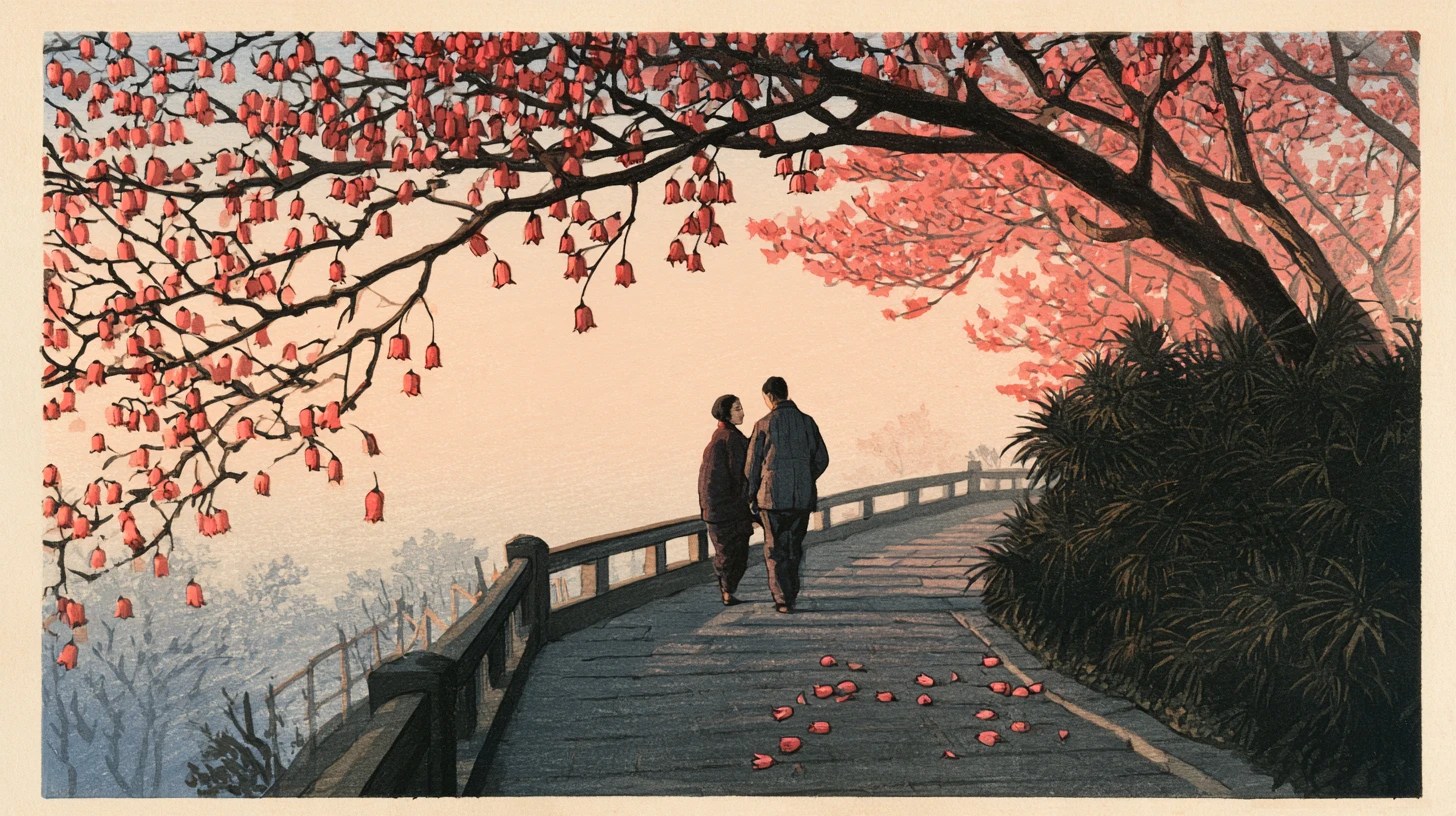
On television, cherry petals come down like snow. Ours don’t. A kanhizakura flower doesn’t let its petals go one by one. It falls whole, and lies on the path like a little bell someone has dropped.
By late January the path was dotted with them, and I learned to walk up slowly, stepping round each one. Halfway up one morning my phone rang, and my heart jumped. It was my wife, asking me to buy eggs on the way home.
At the end of January came the cherry festival. It is held every year on the last Saturday of January and the Sunday after, and the date does not move for the trees. When I was small, I believed the festival was what made the flowers open. That year my wife came up the hill with me on the Sunday, and for once I was the one telling her to slow down.
North
By the end of the month the whole hill had turned bright pink.
From the observation deck near the top, you look out over the town to the East China Sea. On the last morning of January I stood up there and picked out roofs I knew. There were a dozen I had been up on that summer, where my units now sat silent with nothing to do, like me.
That spring I began to follow the cherries the way I follow the weather. On the weather agency’s list of cherry dates, the earliest usual date is Naha’s, in the middle of January, and the latest is in Hokkaido, in the middle of May. Every spring the news follows the blossoms north, day by day, up the whole country. By the time they reach Hokkaido, our own cherries are long over, the afternoons are warm again, and my phone has started ringing.
I was afraid of that January. Now I know that January is where things start, on our hill, while the rest of Japan is still in midwinter. Then spring leaves us and sets off north, to everyone else, and I go back up on the roofs.
If you come to Nago in January, I hope you will find a morning when nobody is waiting for you, and walk up through the trees as slowly as you like. Spring sets off north from this hill, but for a few weeks it is in no hurry to leave.
Things to do in this area
Travel information, separate from the story: food and experiences in this area in the season of the story, from our guides. The people in the story are fictional and did not visit these places.
- Rafute in Okinawa (Food, where: Naha and around) — Ryukyuan pork belly braised skin-on with bonito stock, awamori, sugar and soy sauce. At Yotsutake Kume in Naha it is served with local vegetables as the simmered course of a meal with dance.
- Okinawan Soki Soba (Food, where: Naha and around) — Okinawan wheat noodles in pork or bonito broth, topped with simmered pork ribs.
- Okinawa taco rice (Food, where: Naha and around) — A dish from Kin, Okinawa, with taco toppings layered over rice. In Naha, Kijimuna also serves an omelette-topped version.
- Sea grapes in Okinawa (Food, where: Naha and around) — Green seaweed with clusters of tiny beads. In Okinawa it is served fresh on its own and in salads. At Okinawa Shokudo Shinonome in Naha it is an evening side dish.