All my life,
I watched from the bank.
A short story of early summer in Gifu, told by a woman from the old river-port lanes of Kawaramachi who had always watched the cormorant fishing from the bank.
The fires come back
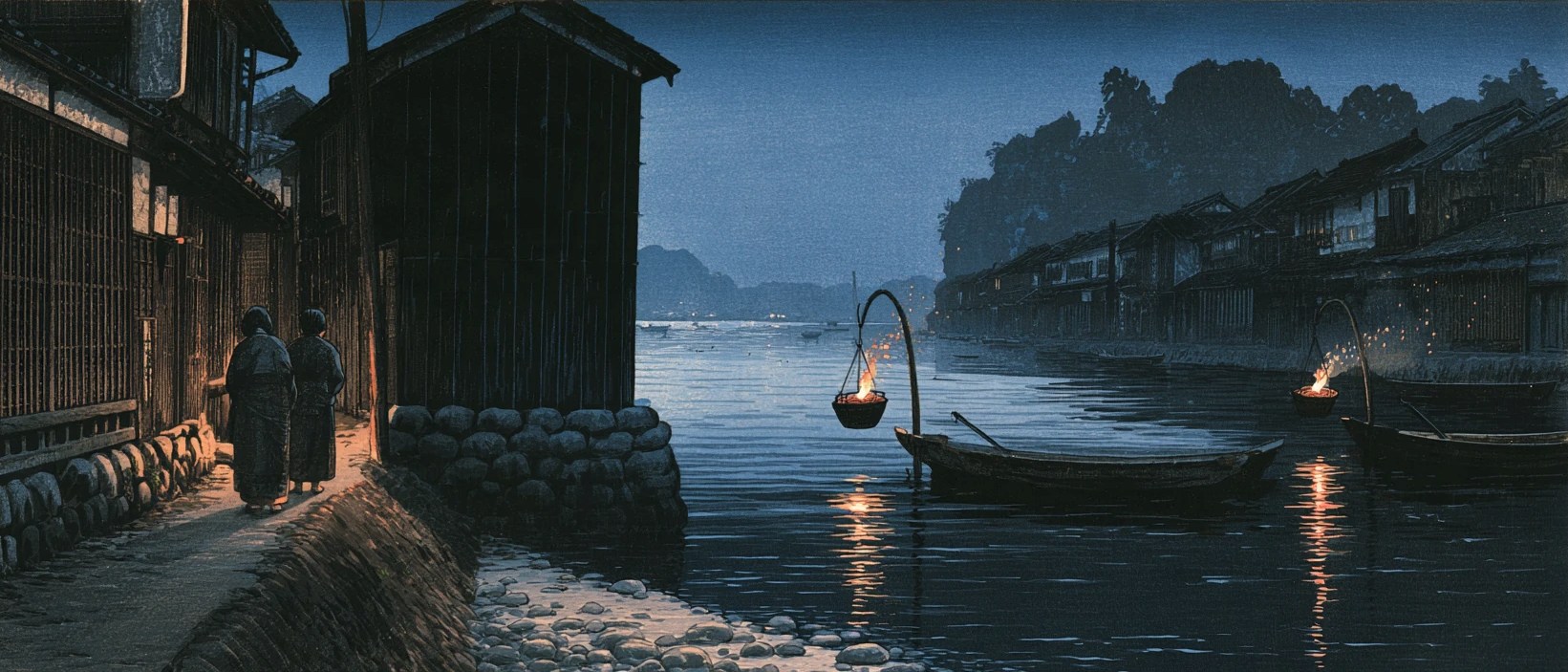
On the evening of the eleventh of May, the fires come back to the Nagara River.
From then until the fifteenth of October, cormorant masters fish the river by firelight almost every night. They rest for one night, usually in September or October, and stop when heavy rain makes the river rise. Gifu City says this fishing has gone on along the Nagara for more than thirteen hundred years. I have only been here for sixty-seven of them.
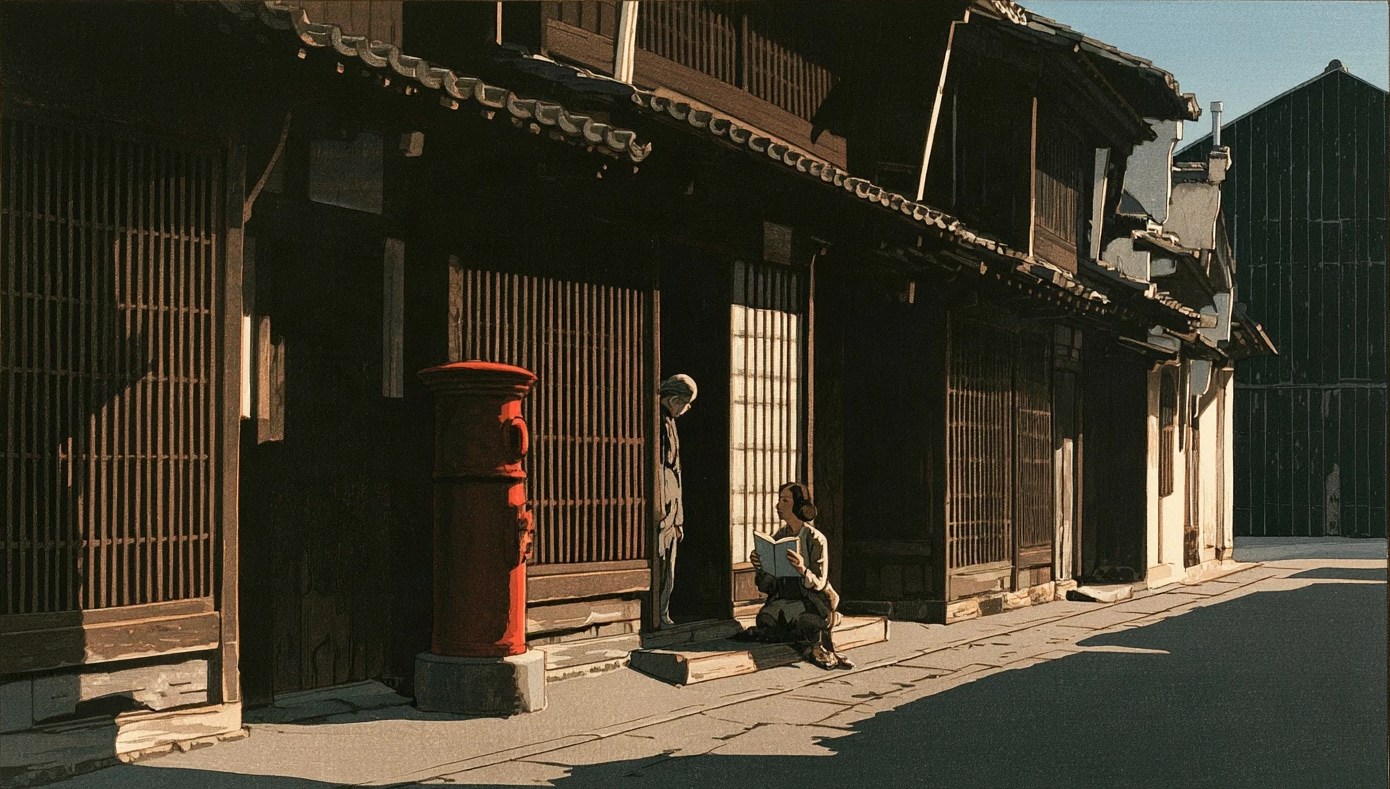
I was born in Kawaramachi, near the river, in a narrow house that runs a long way back from its lattice front. From the time of the warlord Oda Nobunaga, this was a river port where merchants came and went. There are tall black-walled storehouses, and a round red postbox.
In our house, we watched the fishing from the bank at the end of our lane. My mother’s rule was that we stood well back from the water, and I still do. From there the fires come down the river one after another, small and gold, each with a second fire under it in the dark water.
In sixty-seven summers, I had never once been out on one of the boats. Why go out to meet something that passed the end of the lane nearly every night?
The house across the lane
This spring, a young woman named Marta moved into the empty house across the lane. She had come from abroad to work in the city for a year.
On the evening of the eleventh, she knocked on my door. “There’s fire on the river,” she said. “Is everything all right?”
I took her to the end of the lane, where my mother used to make us stand, and told her what I knew. That these were cormorant masters, fishing for sweetfish, ayu, with trained birds. That our city has six masters, appointed by the Imperial Household Agency, and that the post passes from father to son.
Then she asked whether the birds ever got to eat any, and I found that I did not know.
A week later she knocked again, full of answers. A cord at the base of each bird’s neck stops big fish in its throat, she told me, but lets small ones through, so the bird can eat them. The birds are Japanese cormorants, caught wild on the coast at Hitachi, in Ibaraki. Each master keeps about twenty, chooses every day which ones go out, and never pushes a bird that is unwell. And when the birds grow too old to fish, they go on living at the master’s house.
She read me that last part twice. “Sixty-seven years,” she said, “and you never asked?” I never had. The fires had always simply been there, like the river.
On the water
In June, when the rainy season usually sets in, Marta decided I was going out on the water.
It rained all afternoon on the day we went, but the viewing boats have roofs and go out in the rain. I made rice balls, and Marta brought cherries. Our boat went upriver and waited, tied to the bank, while the evening darkened and the rain stopped. We sat on the tatami, as we had been asked, and did not lean over the rail.
A firework announced the start of the fishing. A fishing boat came down the river, and our boat, with the others, went down beside it.
I had seen that fire all my life, but never like this. Pine burned in a basket on a pole at the front of the boat, closer than I had ever imagined, and sparks rose from it and died over the water. The master stood in its light in dark clothes, which do not startle the birds at night, with a cloth wound round his head against the sparks and a straw skirt against the wet and the cold. He held the birds’ cords, as many as twelve, in his left hand, and worked them with his right so that they did not tangle. When a bird caught a fish, he lifted it into the boat and had it give up the fish into a basket.
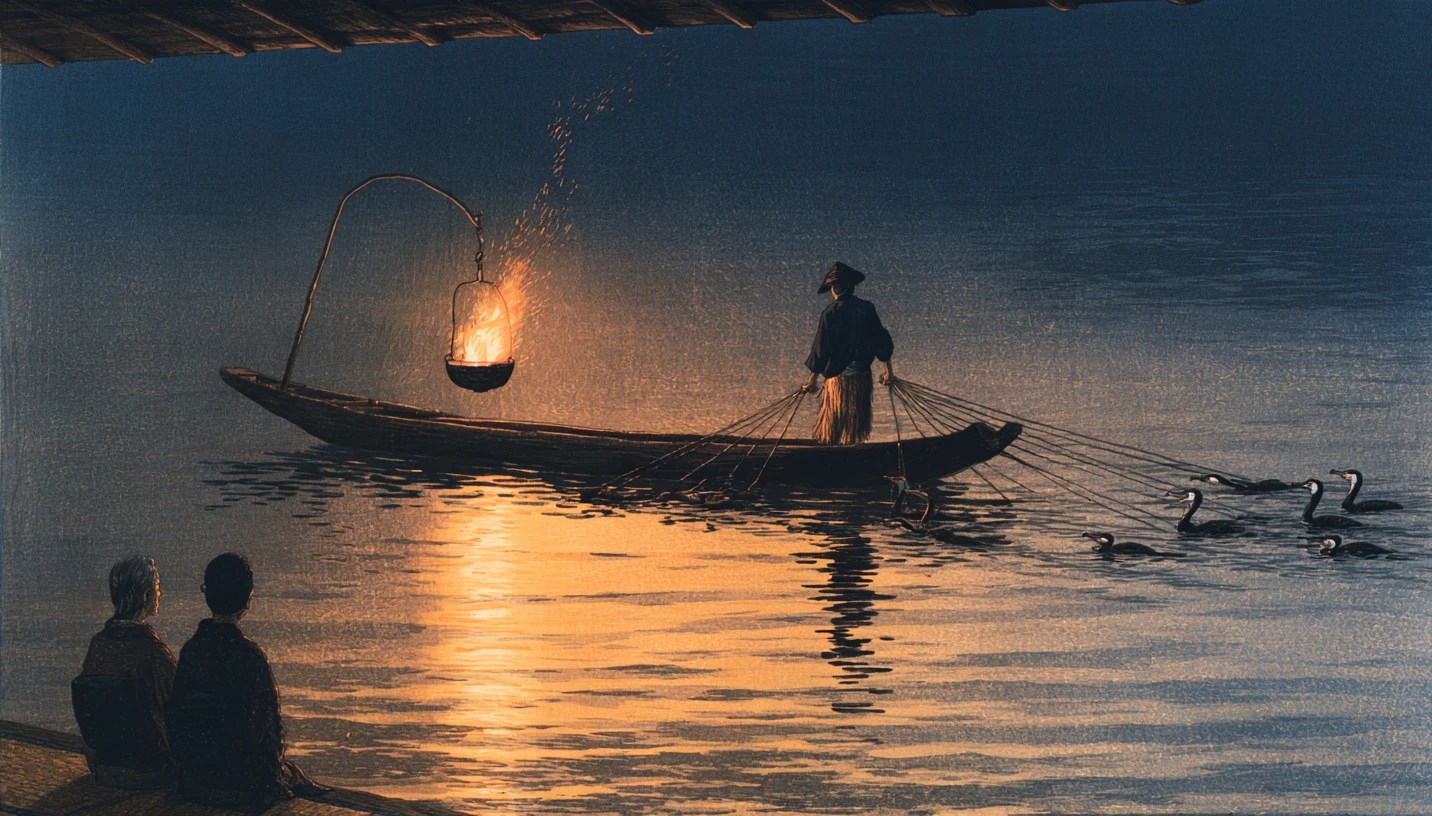
And there was a voice. “Ho! Ho!” The masters call like that while the birds fish, to encourage them. In sixty-seven years on the bank, I had never once heard it. I had not known that the fire could speak.
Marta took my hand without looking at me. Neither of us ate a single cherry.
Delight, and then sadness
At the end, the six fishing boats spread out across the whole width of the river and drove the sweetfish into the shallows together. This is called the sogarami. From the bank I had always seen it as a row of lights. From the water, it filled the river.
Then it was over. Our boat turned back, the fires grew small behind us, and the water was dark again.
In 1688 the poet Matsuo Basho came to Gifu, watched the cormorant fishing and wrote a poem I have known all my life:
omoshiroute / yagate kanashiki / ubune kana
The poem says only that the cormorant boats are delightful, and then, before long, sad. I had always thought it was about the boats. That night, I understood that it was about whoever was watching them.
On the walk home I told Marta about the poem. She shook her head. “It isn’t sad,” she said. “They’ll be back tomorrow.”
And they were. Basho’s sadness is real, I think, but by this river, for most of the summer, it only has to last until the next evening.
Tomorrow
Now Marta and I watch from the end of the lane most evenings, well back from the water. I have never heard the voices from the bank, but now I know they are there, inside each small fire.
Marta has been reading again. Sweetfish live only a year or so, she told me. In autumn the grown fish let the river carry them down to lay their eggs near our city, and the young are carried on to the sea. In spring they swim back up the river. “Everything here comes back,” she said.
Her year here ends next spring. She is trying to stay one more summer, and I have not asked how it is going. But if she is still across the lane next May, I mean to be the one who knocks. “There’s fire on the river,” I will say. “Come and see.”
If you come to Gifu in early summer, I hope you will see the fires come down the Nagara, from the bank or from the water, and let yourself feel both halves of Basho’s poem. And then, as Marta says, there is tomorrow.