Twice a day,
the sea comes home.
A short story of autumn on Miyajima, told by a woman who grew up on the island and has lived by its tides all her life.
The paper by the back door
In my mother’s kitchen, the tide table hung on a nail by the back door. She put up a new one every year, and by December its corners had gone soft from her thumb.
Nobody in our house asked what time it was. We asked where the water was. Twice a day the sea comes in around the shrine and goes out again, and each day it keeps its appointments a little later than the day before, so you cannot learn it once and be done. You have to read it.
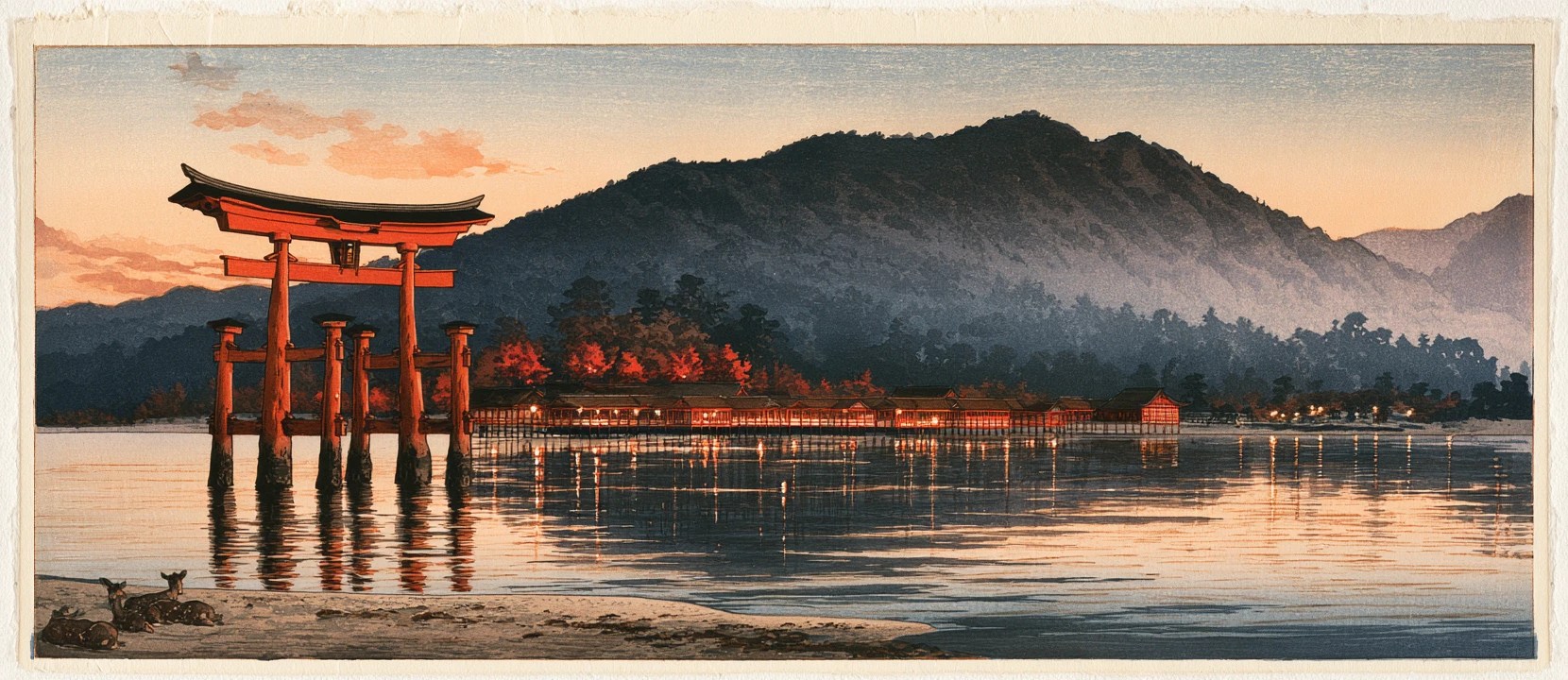
The shrine stands in the sea. It was built out on the water rather than on the land, to protect an island that has long been worshipped as a god, and the old account says its place was chosen where the sea ebbs and flows. When the water is high enough, the shrine seems to float. When it is low enough, you can walk out over the bed of the sea to the vermilion Great Torii.
But not every high tide is high enough, and not every low tide is low enough. My mother could tell from the numbers on the paper, and she told me in the morning, the way other mothers told their children the weather. The shrine floats after lunch today. You can walk out to the torii before supper.
Chrysanthemums at dusk
Every year on the fifteenth of October, late in the afternoon, the shrine holds the Kikkasai, the chrysanthemum festival. After the ceremony come the bugaku dances, music and dance that came to the island in the late twelfth century.
My mother took me every year when I was small. I remember very little of the ceremony and a great deal of the waiting: the cool air off the water, my mother’s hand on my shoulder to keep me still. The shrine’s corridors are built with gaps in the floor, and I liked to look down through them for the sea.
During one of the dances, chrysanthemums are offered to the gods of the shrine. I did not know that then. I only knew that the music went on while the light went out of the sky, and that afterwards, when we had walked home in the dark, my mother would stop at the pots by our door and cut a few chrysanthemums of her own for the kitchen table. She never said why. I do it now, and I do not say why either.
Voices in the dark
Autumn is when the deer court. The stags polish their antlers and daub their necks with mud, a show of strength for the other stags, and they fight over the does. It goes on into November. In autumn you can hear them calling, and I hear them most at night, lying awake with the window open a little. I have never managed to describe it to anyone who has not heard it.
My mother had one rule about the deer, and every child on our street heard it from her: we do not feed them. The deer that sleep in the town have lived among people for so long, she said, that even their young no longer go back to the wild. They have learned to take food from hands and from bins, and a deer that eats paper or plastic can die of it.
Visitors are asked the same: not to feed them, and to take their rubbish home.
When I see a child holding out a leaflet to a deer as if it were a leaf, I say it too, more gently than she did.
The maple valley
November is the month of the maples. In Momijidani, the maple valley, there are about seven hundred of them, and they are usually at their best from the middle of the month to the end.
My daughter lives on the mainland now, in a city with a clock on every wall. She comes home every November on the ferry with her son, and the three of us walk up through the valley slowly, because my knees are old and my grandson stops for everything: a red leaf in the stream, a stone with a hole in it.
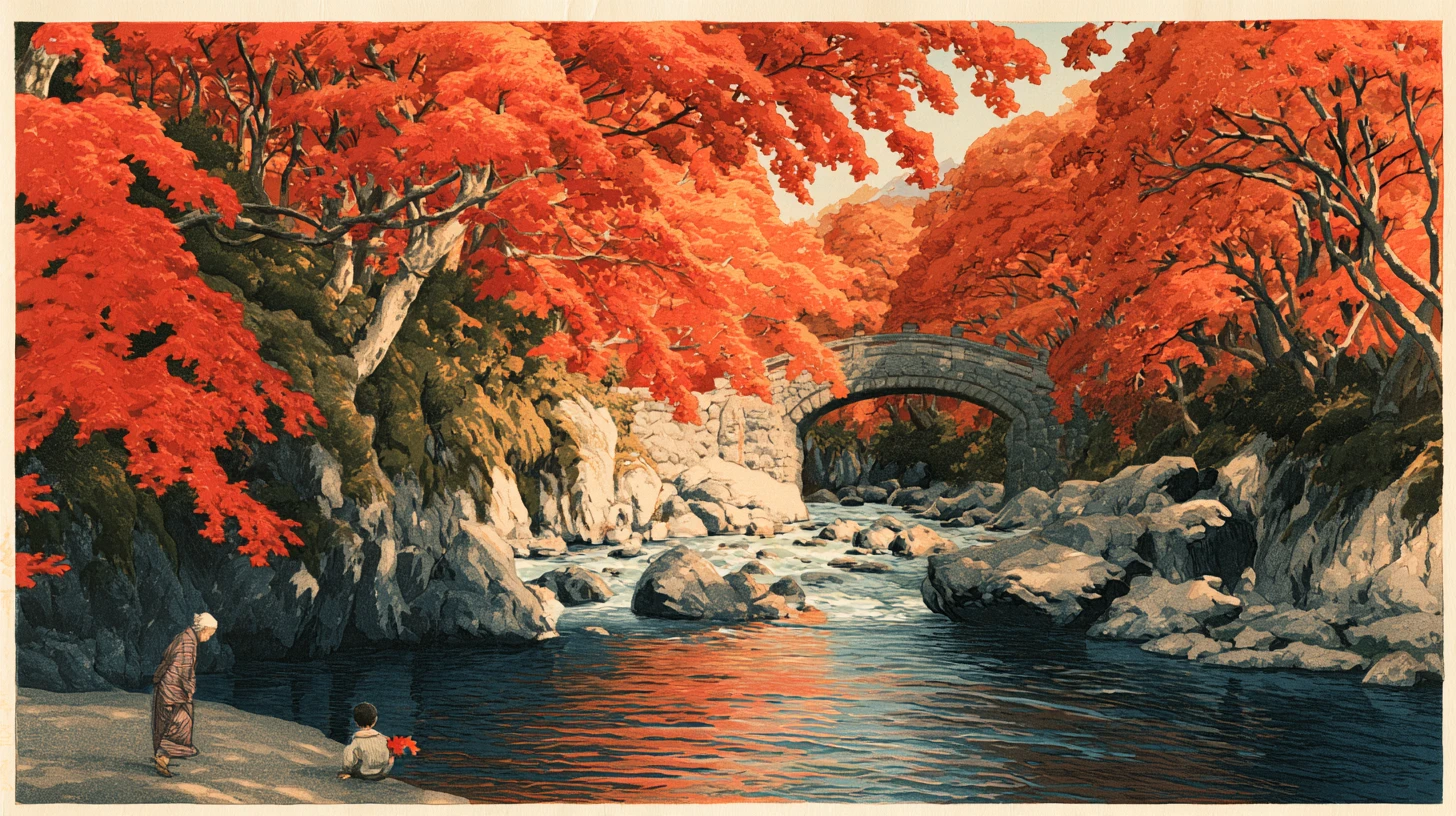
On the way down we buy momiji manju, little cakes in the shape of a maple leaf. The first ones are said to have been made in the late Meiji years, as a gift for guests, one that would suit the valley’s name. There are more than a hundred kinds now, some with chocolate or cheese or cream inside. My grandson wants a different one every year. I have only ever wanted red bean.
And because it is November, there is anago-meshi on our table. Conger eel is said to be at its best in July and August, or in November, when it has put on fat, and my mother was always on the side of November. She laid the grilled eel over rice cooked in broth and poured the last of the sauce over the top, and we ate it under the tide table. I make it now, and we eat it at the same table. My grandson picks the eel off the top and leaves the rice, exactly as I did at his age.
When the sea comes home
I like the island best in the evening. On most nights, after dark, lights come up on the shrine and the Great Torii, and when the tide is high enough, the shrine seems to float on black water, as if it had just arrived from far away.
Last November, on an afternoon when the tide was low enough, my grandson and I walked out over the bed of the sea to the torii, and that evening we stood on the shore and watched the water come back over our footprints. He asked me where the sea goes when it goes out. I told him what my mother told me, which is not science: it goes to see how everyone else is doing, and then it comes home. Twice a day. A little later each day, but it always comes.
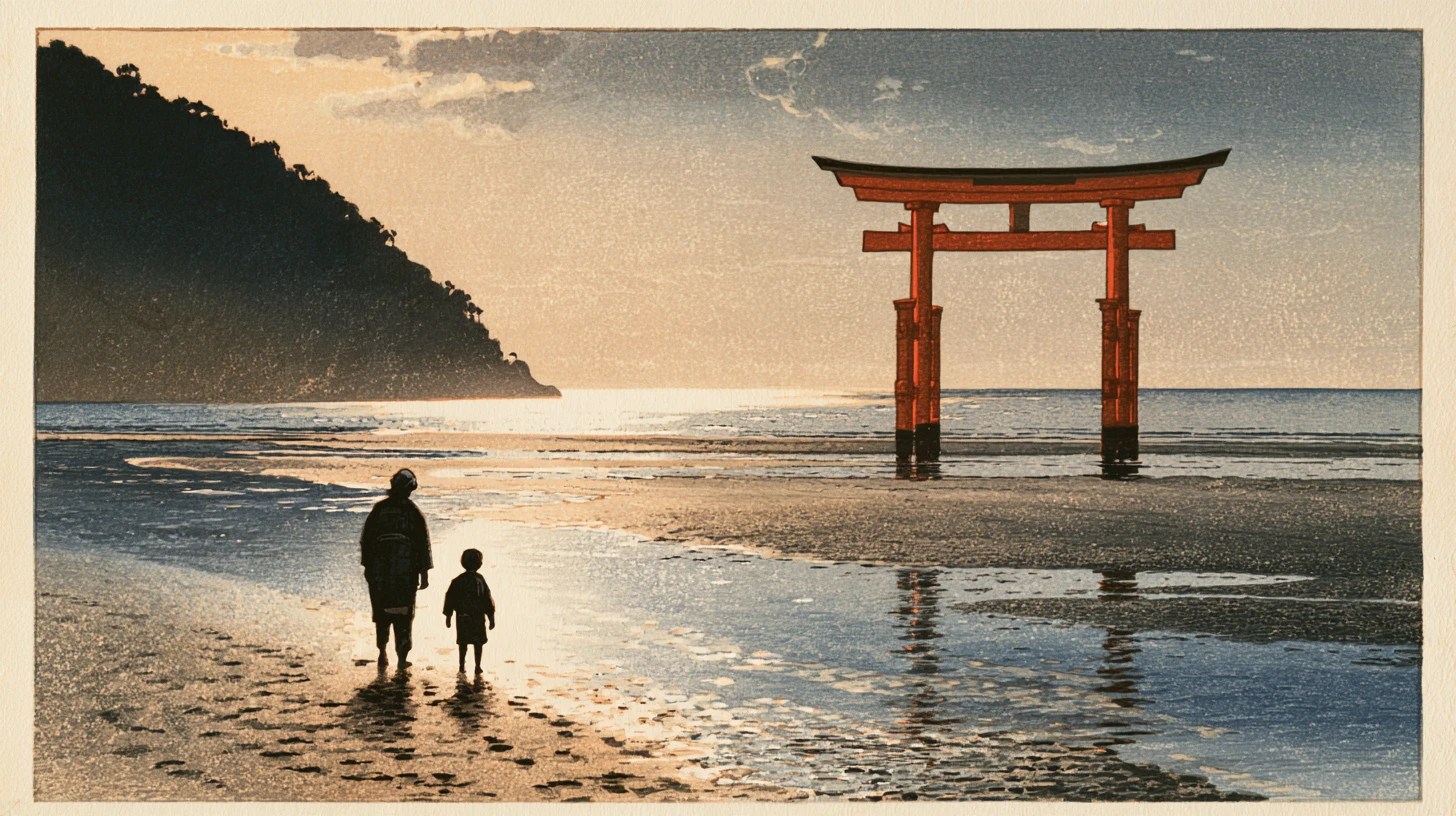
My daughter, standing behind us, laughed. She keeps a clock on every wall, and still she comes home every November.
If you come to the island in autumn, do what my mother did and read the water first. I hope you see the shrine both ways, once with the sea all around it and once from the bed of the sea, standing at the foot of the torii. Then go home, wherever that is. I like to think the island does not mind. The sea leaves too, after all, and twice a day it comes home.
Places in this story
- Hiroshima and Miyajima — destination guide
- Itsukushima Shrine — A shrine built over a tidal beach. Its halls and long corridors stand on posts, and at high tide the sea comes in under them.
- The Great Torii of Itsukushima Shrine — The vermilion wooden torii stands about 160 metres from the halls of Itsukushima Shrine. Mikasa Beach gives a view from shore, and at sufficiently low water visitors can approach across the foreshore. Certain sailings from Miyajimaguchi pass the gate from the sea side.
- Momijidani Park — A valley of about 700 maples at the foot of Mt Misen, rebuilt with its own rocks after a 1945 typhoon. The leaves usually turn red from mid to late November.
Things to do in this area
Travel information, separate from the story: food and experiences in this area in the season of the story, from our guides. The people in the story are fictional and did not visit these places.
- Miyajima anago-meshi (Food) — Conger eel served over rice, a regional dish of the Miyajima area.
- Miyajima Momiji Manju (Food) — A maple-leaf-shaped baked cake. A traditional filling is smooth sweet adzuki bean paste.
- Hiroshima tsukemen (Food, where: Central Hiroshima) — Hiroshima’s chilled noodles and vegetables are dipped into a separate spicy sauce. At Bakudanya you can also order the sauce without added heat.