One flower,
two pairs of glasses.
A short story of the rainy season in Matsue, told by a woman who got her first glasses one June when she was nine, and her second pair at forty-six.
Clouds
Until I was nine, the gates at Gesshoji were only dark shapes in the rain.
Gesshoji is a quiet temple in Matsue, where I have lived all my life. It is the family temple of the Matsudaira, who were once the lords of this domain, and nine of them are buried here, the first to the ninth. Each lies in his own large compound, behind an ornate wooden gate. In the rainy season, about thirty thousand hydrangeas bloom in its grounds, centred on the tomb of the first lord, and it is known as the hydrangea temple of San’in.
Our rainy season usually begins early in June. The temple says the hydrangeas begin to open as the rains come and last for about a month.
When I was small, I thought June simply looked like that: soft and wet, the edges of everything melted together, as if the whole town were made of cloud. Nobody knew I could not see properly. I did not know it myself.
The day the tigers came out
That spring, the eye test at school found me out. One rainy afternoon in June, my father collected my first glasses, put them on my nose himself and, instead of taking me home, drove me to Gesshoji.
“Let’s see what you’ve been missing,” he said.
The cloud came apart into things. The rain fell in separate drops, and every leaf held its own. Then my father pointed at the gate in front of the first lord’s tomb, and there were tigers in the curve of its roof, tigers and bamboo, carved in wood. I had walked past that gate many times. I had thought it was just a dark roof.
Every gate is different. There are dragons on the third lord’s gate, waterbirds on the fifth, and on the ninth, a hawk on a pine, carved right through the wood. On the seventh lord’s gate, where you might expect a creature out of legend, there are grapes. There were nine lords, and I was nine, so I decided the hawk was mine.
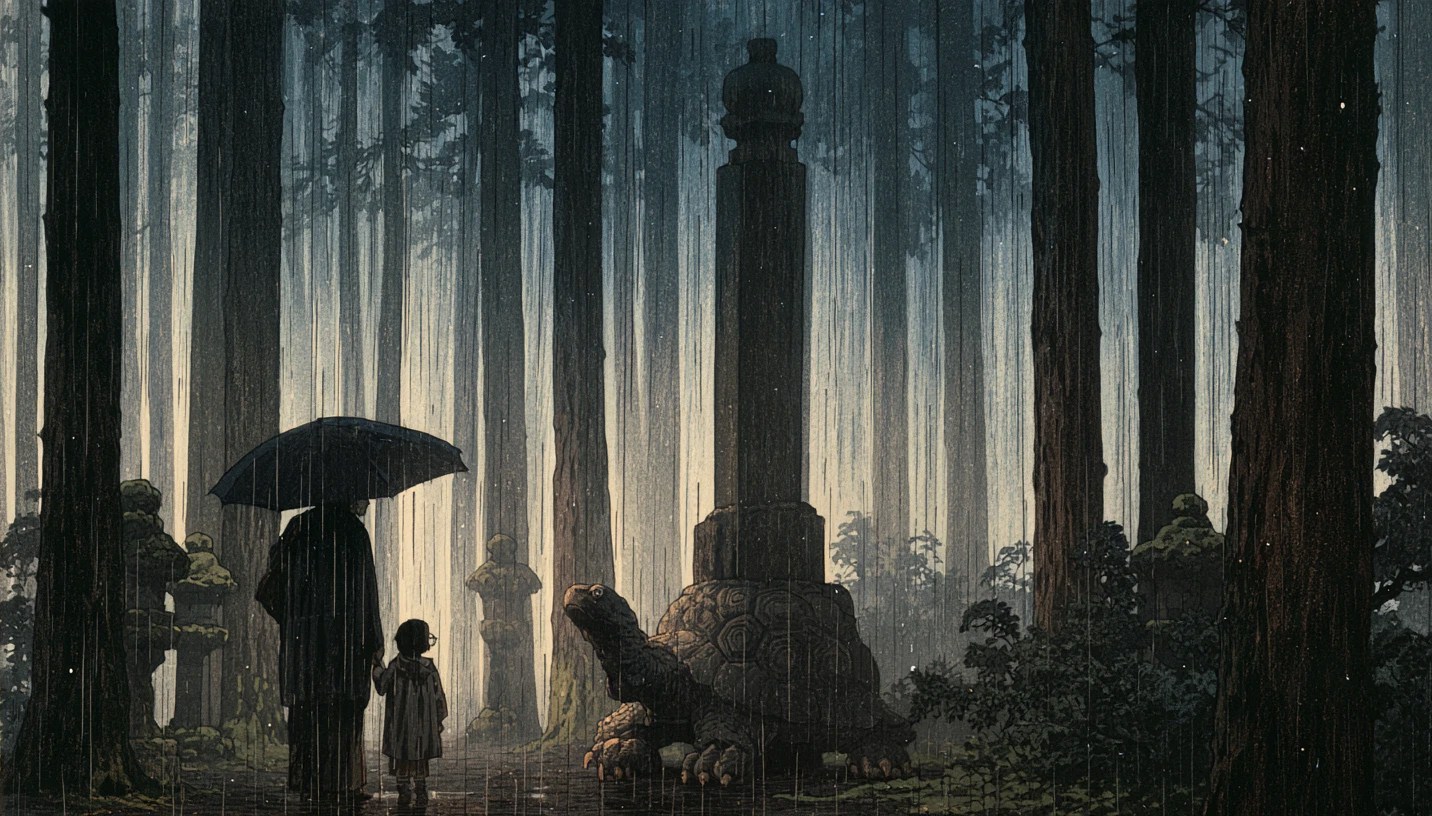
Then we came to the turtle. Beside the tomb of the sixth lord stands a huge stone turtle with a great stone tablet on its back, about five metres tall in all. I had heard the old story at school: that the turtle used to go out at night and frighten people, that it came to drink at the lotus pond in the temple garden, and that the great stone on its back is what keeps it still. Through my new glasses I could see its face for the first time. I held my father’s hand rather hard.
Small print
I am forty-six now. For twenty years I have read proofs for a living, at a desk by my window: other people’s sentences, in small type.
Last winter, the type began to drift away from me. My daughter noticed before I admitted it. She is twenty-three and lives across town, and one evening she watched me read a letter at arm’s length.
“Mum,” she said, “your arms aren’t long enough any more.”
I told her I already had glasses. In May, I gave in. Now I have two pairs: one for far, as always, and one for near, which I push up onto my head and then search for all over the house. My father, who is seventy-eight, still reads the newspaper without glasses, and he mentions it often.
I did not like it. It felt as if, after all those years, the world had begun to blur again, this time from the other side.
Two pairs for one flower
In the middle of June, on a soft, rainy morning, my daughter came to my door with an umbrella.
“It’s June,” she said. “Let’s see what you’ve been missing.” She has heard the story of my first glasses more times than she would like.
Not far inside the temple there is a mound for tea whisks. Every April, the temple holds a memorial service for the whisks that have done their work. I had always walked past it. This time I stopped.
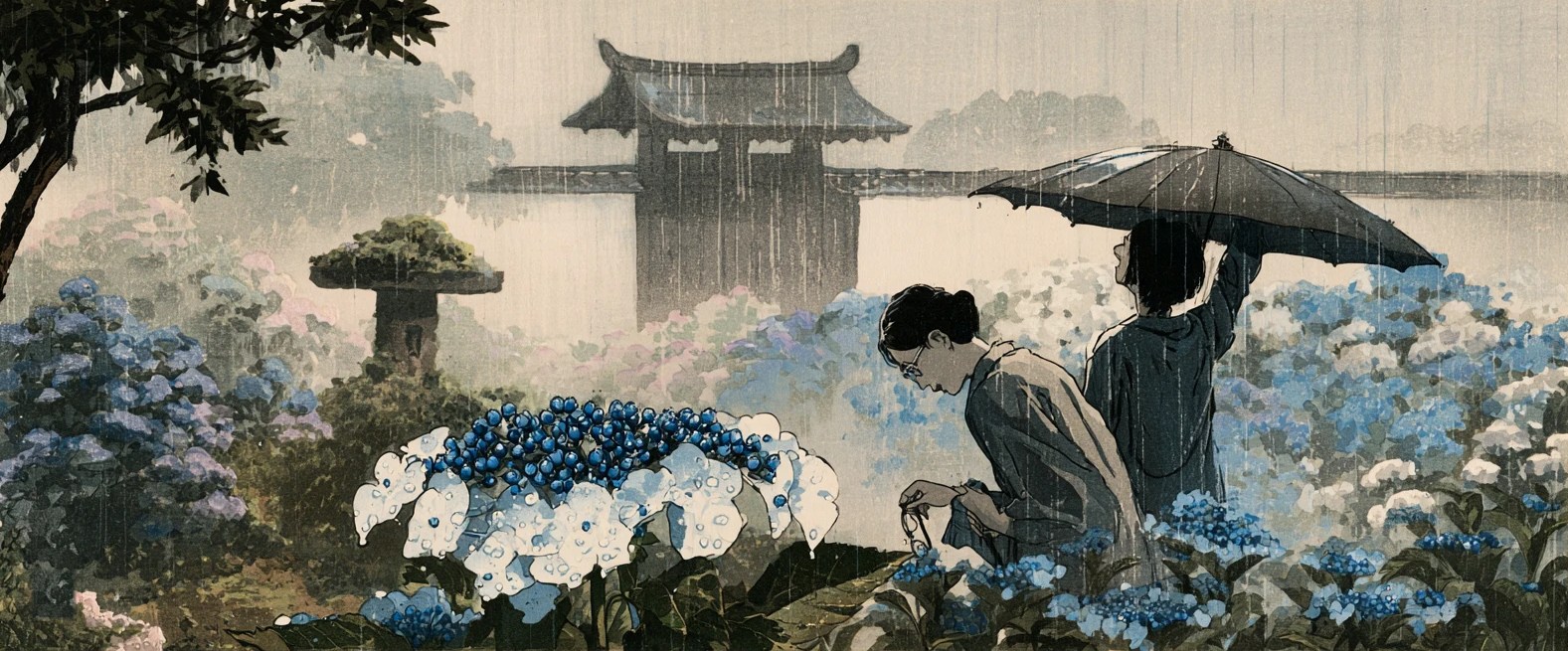
Around the first lord’s tomb, the hydrangeas were out. Among them are lacecaps, which the temple describes as not showy, but delicate when you look closely. A lacecap has open flowers around its edge, and in the middle, a crowd of tiny ones.
With my ordinary glasses I could see the whole sweep of colour in the rain, and the ring of open flowers on the nearest lacecap. Its middle was a blur. I changed to my reading glasses. The middle came up sharp: small flowers, some still closed, like beads. But now everything else had melted back into cloud, the way it was when I was nine.
I changed back. I changed again. My daughter held the umbrella over both of us and laughed.
“One flower,” I said, “two pairs of glasses.”
At the turtle, I told her what I had learned only that spring: the seventh lord set up that great stone for his father, the sixth, to honour him and to pray for his long life. People still come to the turtle to pray for a long life, for themselves and for their families. I put my hands together and bowed, and I thought of my father with his newspaper. I did not ask for anything for my eyes.
Near and far
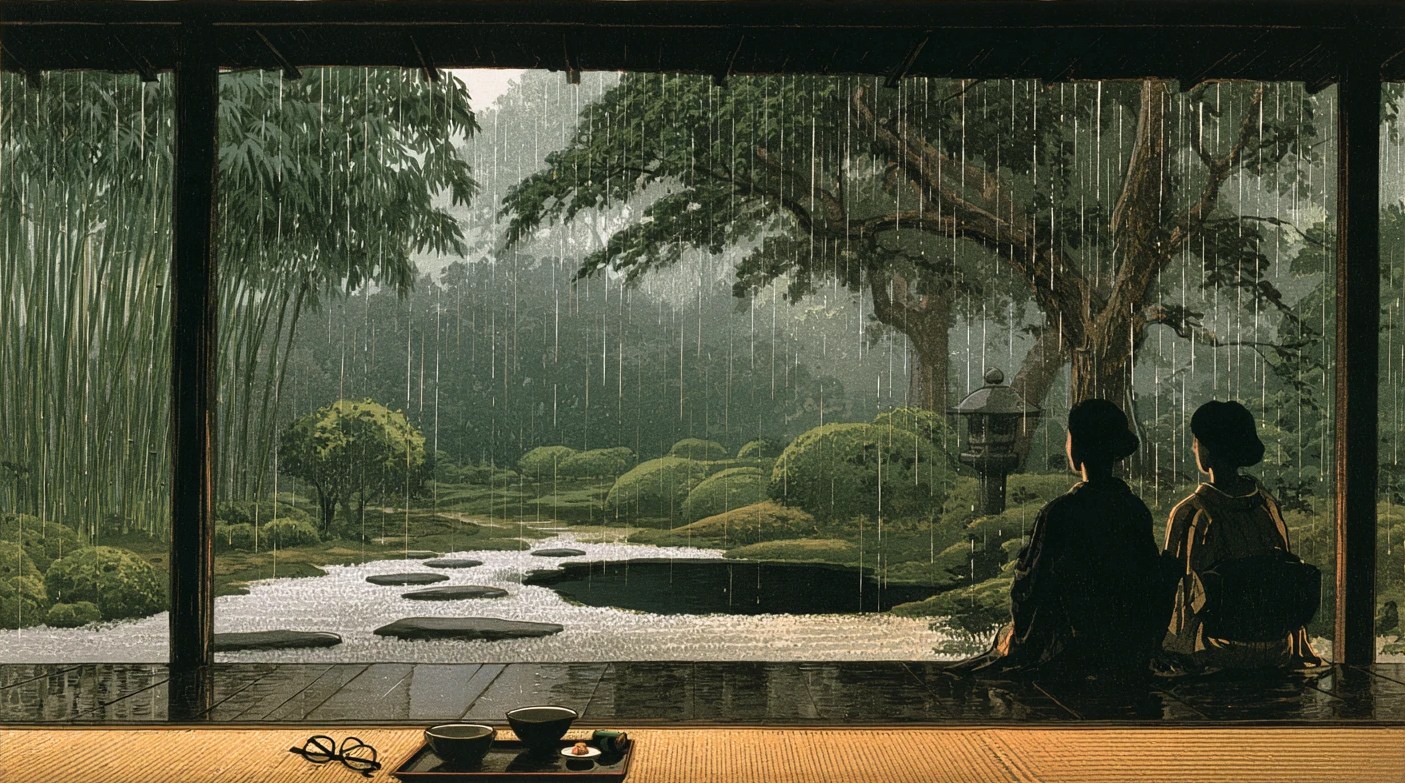
Afterwards we sat in the shoin, the temple’s reception hall, with tea and a sweet, looking out at the garden. It is said to have been restored by the seventh lord, Fumai, who was a master of tea, and there is bamboo at the back of it. Rain ran off the eaves.
I took off my glasses and set them down beside me. The garden went soft, the way all of June used to be. For a while, I simply let it.
At nine, I wanted everything sharp. At forty-six, I find I like knowing that I can choose: near or far, sharp or soft. The tea whisks here are thanked when their work is done. I do not think my eyes are done. I think they have only learned to ask for help, which took the rest of me much longer.
Then my daughter handed me my distance glasses, and we went to see the hawk again.
If you come to Matsue in the rainy season, I hope you will look at one lacecap long enough to find the small flowers in its middle, and then at all of them together, soft in the rain. It took me most of my life, and two pairs of glasses, to learn that a flower can be seen both ways.