Once a year,
the lattice comes off.
A short story of July in Kyoto, told by a woman who grew up in an old townhouse on a street where a festival float goes up every year.
The whole of July
When visitors ask me which day the Gion Matsuri is, I say “July”. They laugh as if I were being difficult. I am not. The festival of Yasaka Shrine begins on the first of the month and closes on the last. My grandmother told me it began in 869, when sickness spread through the capital and across the country, and sixty-six spears were raised, one for each province, to pray it away.
Our house always got ready first. In June, when the afternoons began to feel hot, my mother put our house into its summer clothes: doors of reed in place of the paper screens, rattan mats over the tatami. I still do it every June.
Then, in July, the music comes before the floats. From the meeting house down our street I hear gongs, drums and a flute going over the same phrase again and again. Kon-chiki-chin, kon-chiki-chin. I could hum it in my sleep.
Built with rope
Some days before the procession, the carpenters come, from builders who have worked on our street for generations. They put the float together without a single nail, binding everything with rough rope. The biggest floats stand more than twenty metres high and weigh over ten tonnes, held together by knots.
My father was a kimono-cloth wholesaler, one of many in our part of town, and he would stand me in front of those knots as if they were in a museum. “Look how beautiful,” he said. “And rope can take the shaking when it moves.” Then he pointed at the hangings. About three in ten of the old festival textiles came from overseas, he told me, many first used as rugs and tapestries, and because they were hung only once a year, many are still in fine condition. I liked to imagine them crossing the sea to hang in our street each July.
When the float is finished, it is pulled a little way along the street, with the music playing. The first time I saw it move, I hid behind my father’s legs.
The open room
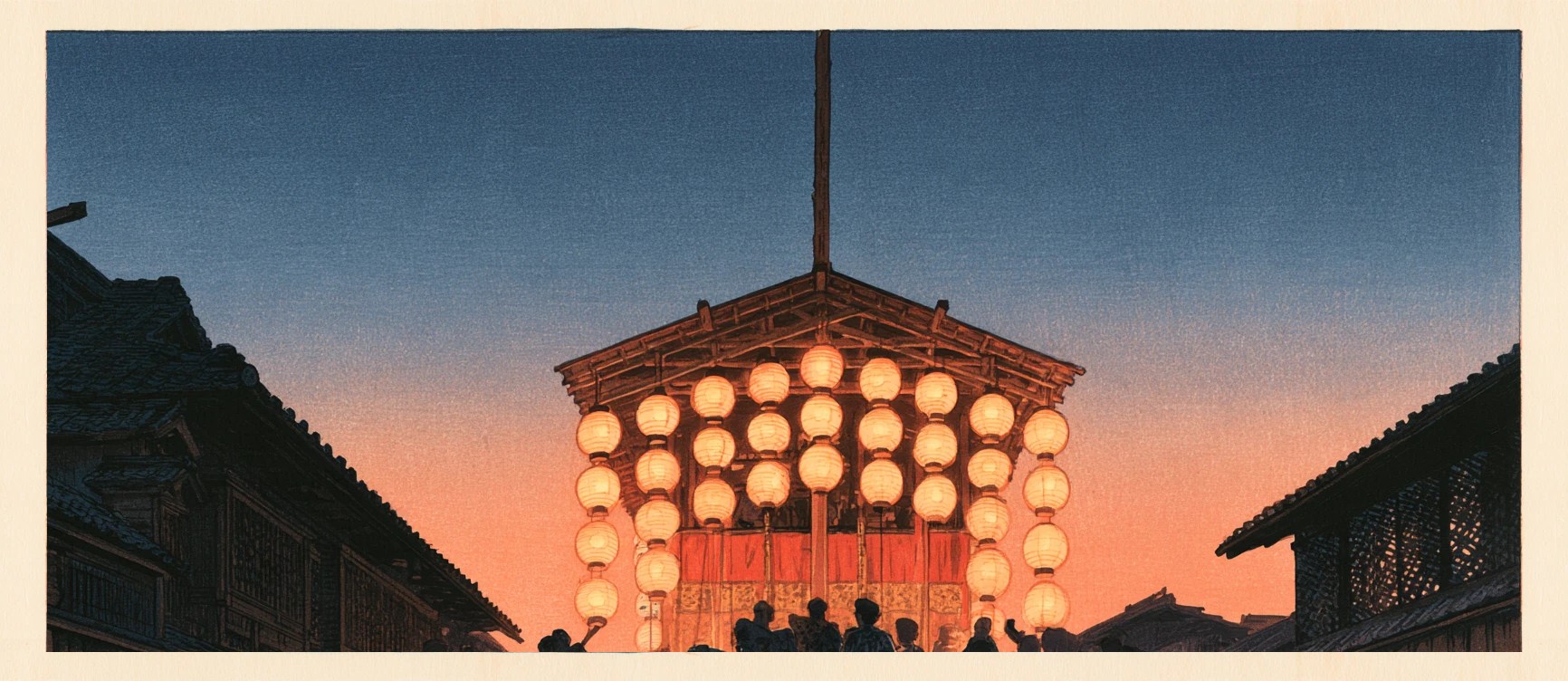
The three evenings before the procession are called yoiyama. At dusk the lanterns on the floats are lit, and kon-chiki-chin comes from the streets all around.
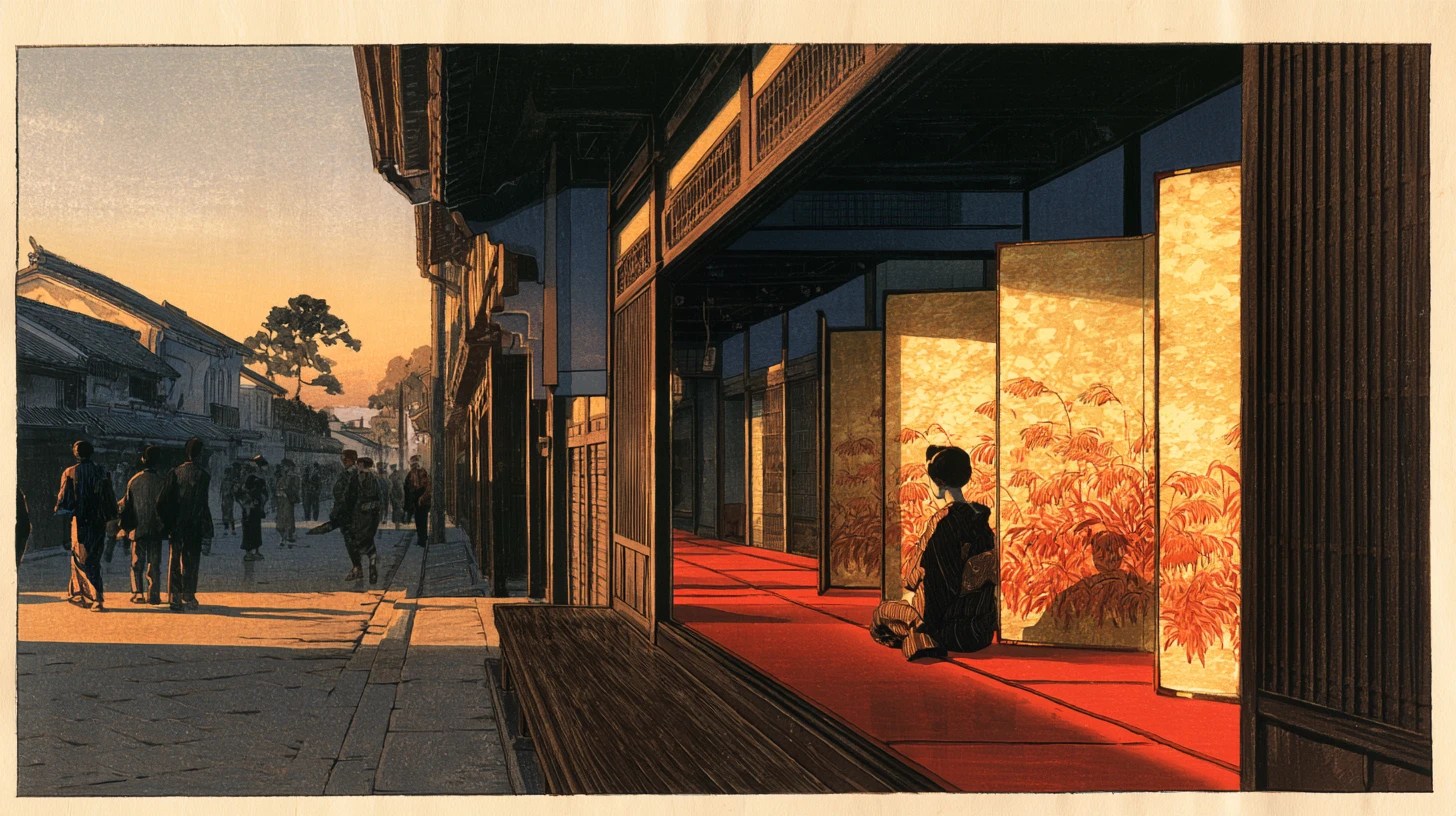
For those three days we take the lattice off the front of the house. The doors between the front room and the parlour at the back come out, and felt is spread over the floor. Ours is what people here call an eel’s bed, narrow and deep, so you can see a long way in. In the front room we stand our family’s screens, autumn grasses on gold, bought by my great-grandfather, so the story goes, with money he did not have. All evening strangers walk past and look straight into our home.
As a girl I had to sit in that room in my yukata, very straight, while people looked at the screens and then at me. I hated it and I loved it. “Tonight the house is the host,” my mother said, “and you are part of the house.” Outside, children sang the old songs as they sold charms at the meeting house.
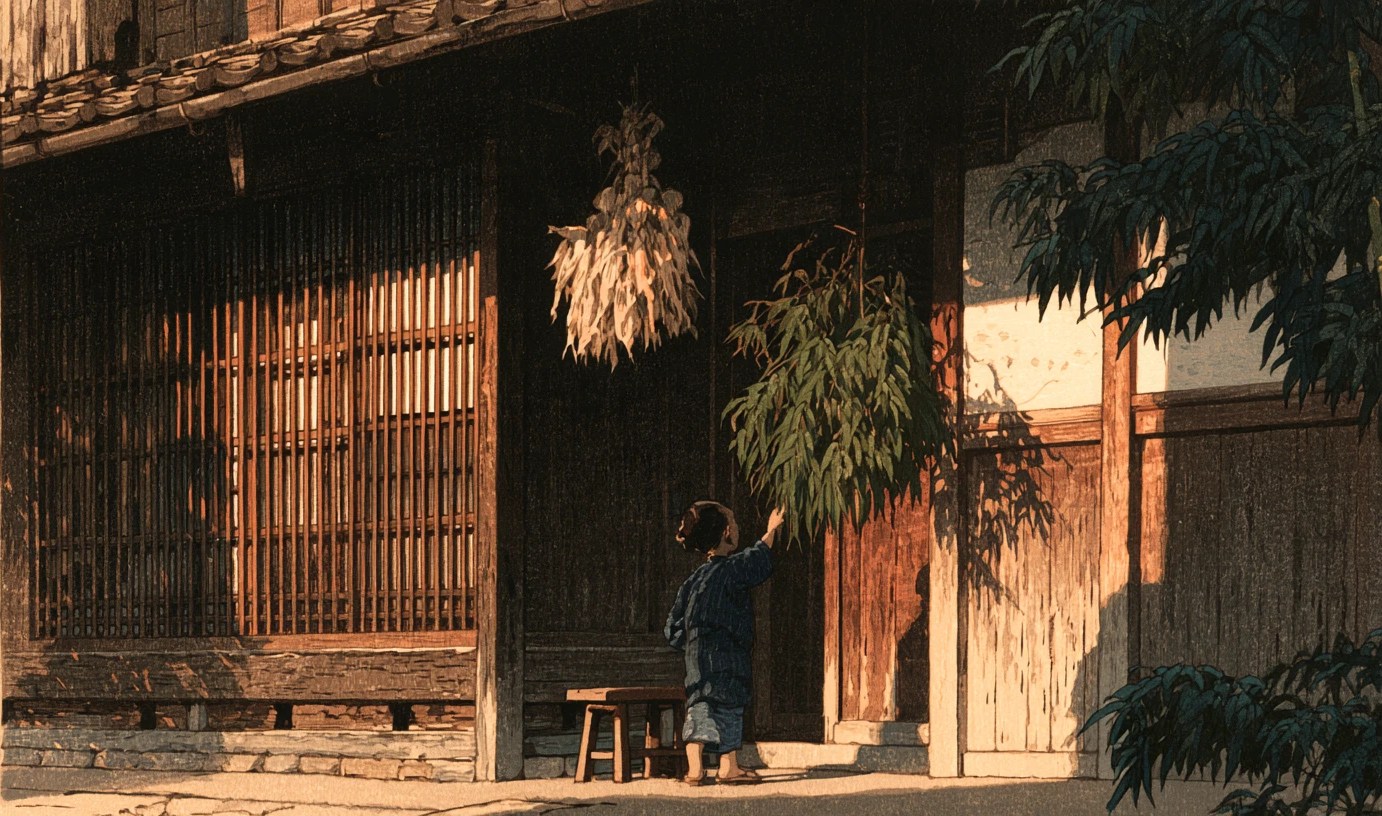
My mother bought a chimaki there every year. It is not food, whatever the name suggests. It is a charm against sickness and misfortune, made of bamboo leaves. She hung it under the eaves over the front door until the next July brought a new one; in Kyoto it is the custom to renew it every year. This summer my granddaughter stood on a stool to hang ours and asked if it worked. I told her I was still here.
Hamo, and the corners
The Gion Matsuri is also called the hamo festival. Hamo, pike conger, is full of troublesome little bones, and cutting them, honekiri, takes a practised hand; people say a Kyoto cook is not fully a cook until they have learned it. Few people make it at home. Once every July my father took us to a small restaurant to eat it grilled with a soy glaze, and none of us said a word. I have read that hamo took root in Kyoto because it is hardy enough to be brought here alive from far away. I think of my father, who was the same.
The first procession is on the seventeenth, the second on the twenty-fourth. By then the heat is something you wear; Japanese has a word for it, aburaderi, oil-shine. I have read that Kyoto, on average, has more days reaching thirty-five degrees than Osaka, which I find oddly satisfying.
I like to watch at a corner, where the great floats have to be turned. Those beside the wheels steer them with wedges, those at the front direct the pullers, and the whole tower, far taller than our house, swings round to face the new street. Every year I hold my breath, and every year the crowd breathes out at once.
As soon as the procession is over, the floats are taken apart, to send away the spirits of sickness they have drawn in. Then our street is only a street again, and I miss it more than I expect to.
The last day
On the last day of July, the festival closes at Eki-jinja, one of the shrines at Yasaka, where Somin Shorai is honoured. There is a ring of grass to walk through, and millet cakes are given out. Every year I step through the ring and out into August, and it feels like closing a door gently.
The chimaki stays over our door through the winter, going pale and dry. Its paper says, “We are the descendants of Somin Shorai.” In the old story, a travelling god asked two brothers for a place to stay. The rich one turned him away. The poor one, Somin Shorai, gave him a seat of millet husks, a meal of millet and a bed. The god promised that when sickness came, anyone who said they were Somin Shorai’s descendants and wore a ring of grass at the waist would be spared.
I did not understand that story as a child. I think I do now. Once a year we take the lattice off and let strangers look in, and a bundle of leaves over the door says we are the children of a man who once took a stranger in.
If you come to Kyoto in July, you will be a stranger on our street. I like the evenings best, when the lanterns are lit and the air feels, for a while, a little kinder. Walk slowly. Look in from the street. That, I think, is what the room is open for.
Places in this story
- Gion: Hanamikoji and Shirakawa — The town that grew up before the gate of Yasaka Shrine. Along Hanamikoji and the Shirakawa River, geiko and maiko still work in wooden teahouses. People live here; it is not a stage set.
- Yasaka Shrine — The shrine at the east end of Shijo-dori, called “Gion-san” in Kyoto. It holds the Gion Festival every July, and its main hall, which shares one roof with the worship hall, is a National Treasure.
Things to do in this area
Travel information, separate from the story: food and experiences in this area in the season of the story, from our guides. The people in the story are fictional and did not visit these places.
- Kyoto hamo dishes (Food, where: Central Kyoto) — Hamo is a type of eel served in Kyoto in dishes such as hamo otoshi and hamo shabu.
- Kyoto nishin soba (Food) — Kyoto nishin soba brings simmered dried herring to a bowl of buckwheat noodles with a light soy-sauce and kelp broth. The dish was devised at a shop by Shijo Ohashi Bridge. It is served next to the Minamiza theatre and at Kyoto Station.
- Saba-zushi (Food) — Salted, vinegared mackerel laid on a log of sushi rice. Japan’s farm ministry says it is said to have been born in the Edo period from mackerel salted in Wakasa Bay and carried to Kyoto along the Saba Kaido.
- Yuba (Food) — The thin skin that forms on soy milk as it is warmed, lifted off and eaten fresh or dried. Japan’s farm ministry says yuba came from China in the Kamakura period and was used in Buddhist vegetarian cooking.