Every fifteenth of May,
the Heian court goes by in my mirror.
A short story of May in Kyoto, told by a barber who has lived in the city all his life and whose shop window looks out on the route of the Aoi Matsuri.
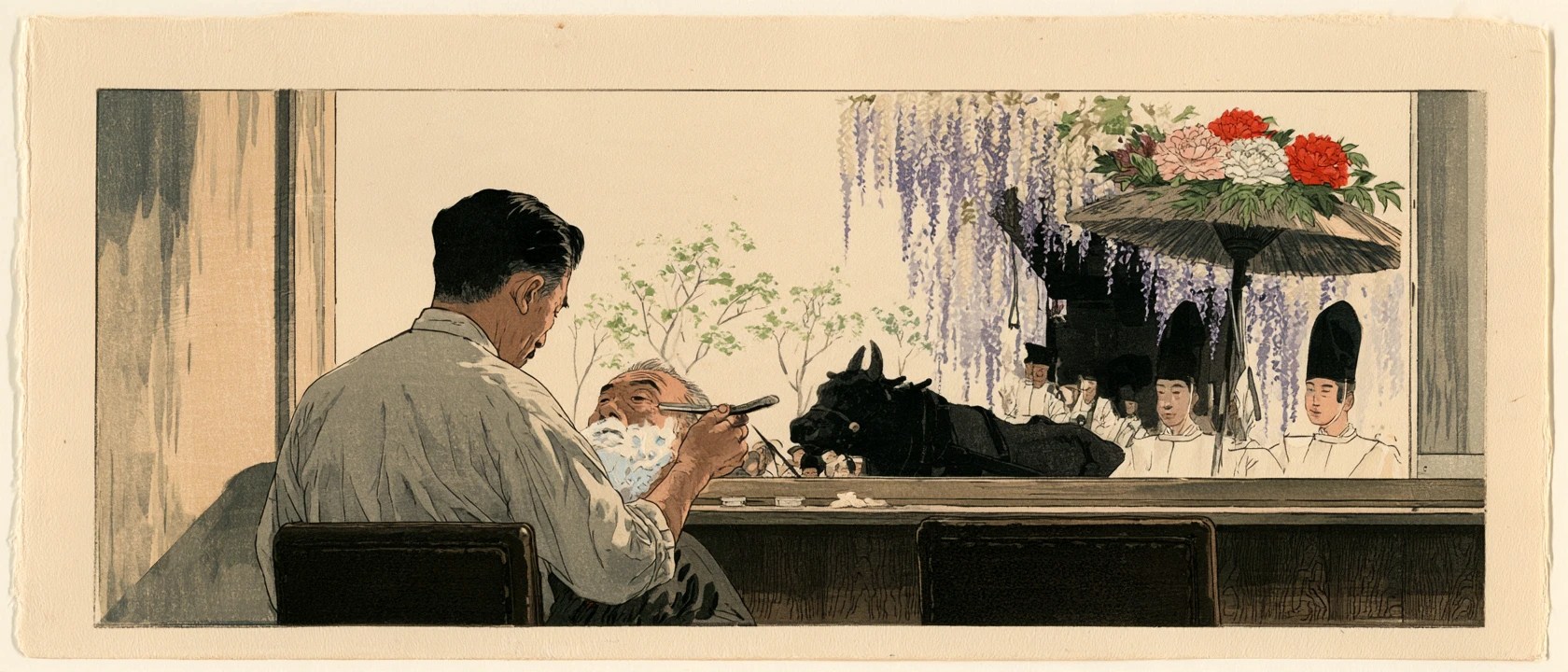
In the mirror
I have watched the Aoi Matsuri nearly every year of my working life, and nearly always backwards.
I am a barber. My shop has two chairs, a long mirror and, behind the chairs, a window onto one of the streets the procession takes. I was born four streets away and have never lived anywhere else. The old barber who taught me the trade had one rule above all the others: never turn your back on a customer while you have a blade in your hand. So on the fifteenth of May, when the Heian court goes by behind my customers, I watch it in the mirror, between one stroke of the razor and the next.
The Aoi Matsuri, properly the Kamo Matsuri, is the yearly festival of Kyoto’s two Kamo shrines, Shimogamo and Kamigamo. It is said to have begun about fifteen hundred years ago, and since the Meiji era it has been held on the fifteenth of May. On that day a procession sets out from the Imperial Palace with the emperor’s offerings, first to Shimogamo and then on to Kamigamo: more than five hundred people dressed as the court of the Heian period, with horses, oxen and carriages, about a kilometre from end to end, on a route of about eight kilometres through the city. It takes nearly an hour to pass. For that hour my mirror holds a picture scroll, with a customer in one corner of it.
Green on green
The name Aoi is said to come from the leaves. After the festival was revived in 1694, the story goes, everything in it came to be decorated with aoi, from the oxcarts and the dress of those who served in it down to the oxen and the horses. In my mirror I see the leaves on the carts and on the dress of those who serve: futaba aoi, the crest of both shrines, wound around small twigs of katsura.
The festival belongs to early summer, when the new leaves are out. For me it comes in the first week of the year that I prop my door open. The trees along our street are freshly green, the procession is green with leaves, and in the mirror it is green on green. My customers start asking for it shorter.
I know every part of the procession by heart, in the glass. The first part centres on a rider in black court robes on a decorated horse, who stands in for the emperor’s messenger. Chests of offerings go by on the shoulders of attendants, and great umbrellas with the flowers of the season on top, peonies among them, every one made, not grown. And there is the oxcart, the gissha, with wisteria at its eaves. The emperor’s messenger once rode in it. Now it goes along as decoration.
The second part centres on the Saiodai. In the Heian period an imperial princess served at the festival; now a woman of the city is chosen to stand in for her. She sits on a palanquin in the layered robes called the twelve layers, carried on the shoulders of her attendants, with court ladies and flowered umbrellas, and women on horseback.
All of it passes above my customer’s head and the heads of the people on the pavement. I always thought of it as floating.
No feet
My oldest customer is a retired schoolteacher from three doors down. For twenty years he has booked the first chair on the fifteenth of May. “The messenger should find me tidy,” he said the first time, and he sits very still while we watch the mirror together.
Some years ago, with his face half lathered, he asked me, “Have you ever actually seen it?”
“Every year,” I said. “More often than you.”
“In the mirror,” he said. “That doesn’t count. In your mirror it has no feet.”
I looked, razor raised. He was right. My mirror shows the street from the shoulders of the people on the pavement upwards. In thirty years I had never once seen a hoof, a step or the wheel of an oxcart. I must have seen the procession the right way round as a boy, but I remember none of it. The Aoi Matsuri I knew floated.
Rain on the fifteenth
If it rains on the fifteenth, the procession is put off until the sixteenth.
Then, one year, it rained. All day my mirror held nothing but ordinary umbrellas, a bus and the wet street. The schoolteacher came for his shave anyway, and frowned at the empty glass as though a pupil had not handed in his homework.
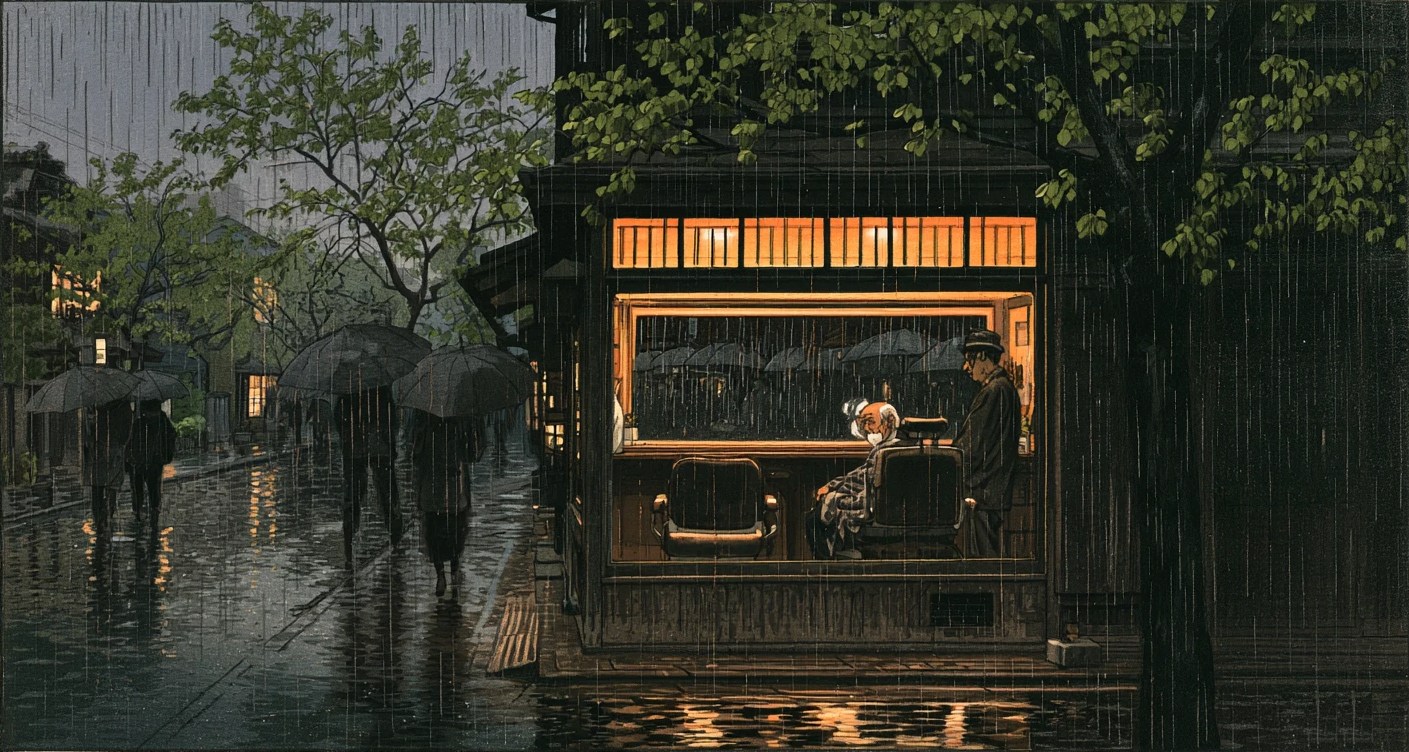
That year the sixteenth fell on the day my shop is closed. For the first time on a festival day, I had nothing in my hands. I went out, stood at the edge of the pavement in front of my own window, and turned my face to the street.
The right way round
It came from the wrong side. For a moment the whole thing looked strange to me, the way your own face looks strange in a photograph, because you only know it from the mirror.
Then I saw its feet. Hooves on the asphalt. Hundreds of feet, walking without hurry. Leaves even on a horse’s tail. And the gissha, its wisteria swaying, its wheels turning slowly, and from somewhere down there a squeak I knew. For thirty years I had heard it faintly through the glass and thought, every May, that I must oil the door.
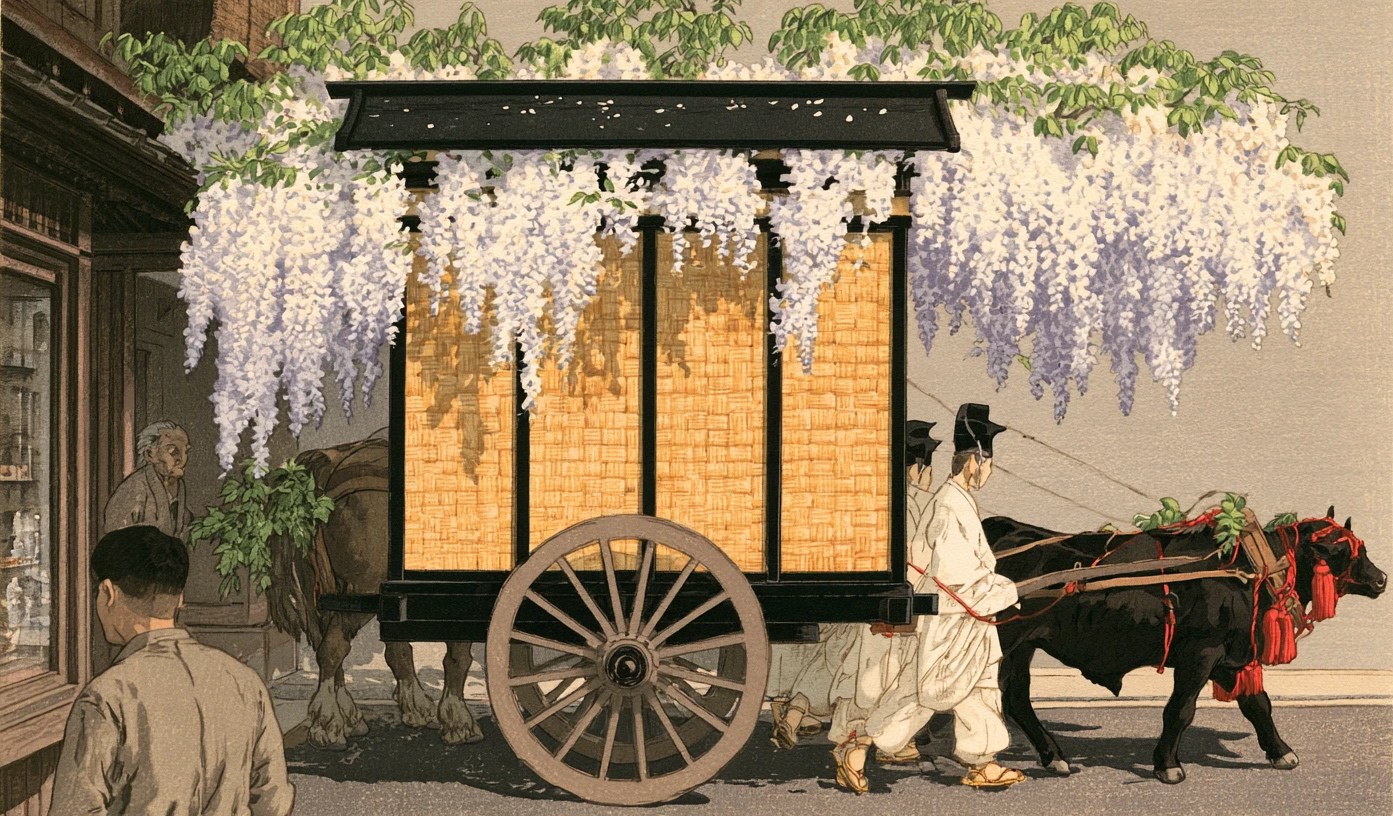
Three doors along, the schoolteacher stood on his own step. He raised his eyebrows at me.
“It has feet,” I said.
He nodded, like a teacher handed his homework at last.
The next year it did not rain, and I was back at the chair with a razor in my hand and the procession in the mirror, floating, as it always had. I have not changed my rule. But now, when the roof of the oxcart slides across the glass, I know what is going on below the edge of the mirror: the hooves, all those feet, the wheels going round and the squeak I used to blame on my door, crossing my city at the pace of an ox.
If you come to Kyoto in May, you will see it the right way round, feet and all, and I hope you do. On its way across the city it passes a great many ordinary windows. Behind one of them I will be watching it backwards, with a razor in my hand, perfectly happy.