In April,
the daylight is let in by hand.
A short story of April in Kotohira, told by a woman who has lived in the town all her life and goes to the old playhouse with the carpenter she married.
Older than all of us
The playhouse is older than anyone in Kotohira. On its hill, though, it is younger than me.
Kotohira is a town in the west of Kagawa, on the island of Shikoku. It grew up as the gateway town of Kotohira-gu, the shrine known as Konpira-san, which stands high on the slope of Mount Zozu, a mountain shaped like an elephant. In the Edo period, pilgrims came to Konpira from all over Japan, and in 1835 a permanent playhouse was built to entertain them. Its proper name is the Kyu Konpira Oshibai, but since around 1900 it has been known as the Kanamaru-za, and that is what we call it at home. The town calls it the oldest surviving playhouse in Japan.
Over the years it changed hands and names and became a cinema, and in the end it closed and began to fall apart. People in the town wanted it saved. In 1970 it was made a national Important Cultural Property, and when my husband and I were children, it was taken apart and put back together partway up Mount Atago, a hill in the town. That took four years. He says it is what made him a carpenter.
He did become one, and all his working life he built and mended houses here. He never worked on the playhouse. Nobody asked him, he says, and he would not have dared.
A thousand banners
Our first outing together was not in April at all. It was a June day in 1985, the day before the first Shikoku Konpira Kabuki.
The summer before, the old playhouse had been filmed for a television programme, and the kabuki actors who came wanted to perform on its stage. That June they did, for three days. On the day before, the actors rode through the town in rickshaws. The streets were full of banners, about a thousand of them, and of people who had come out to watch. Somewhere along the way he found me in the crowd, and we walked on together, not saying much.
We did not get in. The playhouse was full all three days. “Next time,” he said, as if he had arranged it.
Since then the kabuki has come in spring, in April or May, and it has become a sign of spring in Shikoku. For me it is the surest one. These days, on the day before the run opens, the actors parade through the town again, and townspeople and fans line the way. I still go out to watch, and he still finds me.
On the floor
It was years before we sat inside together. Now we go most springs, when the kabuki is held.
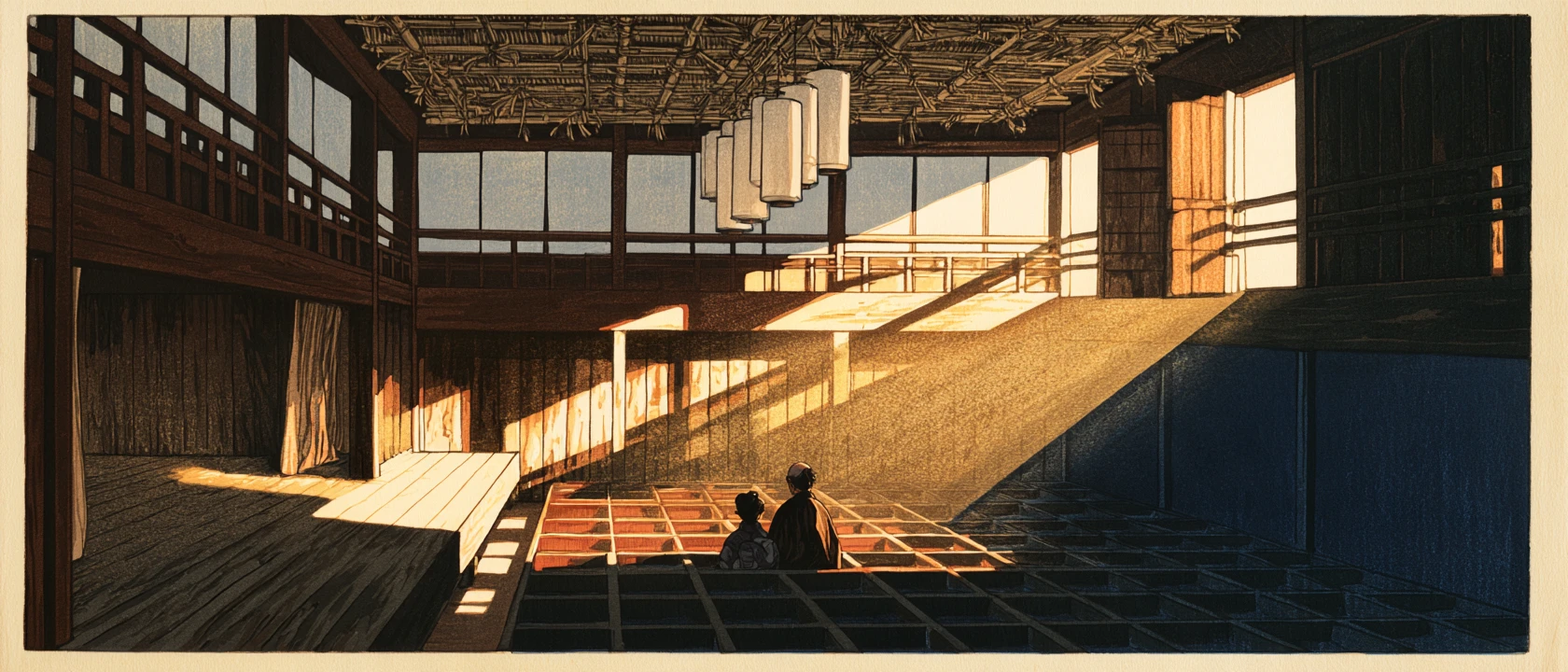
We sit on the floor, in one of the small square boxes that fill the middle of the hall. The floor slopes gently down towards the stage, so that the people behind can see. It is a small hall. The stage is close, and so is the hanamichi, the walkway that runs through the seats to the stage. Overhead hang great lanterns, each more than a metre tall and bearing an actor’s crest. When you come in, they are the first thing you notice.
What I watch, though, is the windows.
Behind and above the galleries along the sides of the hall are windows with paper shutters and wooden shutters. When the wooden ones are open, the daylight comes in through the paper, soft and even, like the light in an old house. During the play the windows are opened and closed by hand to change the light in the hall. Somewhere along the galleries, someone is deciding how bright our world should be. I have never once seen who it is. I only see the hall brighten or dim, as though a cloud had passed, except that clouds never keep such good time.
Under the floor
My husband watches the stage floor.
He cannot see under it, of course, but he knows what is there the way other men know baseball scores. The revolving stage is 7.3 metres across. In the space below it there are four poles and thirty-six stone footholds set in an earth floor. To turn the stage, people push the poles and step from one stone to the next. A lift in the stage floor works by hand as well.
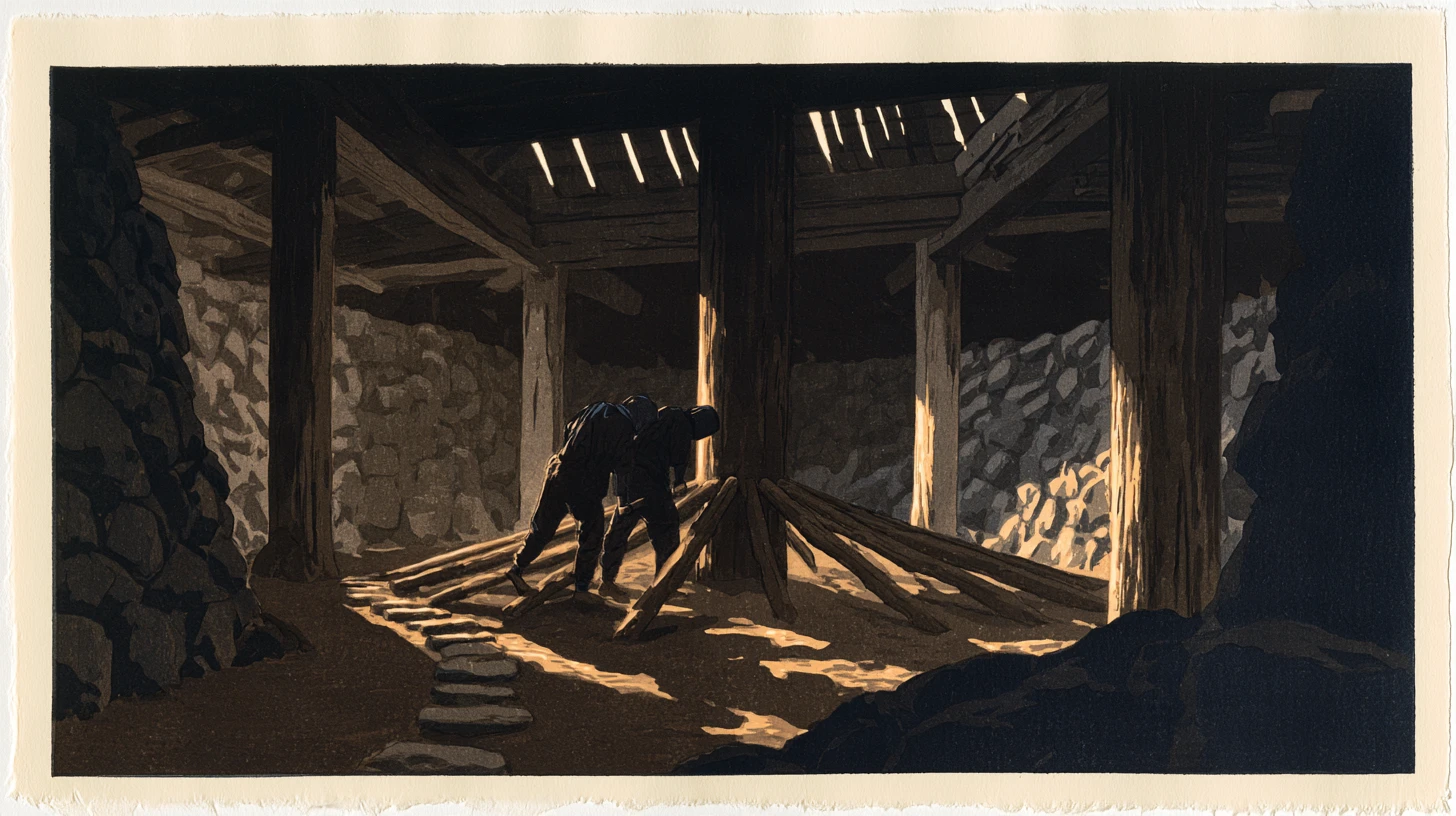
When the stage begins to turn, I watch the scenery go round. He watches the rim of the circle, where the turning boards meet the still ones. “Four poles,” he says afterwards, every time. “Thirty-six stones.” He says it the way some people say grace.
He approves of the ceiling, too. Over the seats is a grid of bamboo, about five hundred lengths of Kagawa bamboo tied with rough rope. When the playhouse was repaired about twenty years ago, traces of it were found on the great beam above the seats, where the lanterns had hung, and it was put back. Paper snow and paper cherry petals can be let fall from it onto the audience. One spring a few petals came down on us, and one rode in his hair all the way down the hill. I did not tell him.
When the shutters close
Some plays call for darkness. Then the wooden shutters are closed by hand, all at once, and the whole hall goes dark.
It is a deep, old-fashioned dark. For a moment nobody moves. A hall full of people sits perfectly still together, and I like to think that somewhere under the stage, someone has both hands on a pole, waiting. In that dark, his hand always finds mine. He says it is because he knows where everything is in a wooden building. I think he simply always knows where I am.
Then the light comes back. It is let in again, through paper, by someone’s hands.
Afterwards we walk down into the town. In spring the cherry trees flower in Kotohira Park, beside the way up to the shrine, where 785 stone steps climb to the main shrine. We never climb them on a kabuki day. Our knees have done enough sitting.
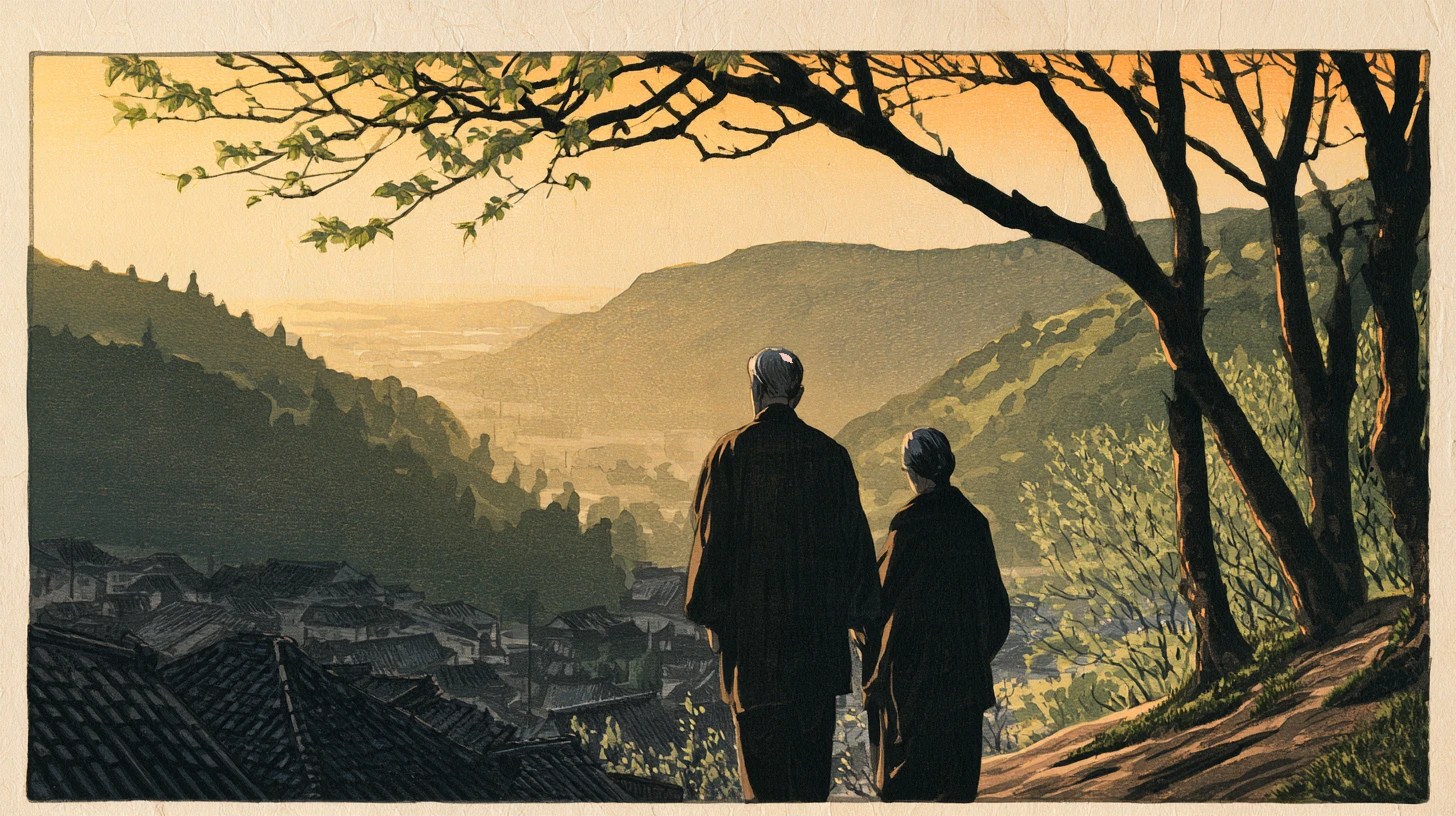
If you come to Kotohira in April and find yourself on that old floor, I hope you will look up at the windows when the light changes. And once, if you think of it, I hope you will look down at the boards of the stage. When it turns, someone under there is turning it for you, one stone at a time.