The crab comes,
and so does she.
A short story of winter in Kinosaki, told by a woman who has walked to the public bath nearly every evening of her life.
A house without a bath
Our house has never had a bath.
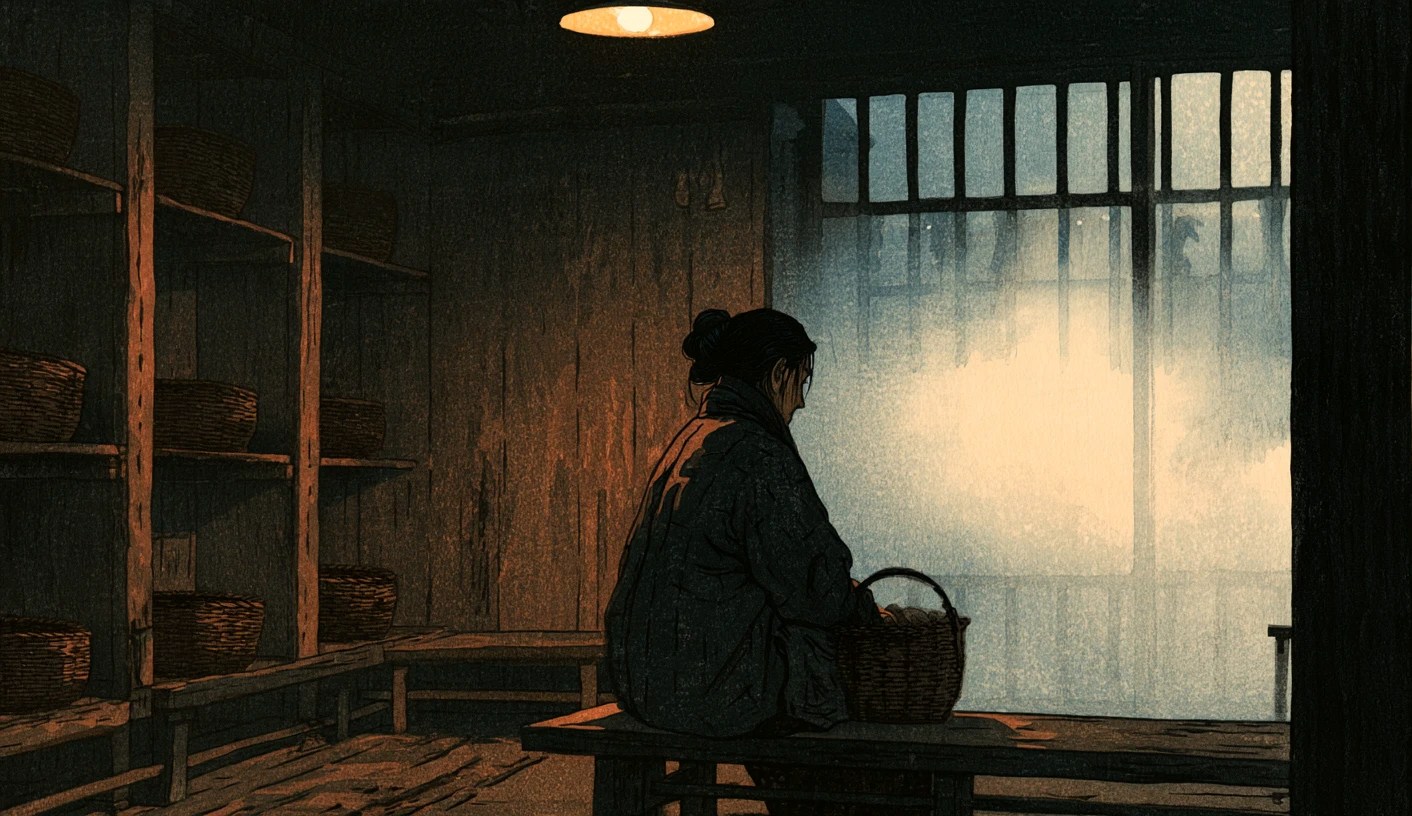
Long ago, before there was plumbing, houses in Kinosaki did not have baths of their own. People walked a few steps to the hot springs instead, and many who live here still go to a favourite bathhouse in the evening. Some houses, like ours, still have no tub at all. So on nearly every evening of my life, I have picked up my basket, with soap, shampoo and a small towel in it, and walked to the bath.
Most evenings I go to Jizo-yu. In the Edo period it was called the villagers’ bath, because so many people from the village bathed there. Its name comes from an image of Jizo said to have come out of its spring. I was born three streets away, so I suppose I am one of the villagers.
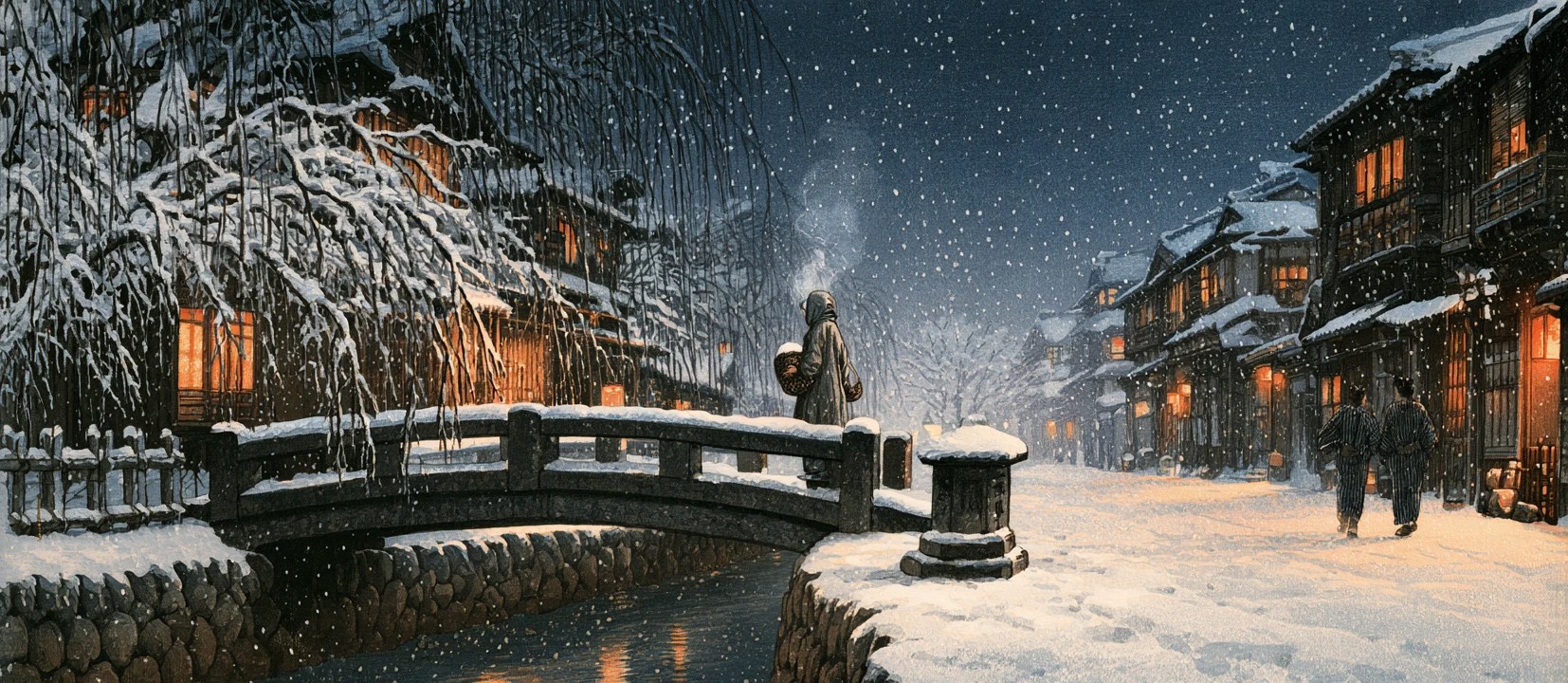
Here, the whole town is thought of as one big inn. The station is the front door, the streets are the corridors, the inns are the rooms and the hot springs are the baths. Under the willows along the river and over the arched stone bridges, visitors go from bath to bath in the yukata and geta their inns provide. I have spent my whole life, then, in the corridors of an inn. A woman I met in the bath told me that once, and laughed when she said it.
The smell of crab
For me, the crab season begins with the wind. When the strong winter winds start blowing in off the Sea of Japan, a few kilometres north of us, I know the crab is coming. The season opens every year on the sixth of November, and from then until March, the whole town smells of crab.
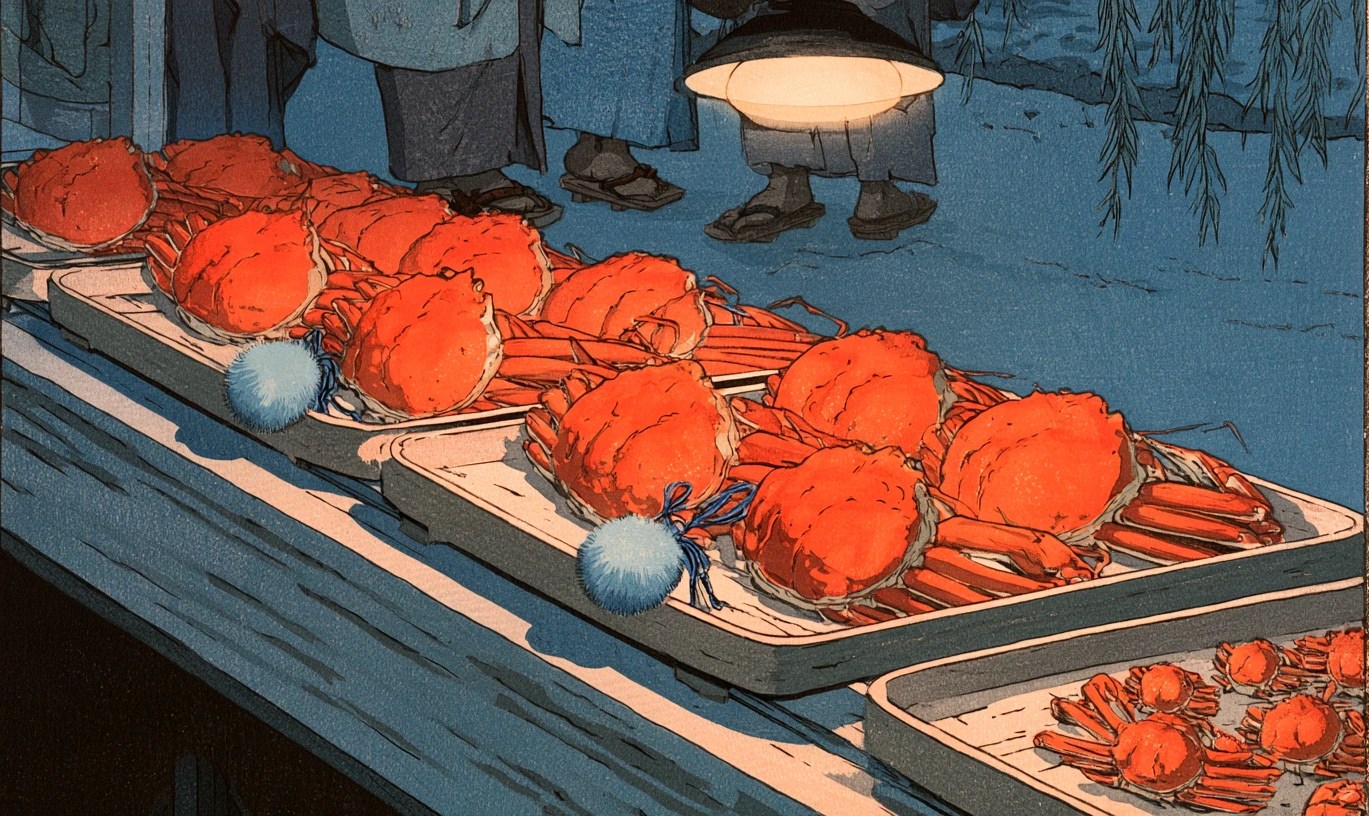
The fish shops set out their crabs in rows, and outside many of the gift shops there are crab buns for people walking by. The big male crab is Matsuba crab. The ones landed at Tsuiyama, a fishing port nearby, are called Tsuiyama crab and wear a blue tag.
In the evenings, our corridor comes to life. After dark there are more people in yukata than out of them, and in winter they wear coats on top. Geta clatter past our door. I walk to the bath among them in my old coat with my basket on my arm, like a guest who forgot to change.
In our house, crab has always meant Seko crab, the female. She is much smaller than the male, but she carries, on average, about a hundred thousand eggs. She is only caught in November and December, because the fishers have agreed to stop by the end of the year. So for us, she is the taste of the year ending.
“You’ve got a basket”
Twenty winters ago, on an evening in early December, a woman in the bath leaned towards me and said, quietly, “You live here, don’t you? You’ve got a basket.”
She was right. You can usually tell those of us who live here by our baskets; visitors mostly bring the small towel their inn gives them. She had come from a city for the crab, and that night, after her bath, she was having Seko crab. “The little one first,” she said. “Tomorrow, the big one.”
She asked me what it was like to live in an inn. I said I had never thought about it. “So you live in the corridor,” she said, and laughed.
The next December she was there again, in the same week, at the same hour, and the December after that. She would fold her towel on her head and tell me, quietly, what she was going to eat that night. I would tell her my year: when the snow had come, how the willows were, who in town had a new baby. A whole year, told in the time it takes to get warm through. When we began to feel too hot, we got out and cooled down, and said, “Next year, then.”
We never asked each other’s names. In the bath, nobody needs one. And there are no photographs of us. Nobody is allowed to take pictures in the bath.
The winter she did not come
Then, two winters ago, she did not come.
I went at the same hour every evening that week, and the week after. I stayed in the changing room longer than I needed to. Walking home, I passed visitors going the other way in coats over their yukata, and I realised that I did not know her name, or her city, or which inn she stayed at. I had nothing of her at all.
Here the snow usually starts some time in December, though nobody can say exactly when. That year it came while I was still looking for her. I walked home under willows white with snow and over the bridges, and my wet hair steamed under my hood.
When December ended, and the Seko crab with it, I stopped looking. I told myself that lives change, and that a friendship in the bath is not meant to last. I did not believe it.
Names
Last December, in the same week, I stepped into the bath, and there she was in the steam, her towel folded on her head.
“My knee,” she said. “And you?”
“Where else would I be?” I said. “I haven’t got a bath.”
That night she told me that all these years she had come in the same week so that she would find me. All that time, I thought I was only having my bath. It turns out I was part of someone’s winter.
Then, for the first time, we told each other our names. I am not going to tell you hers.
This year the crab season has opened again, and I find I am counting the weeks to December.
If you come to Kinosaki in winter, I hope you will walk the corridors in your yukata and a warm coat, smell the crab, and get warm through in the water. Somewhere in the steam there may be a woman with a basket, only having her bath. I hope you will say good evening, quietly. That is how one of my winters began, and all of them since.