All summer, one word
would not go into English.
A short story of summer in Kibune, told by a sixteen-year-old who has lived all his life in the valley north of Kyoto and spent his summer holidays trying to put one Japanese word into English.
One word
Before the summer holidays, our English teacher asked each of us to choose one word: a Japanese word with no good English for it, to be explained over the holidays, in English, to someone who had never been to Japan.
I chose suzushii. I thought I had picked the easiest word in the class.
I live in Kibune, a small village in the mountains in the north of Kyoto, beside the Kibune River. In summer, people come up from the city to keep cool beside its clear water. The city’s tourism association calls Kibune Kyoto’s oku-zashiki, its inner room: the quiet room at the back of a house. My parents both work down in the city, and on summer evenings, when they come in at the gate, the first thing either of them says is “Suzushii.”
I had heard that word all my life. All I had to do was put it into English.
Cool, chilly, fresh
The dictionary said cool. But cool is also what you call a jacket. Chilly has a complaint in it. Fresh is for bread, and for the air on a winter morning. To me, suzushii is cool air that you are glad of. I have never heard it said in January. I only ever say it after I have been hot.
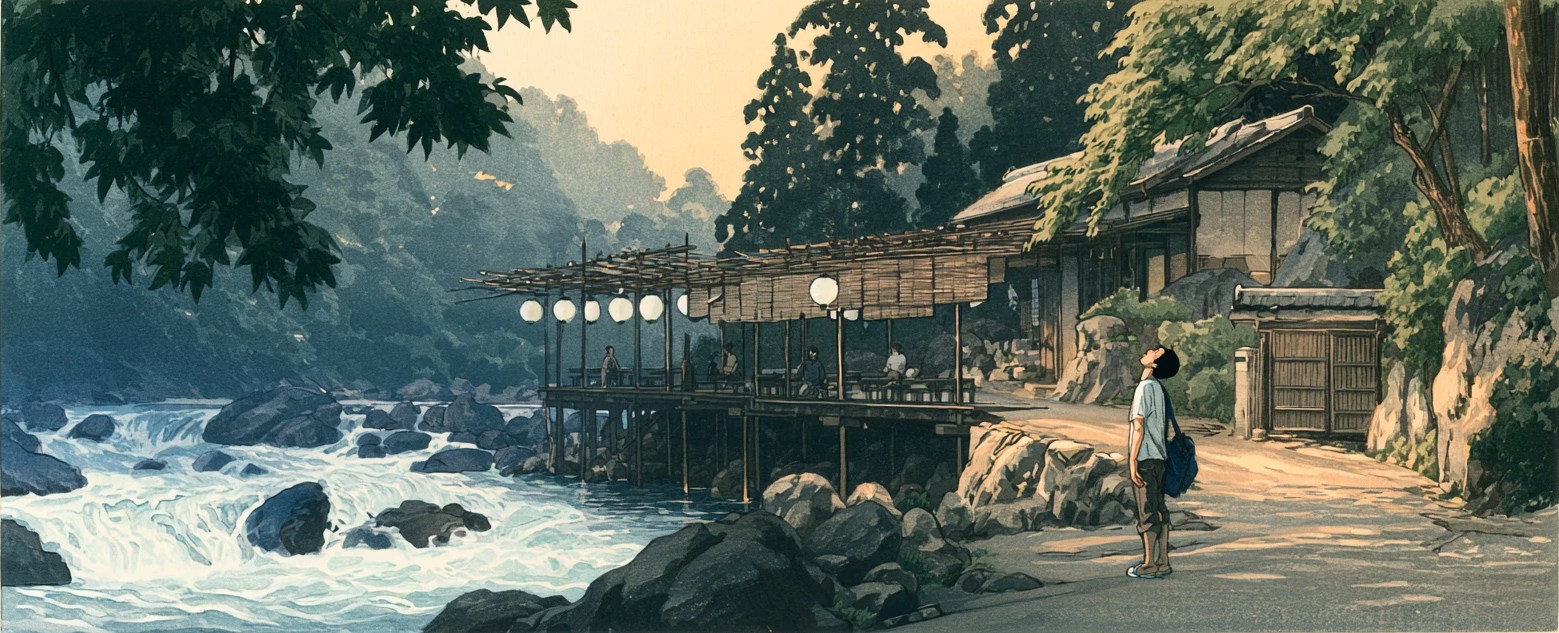
Every summer, usually from May to the end of September, the restaurants along the river put platforms out over the stream, called kawadoko, and serve meals on them. From our kitchen window I can see the edge of one across the road, with the water running under it. In the evenings, the voices of people eating come up over the sound of the river. They are sitting in the cool breeze off the water. That is what they have come up for.
I went looking for better words. The tourism association’s page says that the air in Kibune is fresher and cooler than in the city, but in Japanese the word it uses for cooler is suzushii, so that was no help. The prefecture’s plan for the Kamo River says that up in the mountains it is cooler and rainier than down on the plain. I copied it all into my notebook. It was all true, and all about the weather, and suzushii is not only about the weather.
Water beside Kyoto
Suzushii is written with the character 涼. I had written it a hundred times without looking at it. On its right is 京, the first character of Kyoto’s name. On its left are three short strokes, the same as on the left of 海, sea, and 池, pond. I have always thought of them as water. Water, beside Kyoto. I do not know why, and it probably has nothing to do with our city. But I sat and looked at it for a long time.
That evening I walked up to Kifune Shrine, which says its name with an f rather than a b. Its stone steps are lined with red lanterns, and they are lit every evening. The shrine enshrines the god of water and is the head shrine of about two thousand shrines to the water god across Japan. It says that its god calls up the clouds, brings the rain and calls out the sun, keeps the rain that has fallen in the ground, and lets it out again little by little, in the right amount. In front of the main shrine, spring water from the mountain wells out of the stone wall. If you float one of the shrine’s blank fortune slips on it, words appear. I floated one. Words came up, but none of them was the one I needed.
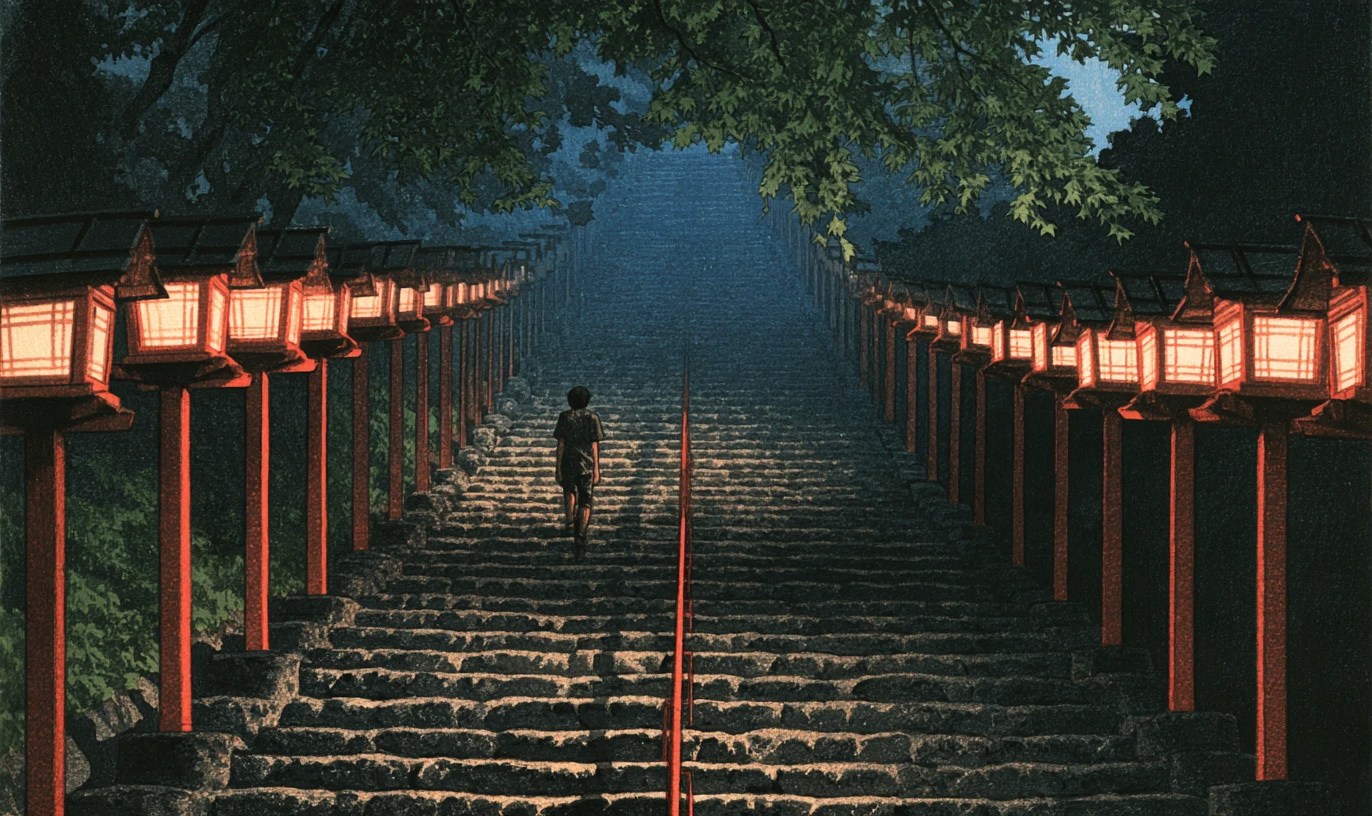
Every year on 7 July, the shrine holds a water festival, to thank the god for water and to pray for good weather and the right amount of water for the year. I wrote in my notebook that suzushii must be what the right amount feels like. Then I crossed it out.
Atsui
In August I went down to the city to look for a bigger dictionary. I took the bus to Kibuneguchi and the train to Demachiyanagi. Kyoto lies in a basin, with mountains on three sides, and its summers are hot and humid. In August, the normal daily high in the city is 33.7°C. I did not hear anyone down there say suzushii. I heard atsui, hot, all day.
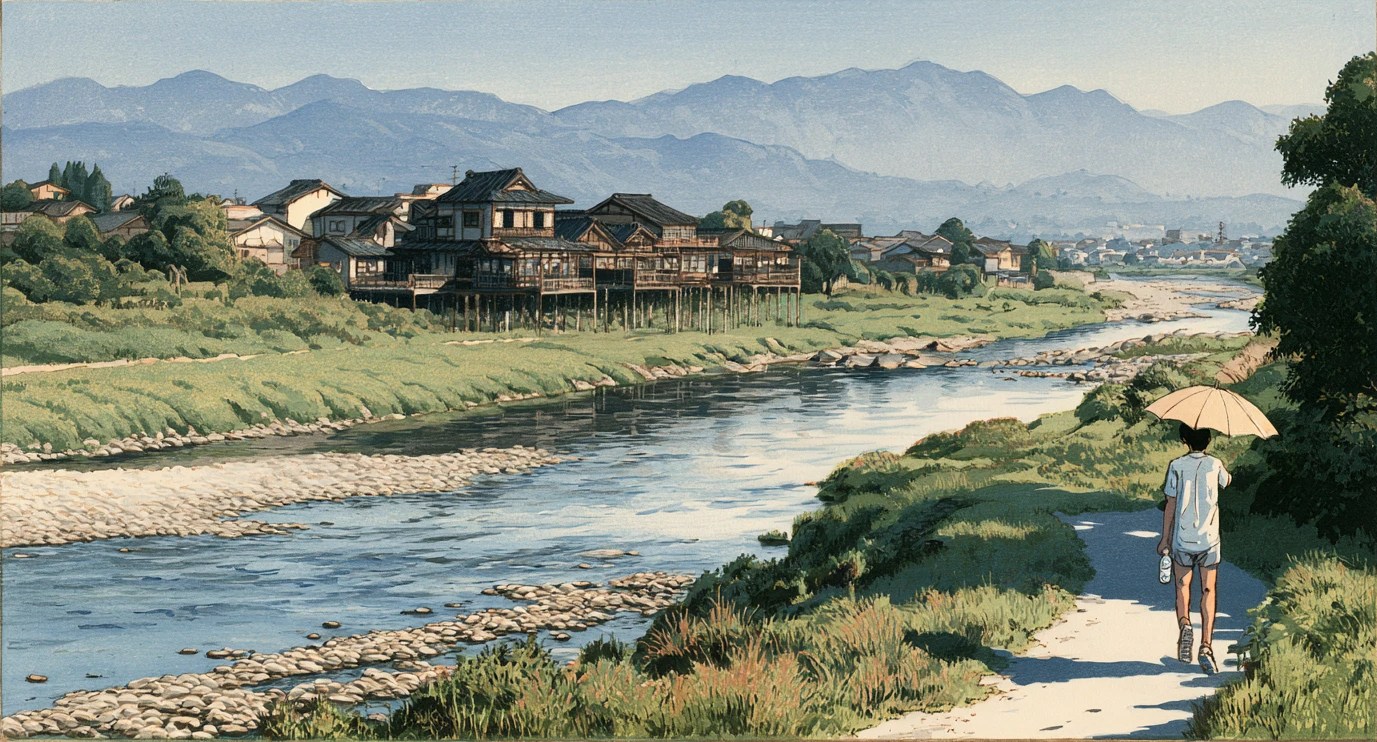
I walked beside the Kamo River with a bottle of water and my mother’s parasol, which I would never carry at home. In the middle of the city, restaurants put out their own platforms beside the river in summer; there, they are called noryo yuka, a name with 涼 in it too. The shrine says that Mount Kibune, our mountain, is part of where the Kamo River begins, and the prefecture’s plan names the Kibune River among the streams of its upper reaches. So some of the water going past those platforms had come down past our kitchen.
In one of the shrine’s old stories, a goddess, Tamayori-hime, came the other way. She came in a yellow boat from what is now Osaka Bay, up the Yodo, the Kamo and the Kibune rivers, to the source of the water, where the inner shrine, Okumiya, stands now. She came up, like the people in summer. The water goes down. That day, so did I.
The dictionary in the bookshop was twice as heavy as mine. It said cool.
Ahh
It was evening when I got home. I got off the bus and walked to our gate. The air off the river touched the back of my neck, the water was loud below the road, and up the valley the lanterns on the shrine steps would be coming on. I heard myself say it. Not suzushii. Just “Ahh.”
That was the translation. Not a word at all, but a sound: the one you make when you put something heavy down.
Once I knew what to listen for, I heard it all summer, from people walking past our gate, in Japanese and in languages I did not know. It was always the same sound.
I wrote my essay about our gate, the air off the river and the lanterns on the steps, and at the end I wrote that suzushii cannot be translated, only said. Our teacher gave it back with one line in red pen: “Now I want to go and say it.”
So this is for anyone who has never been here. If you come up from the hot city on a summer day, I think you will say it too, when the air off the river first reaches you. It will come out in your own language, and it will sound just like ours.
Places in this story
- Kibune — A mountain valley in northern Kyoto, along the Kibune River. Kifune Shrine honours the god of water, and from May to September restaurants serve meals on platforms over the river.