My river has travelled
further than I have.
A short story of February in Kawazu, told by a woman who has walked to work beside its cherry-lined river for more than twenty years.
Weeks ahead
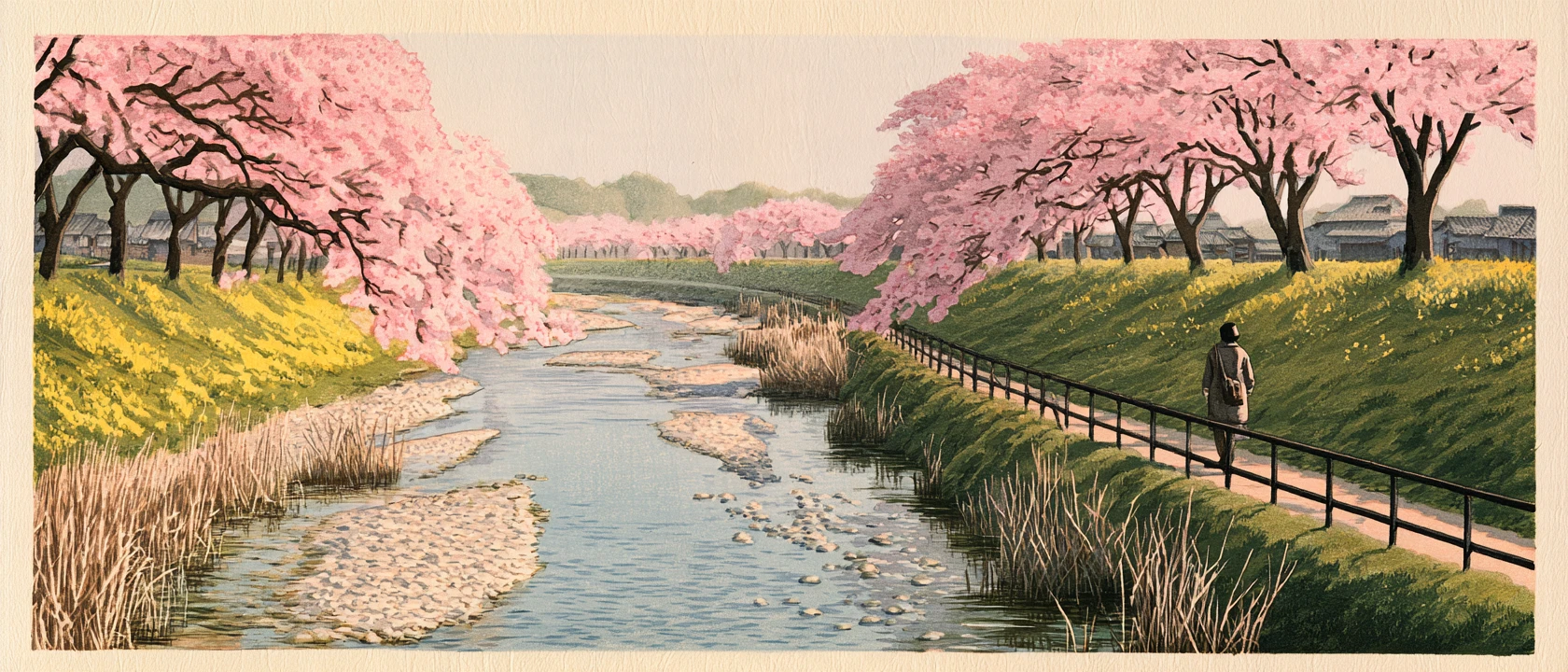
In February, when most of Japan is still waiting for spring, the river I walk beside every morning turns pink.
Kawazu is a hot-spring town on the Izu Peninsula, where the winters are mild. The cherries here are Kawazu-zakura, an early-flowering kind. They usually begin to open in early February, and full bloom comes about a month later. In Tokyo, the usual day for the cherries to open is not until late March.
About 850 of these trees grow along the Kawazu River, and about 8,000 in the whole town. Along the river they make a line about four kilometres long, from near its mouth upstream to Mine Onsen, one of the town’s hot-spring areas. Their petals are large and pink, and in places the ground beneath them is yellow with rape blossom. Pink above, yellow below, and the river running between.
I was born in Kawazu and have never lived anywhere else. For twenty-two years I have worked in a small shop near the station, and I walk there along the river path. All year, I help customers at the shop counter. In February, people I have never met ask me to help them with something else.
“Could you take one?”
During the cherry festival, stalls line the river, and visitors come from all over Japan and from abroad. Some sit at the foot bath in the park by the river, warming their feet. Sooner or later, one of them holds out a camera to me.
The first time, I was thirteen. A couple asked me, and I was so nervous that I cut off the tops of their heads. I have been asked every February since. First it was film cameras, then small digital ones, and now it is phones. I must have taken thousands of pictures of strangers.
Over the years I have learned a few things. I crouch down, so that the branches fill the top of the picture and the sky shows through the flowers. I wait for the wind to drop. And whenever I can, I put a little of the river in, low in one corner.
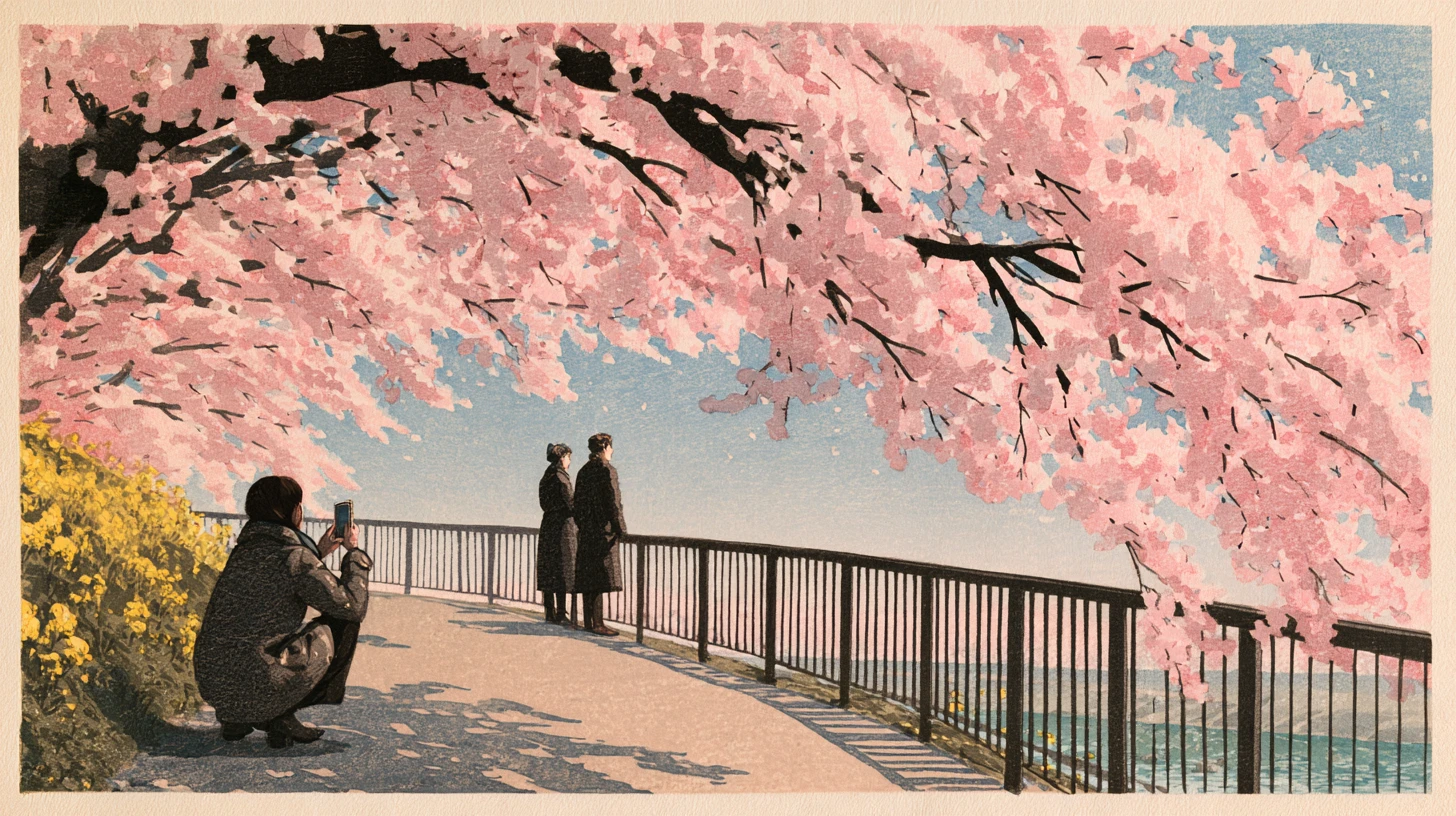
I have two rules of my own. I never step off the path for a better angle, and I never pull a branch down into the picture. A volunteer group takes the lead in caring for these trees. The least I can do is leave them be.
One young tree
Everyone who hands me a camera is photographing something that began with one young tree.
In about 1955, it was found by chance in our town, and a man named Iida Katsumi, in Tanaka, one of its districts, planted it in his garden. It flowered for the first time in 1966. Others grew more trees from it. When it was studied, it turned out to be a new kind, and in 1974 it was named Kawazu-zakura, after the town where the first tree grows. The next year, it became the town’s tree. That first tree still stands in the same garden.
Around 1975, the tourism association and other local people took the lead in planting about 200 of the trees near the river mouth and the station. So those trees went in about ten years before I was born. When I was small, they were young too.
The first Kawazu Sakura Festival was held in February 1991. In 1999, it drew more than a million visitors. That was the year of the couple without the tops of their heads.
Three seconds
When I have taken the picture, I hand the camera back, and the stranger looks at the screen. For about three seconds, I see it too. Then it goes away with them, and I never see it again. I have seen thousands of pictures of my own river, each one for about three seconds.
During the festival, the trees are lit after dark, and the lights and the blossom shine in the water. One evening last February, on my way home, a young woman with a rucksack held out her phone. I crouched, waited for the wind, and got her under the lit branches, with their reflection in the river below.
She looked at the screen for much longer than three seconds. Then she turned it round to show me.
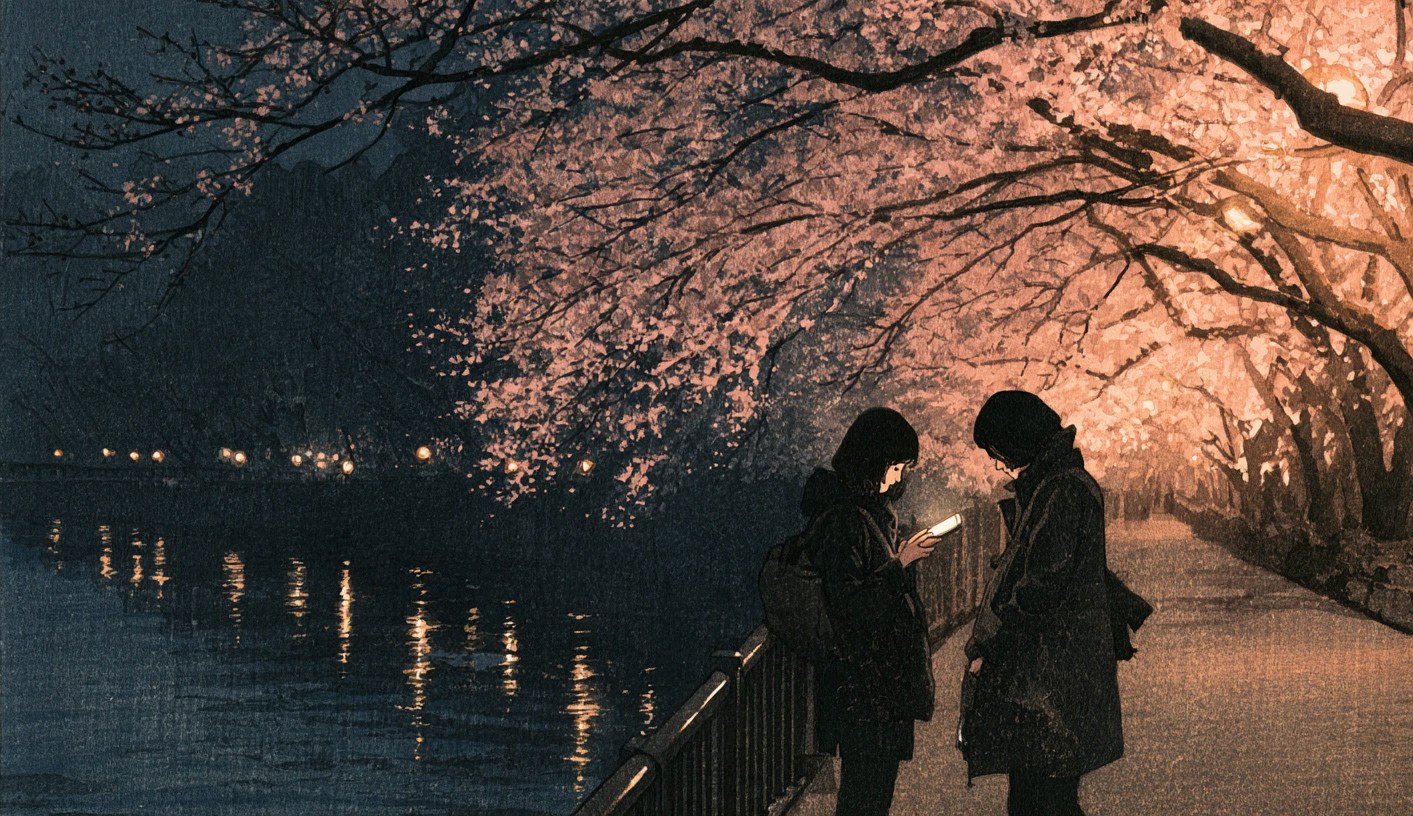
“You put the river in,” she said in English, slowly. “All day, people have cut it off.”
My English is mostly for the shop counter, but I found enough. “Without the river, it could be anywhere,” I said. “So I put it in.”
She nodded as if that made perfect sense, thanked me, and walked on under the lights. I stood there longer than I needed to. In all those years, nobody had noticed.
The green that follows
Full bloom lasts only about a week to ten days. Then petals drift down onto the water, and the leaves come out after the flowers. The stalls go, and soon I walk to work under green.
People sometimes ask whether I mind that I have hardly been anywhere. I used to wonder about it myself.
Now I think of all those pictures. On phones and on walls in places I will never see, there is a little of the Kawazu River, low in one corner, under the pink. My river has travelled much further than I have. I was the one who sent it.
If you come to Kawazu in February and hand your phone to a stranger on the river path, I hope she crouches down for you. And later, far away, when you look at the picture again, I hope you find the river in the corner, and know that someone meant it to be there.
Things to do in this area
Travel information, separate from the story: food and experiences in this area in the season of the story, from our guides. The people in the story are fictional and did not visit these places.
- Oden (Food, where: Shizuoka City) — Egg, daikon, konnyaku and fish cakes can all go into oden. The Shizuoka version simmers black hanpen fish cakes and beef tendon on skewers in a dark broth and dresses them with green laver and fish powder.
- Fujinomiya yakisoba (Food, where: Mt Fuji’s southern side and Mishima) — Fujinomiya cooks fry locally made steamed noodles with cabbage and rendered pork pieces, then add powdered sardine shavings. The Antenna Shop in Omiya Yokocho, south of Fujisan Hongu Sengen Taisha, serves regular and large portions.
- Lake Hamana Unagi (Food, where: Western Shizuoka) — Lake Hamana unagi is Japanese eel raised in Hamamatsu and Kosai. Maruhama, the eel cooperative’s restaurant near Hamamatsu Station’s south exit, serves glazed kabayaki and shirayaki grilled without that sauce.
- Shizuoka kuro hanpen (Food, where: Shizuoka City) — This half-moon fish cake comes from Yaizu. The skin and bones are ground into the paste, giving it a grey colour. Look for it on a skewer in Shizuoka oden or coated in crumbs and fried.