Watch my side,
and I’ll watch yours.
A short story of August on the Kanmon Strait, told by a man from Moji who has looked across the water at Shimonoseki all his life.
The other side
Shimonoseki is close enough to see from the terrace behind our house in Moji: not just its shape, but its buildings, its cars and its lights coming on in the evening. I have looked across at it every morning of my thirty-one years. For most of them, it was simply the other side.
Between us is the Kanmon Strait, a waterway 27.7 kilometres long that separates Kyushu, where I live, from Honshu, Japan’s main island. Moji is part of the city of Kitakyushu, in Fukuoka Prefecture, and Shimonoseki is a city in Yamaguchi. At Hayatomo, its narrowest point, the strait is less than a kilometre across. On a busy day as many as a thousand ships pass through, some of them huge cargo ships bound for America.
For nine years I have worked in an office by the port, doing the paperwork for ships that call here: where they have come from, when they arrive, who is on board. My days are full of ships’ names.
This spring, at a friend’s wedding, I met Mio, who has lived all her life on the other side. When people ask whether it is hard, going out with someone from another prefecture, I tell them it is less than a kilometre at the narrowest. Mio says it depends which way the water is going.
Water that changes its mind
She has a point. The current in the strait is fast, and it changes direction every six hours: east, then west, then east again. It happens because the seas at the two ends of the strait rise and fall by different amounts.
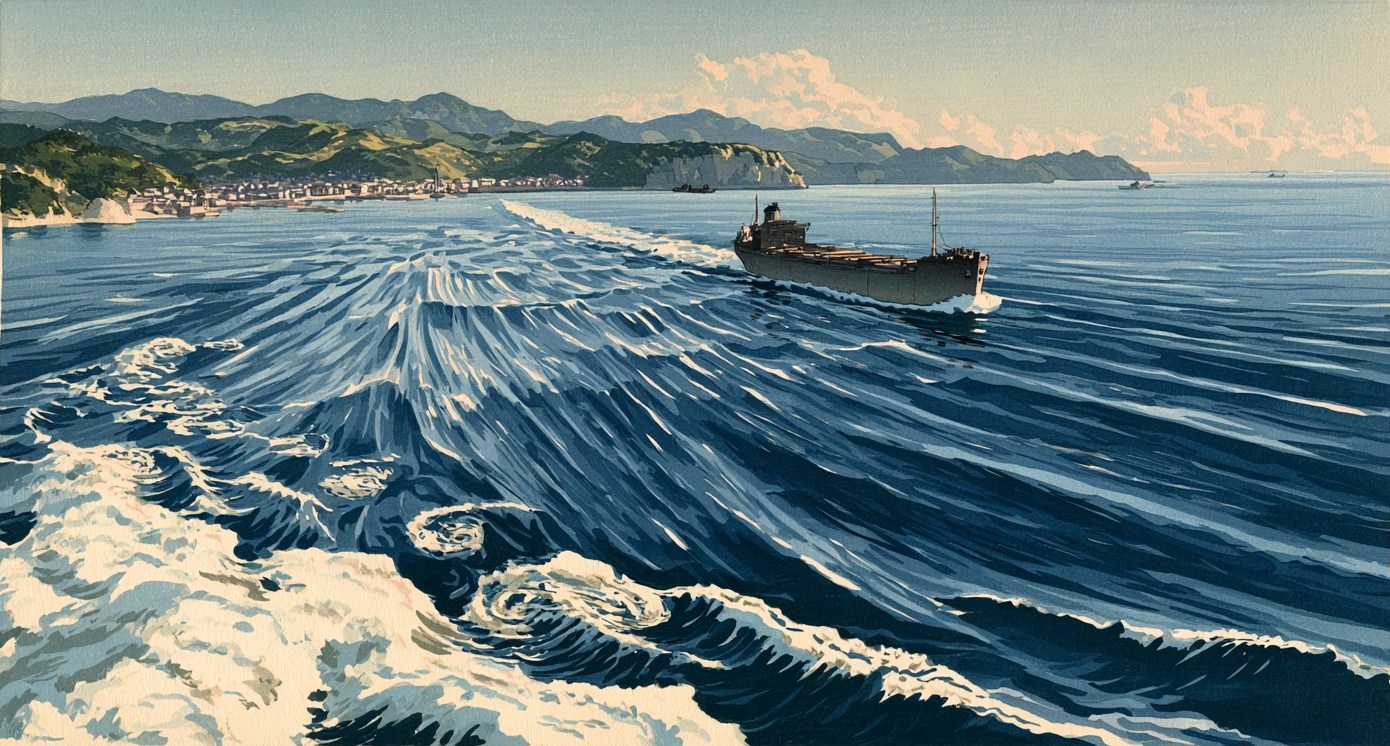
“So even the sea here can’t make up its mind,” Mio said, the first time I explained this to her. She was looking at me when she said it.
Most Sunday mornings, we meet under the sea. Beneath the strait there is a tunnel with a walkway for people on foot, 780 metres long. You take a lift down, about sixty metres on my side and fifty-five on hers, and walk for about fifteen minutes from end to end. Halfway across, at the deepest point, a thick line marks the border between Fukuoka and Yamaguchi.
We each go down on our own side and walk towards the middle. Mio walks faster than I do, so she is usually at the line before me. Walkers and joggers go by, and traffic rumbles somewhere overhead. The tunnel is air-conditioned, and in August it is the coolest walk I know. Mio always steps over the line to say hello. I always stay on my side a moment longer, to make her laugh.
The thirteenth
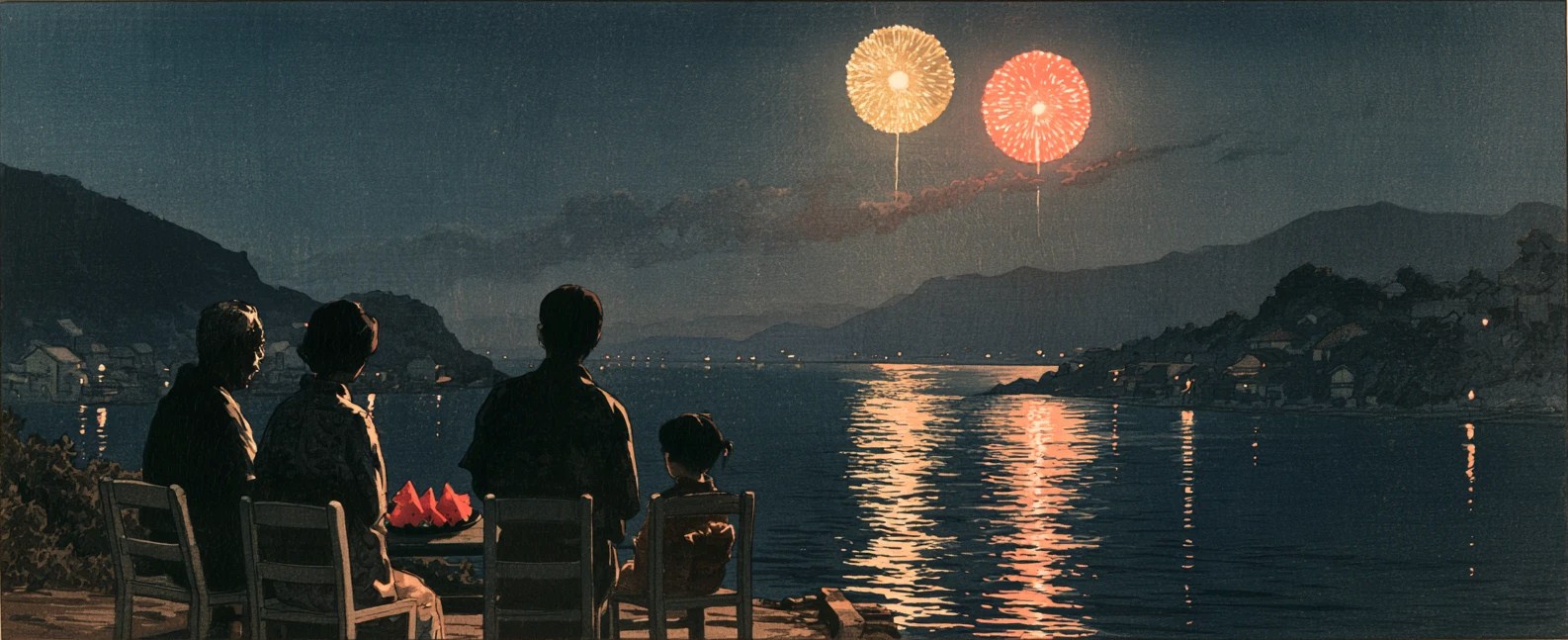
On the thirteenth of August every year, fireworks go up over the strait from both shores at the same time.
Mio’s side began it, in 1985. Mine joined three years later, and since 1988, the Shimonoseki organisers say, the two shores have fired on the same day and at the same time. It is known, Mio has told me more than once, as the only fireworks display in Japan held across a strait and across a prefectural border.
“Your side started it,” I said. “Mine answered.”
“Three years later,” said Mio. “That’s you all over.”
The date is tied to Obon. On our side, the organisers call the fireworks a mukaebi, a welcoming fire for the people who come home for Obon and for their ancestors. On hers, they say it began for people spending Obon in their home town.
In our house, the thirteenth has always been a family evening: an early supper, then everyone out on the terrace. Mio’s family spends the evening the same way, on the other side of the water. So in our first summer, we did not watch together.
“Watch my side,” she said, the Sunday before, standing at the line. “And I’ll watch yours.”
Both shores at once
The thirteenth of August is hot here. By the weather agency’s averages for Shimonoseki, across the water, the day reaches almost thirty-two degrees, and the night cools only to around twenty-six. My father set out the chairs. My mother brought a plate of cut watermelon, and my younger sister took the best chair, as she has every year since she could walk.
The first shells went up from both shores at once. Ours are fired from the sea side of the Kanmon Strait Museum, close by. Across the water, hers went up from two barges on the sea and from a jetty. I watched them, as I had promised.
“You’re watching the wrong shore,” my sister said. “Ours are the near ones.”
“I know,” I said, and went on watching hers.
But the big shells opened so wide that I soon lost track. A gold one from her side seemed to open right over the middle of the strait, a red one from ours spread out to meet it, and I could not have told you where Yamaguchi’s sky ended and Fukuoka’s began. Somewhere in the middle of it, I stopped trying.
When it was over, the smoke hung above the water, and under it the current went on, east or west; in the dark I could not tell which. My mother asked whether next year Mio would come here or I would go there. I said we had not decided.
The line
Early the next morning, I took the lift down. Mio was already at the line, and for once she stayed on her own side of it.
“Which of mine did you like best?” she asked.
I told her about the gold one that opened over the middle of the strait.
She was quiet for a moment. “I liked a gold one over the middle too,” she said. “I thought it was yours.”
We stood on either side of the thick line, with traffic rumbling overhead, and laughed until a passing jogger looked round.
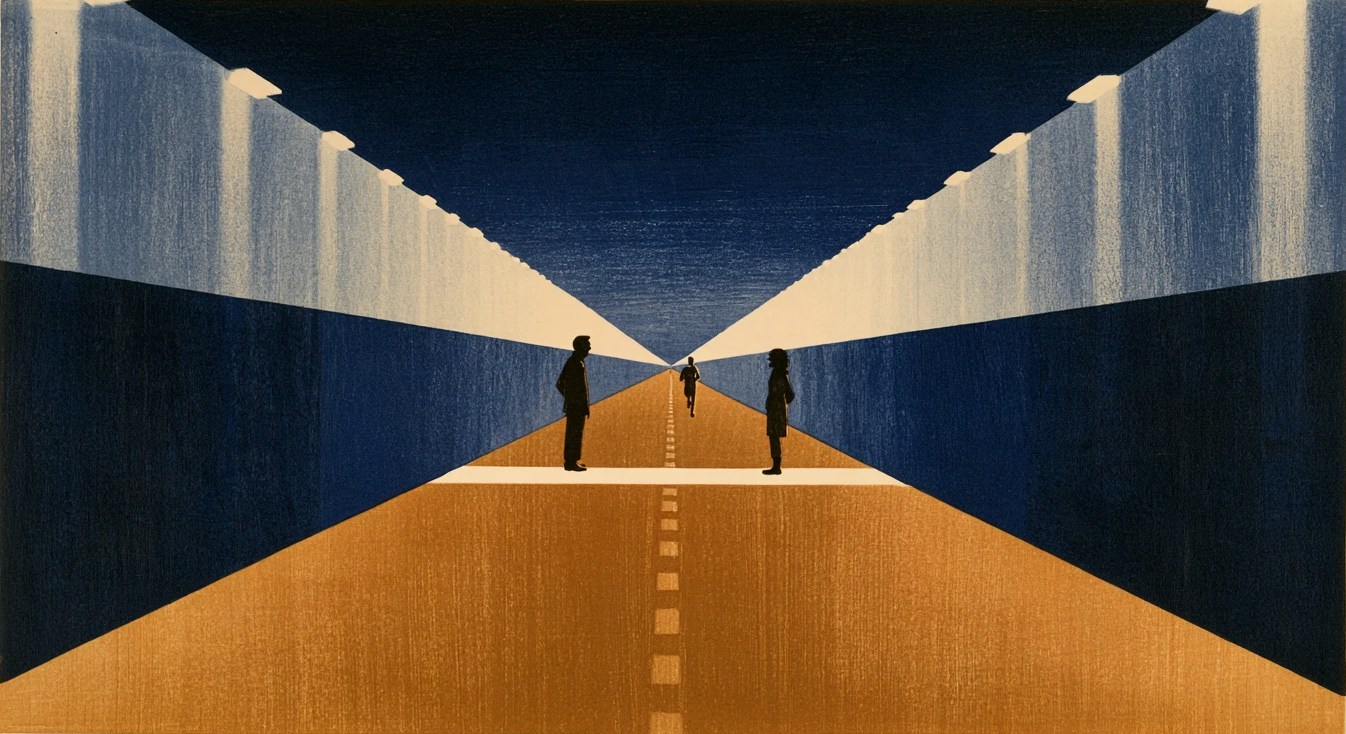
Down here, the border is easy to find. It is marked with a thick line. On the thirteenth of August, I looked for it in the sky over the strait, and I could not find it anywhere.
Next year, Mio says, we will watch together. We have not decided from which shore. Either way, one of us will be looking across the water towards home.
If you come to the strait on the thirteenth of August, I hope you will see the fire go up from both shores at once, and that you will try, as I did, to tell which side is which. I hope you can’t.