Some of the monkeys
don’t like the bath either.
A short story of winter in Yamanouchi, told by a man who was born in the hot-spring village of Shibu and has never liked hot water.
Too hot
I was born in a hot-spring village, and I have never liked hot water.
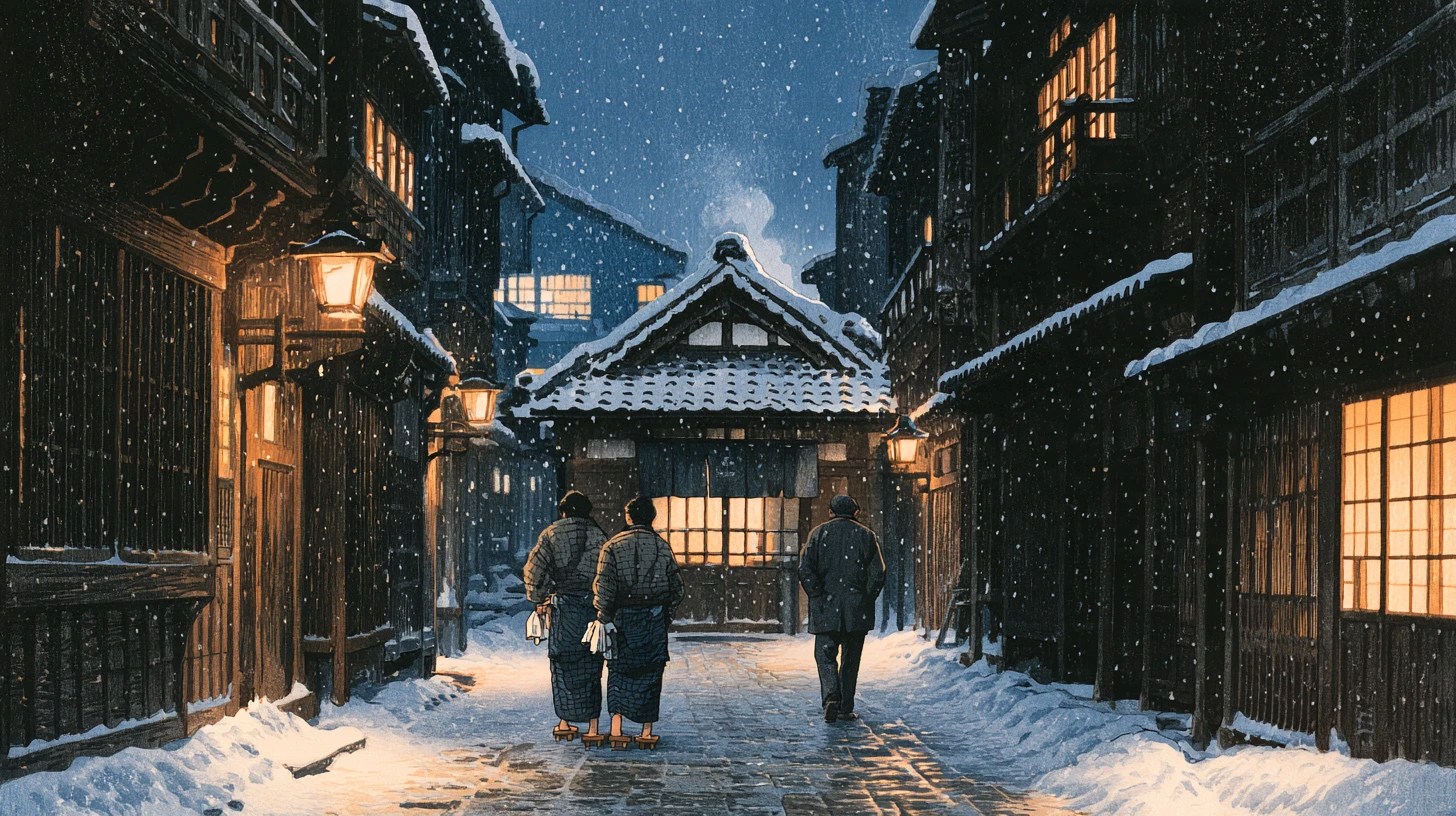
Shibu is one of the hot-spring villages of Yamanouchi, in the north of Nagano. People have been coming to its springs for more than 1,350 years. Its narrow lanes are paved with stone, and traditional inns stand along them. Nine public baths are scattered through the village. Guests at the inns can go round all nine, collecting a stamp from each on a special towel, and then climb seventy-eight steps to the temple of Shibu Takayakushi for the last stamp and a prayer. Doing so is said to ward off evil and bring a safe birth and a long life. It has never tempted me.
In our house, the bath was always hot, because my father liked it that way. As a boy, I sat on the edge with my feet in, and that was as far as I went. My sister, three years older than me, called me “the boy on the edge”.
Up the valley
Behind our town, a little way up the river, is a valley called Jigokudani, and that is where the monkeys are.
People named it Hell Valley for its steep cliffs and its fountains of hot water. From the bed of the river, water hotter than ninety degrees Celsius shoots up without stopping, in a column that can reach twenty metres. Even the ground here, it seems, cannot keep its hot water to itself.
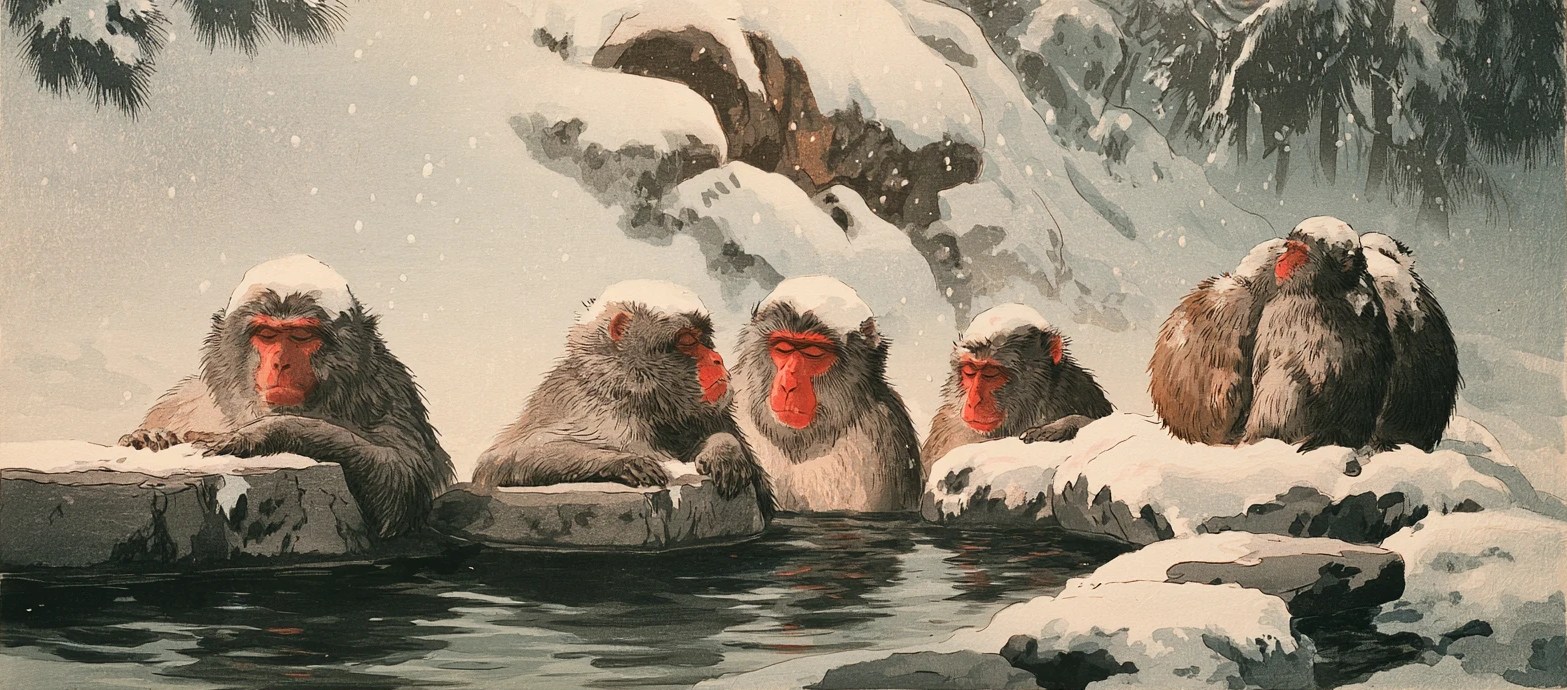
The monkeys are wild, and they come and go as they please. In winter they sit in a hot-spring pool made for them alone, and people come from all over the world to watch. A photograph of them bathing was on the cover of an American magazine before I was born.
They have not always bathed. Generally, Japanese macaques do not like getting wet. It began, they say, when a young monkey happened to learn to get into the open-air bath of an old inn close to the park. Other young ones followed it in and, little by little, grew used to the heat. I never did. When the young females grew up, the story goes, they took their babies into the water with them, and so the habit was handed down. Other monkeys took it up as well, and the park built them a pool of their own.
When I was nine, my sister came home with this story and told it at supper. “Even the monkeys get in,” she said, and looked at me.
In the park’s own words
Last winter, when I was forty-five, I read a line that changed things. It was on the park’s own website. Some monkeys, it said, do not like bathing. Bathing is only a small part of a monkey’s life, and even the ones who enjoy it care more about eating and being with the others. A hot spring is not something a monkey cannot live without.
I laughed out loud. For most of my life, I had thought the monkeys were on my sister’s side.
On a snowy day that January, I went up to see for myself. I walked the forest path in snow boots with ice grips over them, as the park advises. The valley is so deep that the sun does not reach the bottom, and all winter the temperature stays below zero.
In the pool, monkeys sat with snow on their heads and steam around their shoulders. They did not wash. They simply sat there getting warm, and some had closed their eyes. One looked very nearly asleep. On cold, snowy days like that one, many of them get in, the park says, and some stay for hours. A little way off, others sat close together on the snow, not in the water at all.
I watched from where people stand. I kept my distance and did not stare into anyone’s eyes. The park asks you to imagine how you would feel if a stranger were rude to you, and that seemed fair.
I could not tell which of them disliked the water. Perhaps the ones on the snow had only just got out. Nobody in the valley seemed to mind either way.
Passing down the edge
My son turned eight last autumn. One evening in February, he sat on the edge of the bath with his feet in and said it was too hot.
My sister lives a few streets away and comes for supper on snowy nights. She looked round the bathroom door and laughed. “Even the monkeys get in,” she said.
“Some of the monkeys don’t like the bath either,” I said. “The park says so.”
My son looked at me as though I had handed him something. My sister, to her credit, laughed again.
Up the valley, so the story goes, the mothers took their babies into the water, and that is how the habit was handed down. In our house, it seems, I am handing down the edge.
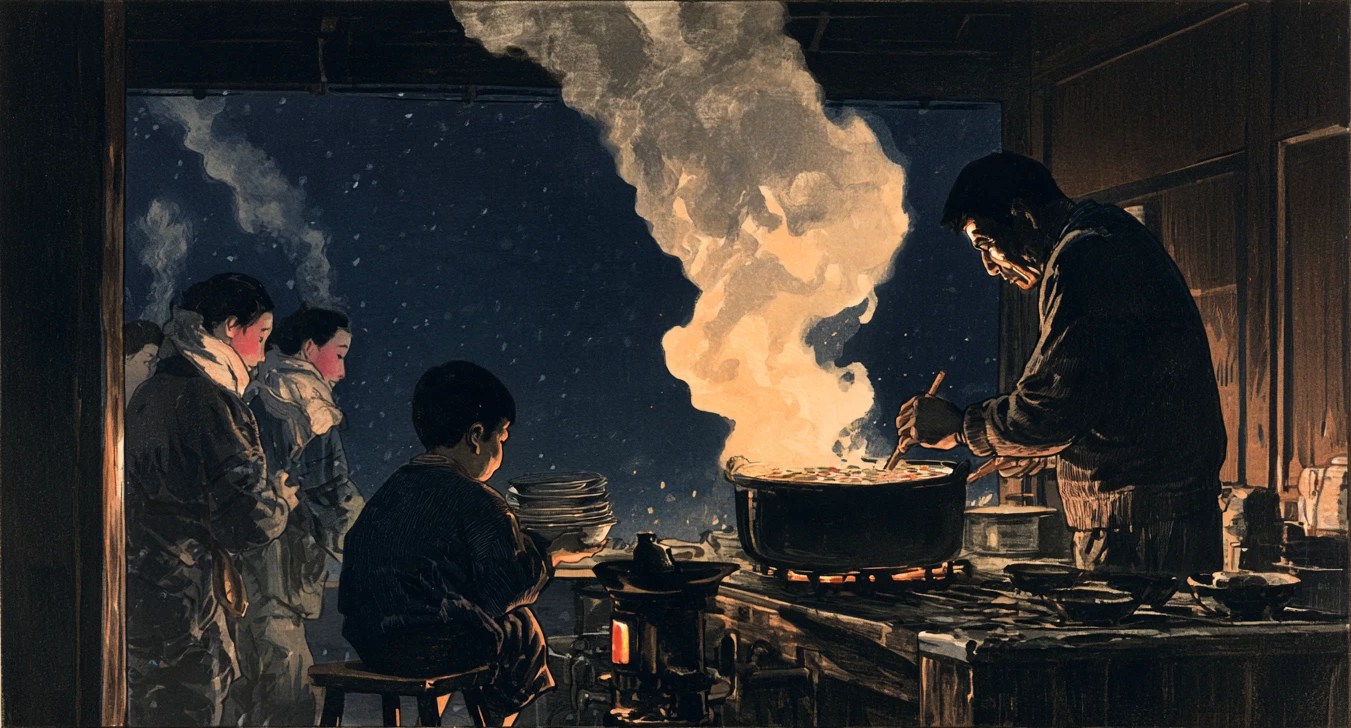
In winter, I do the cooking. While the others take their turns in the bath, I make a big pot of soup, and they come into the kitchen pink and steaming. For the rest of that winter, my son sat by the stove and helped me. Eating and being together matter more than bathing, the park says. On that, at least, the monkeys and I have always agreed.
Two kinds of steam
From about December to March, when it is coldest, the monkeys use the hot spring. In January and February the snow in their valley piles up more than a metre deep. Some days they do not come to the park at all. They are wild, and that is their business. In the warm months they hardly ever get in, and for those months the whole valley agrees with me.
Now it is November again, and my son has started asking when the snow will come.
On snowy evenings, my kitchen fills with two kinds of steam: one rising from the pot, and one from my family’s hair as they come in from the bath. By the time we sit down, you cannot tell which is which.
If you come to Yamanouchi in winter, I hope you get in, if you like it hot. If you don’t, you will not be the only one, in the town or in the valley, and there are other ways to get warm: a bowl of something hot, a seat by the stove, someone to sit close to. And when you go up to see the monkeys, keep back and never show them food, as the park asks, and let them be: the ones in the water, and the ones beside it.