In the month with gods,
my chisels rest.
A short story of the month with gods in Izumo, told by a carpenter who has spent his whole life a short walk from the great shrine.
The month with gods
In most of Japan, the tenth month of the old lunar calendar is Kannazuki, the month without gods. Here in Izumo we call it Kamiarizuki, the month with gods. It is believed that in that month the gods of the whole country gather here, at Izumo Taisha. In the calendar we use now, they usually arrive in November.
I was born a short walk from the shrine, and I have been a carpenter for fifty-six years. Most mornings you can hear my workshop before you see it: the saw, the plane, the mallet on the chisel.
For one week a year, you can’t. The evening before the gods arrive, I clean every chisel, oil it and wrap it in cloth. Then I close the doors to the street, and the workshop stays quiet until the gods have gone.
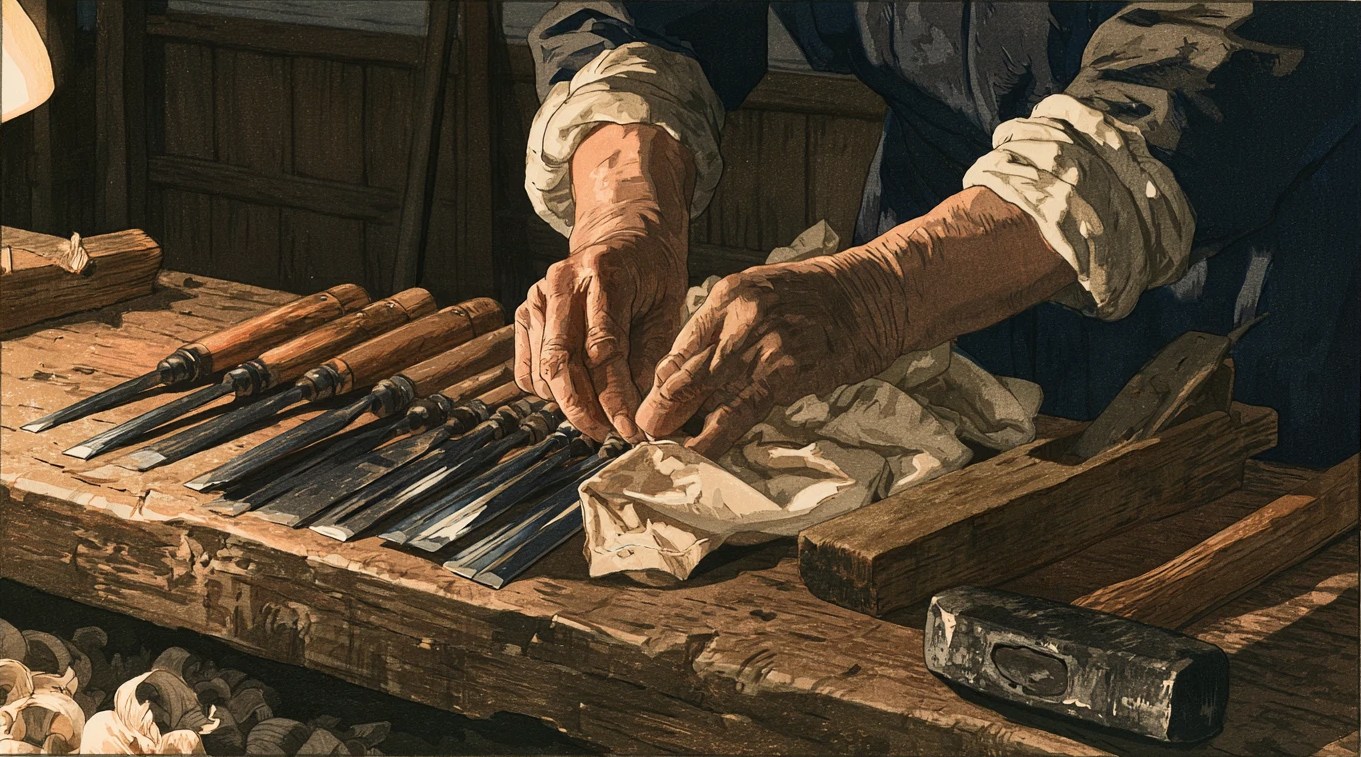
The shrine says that it keeps its rites in that week very quiet, so as not to disturb the gods in their meeting. It also says that in the past, carpenters and builders in the neighbourhood stopped work, and the people who lived here kept quiet too. My master did. I was fifteen when he first handed me a cloth for the chisels. Now it is simply my own habit.
Fires on the beach
The gods arrive on the evening of the tenth day of that month, from the sea, at Inasa Beach, about a kilometre west of the shrine. In the old myths, this is where Okuninushi, the shrine’s god, talked with a messenger from the heavens about handing over the land. By day it is a long white curve of sand, with a small rocky island that people here call Benten-san.
On the tenth night, it is somewhere else.
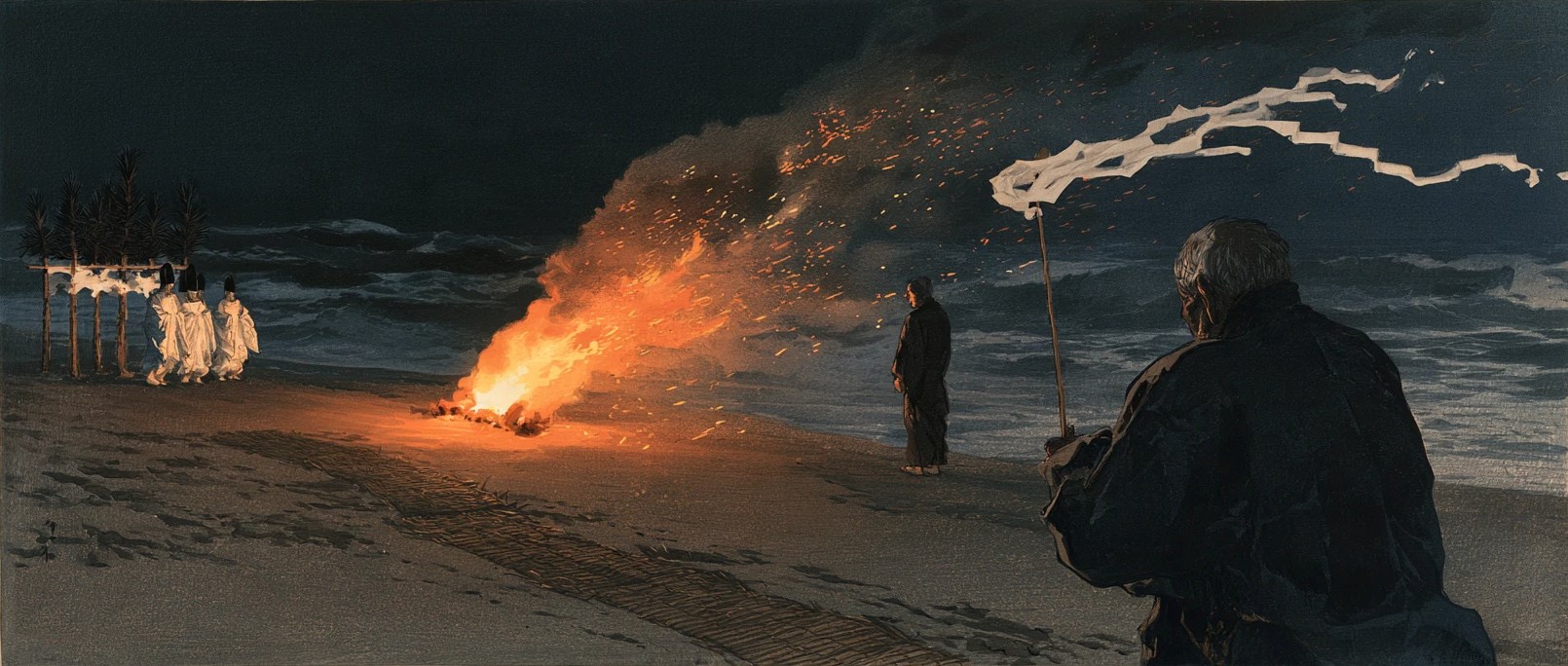
Last year I walked down in the dark. November nights here are already cold, and the wind was coming in off the sea. At the entrance to the beach ritual area I was given a white gohei, a wand with paper streamers. Straw mats had been laid for the gods’ path, and we kept off them. The priests lit bonfires and set up a temporary altar on the sand to receive the gods. It is believed that their messenger, a sacred dragon-serpent, leads them. There was only the sea, and the fire, and the paper of the gohei moving in the wind.
Then, on the far side of the fires, I saw my younger brother. We had not spoken in eleven years.
After the rite, the priests led the gods in procession to the shrine, and I walked behind with others. All the way, I kept his back in sight. He did not turn round. At the shrine, the gods were welcomed again in the worship hall, and I lost him in the dark.
A quiet week
For the rest of the week, the gods are said to stay at the shrine, in two long buildings with nineteen doors each. They meet at Kaminomiya, a shrine near the beach, and there, it is believed, they decide the bonds that people will form in the coming year.
As a boy, I thought that meant marriages. The shrine says it means every kind of bond between people, not only marriage. I have come to believe it. In that quiet week I think about the bonds in my own life: my wife of forty-four years, my customers, my neighbours. And my brother.
He is three years younger than me and lives on the road to the beach, behind a gate I made for him the year he married. Eleven years ago we quarrelled, over something so small I would be ashamed to write it down. A month went by without either of us calling, then a year. After that the silence was like a joint left out in the rain. It had swollen tight, and neither of us knew how to take it apart.
In our house, my wife makes zenzai that week, sweet red bean soup with rice cakes. That is her habit, not the town’s. It is said that zenzai began here: that at the Kamiari-sai, people in Izumo used to serve jinzai-mochi, rice cakes named for the gods being here, and that in the way we speak, jinzai turned into zenzai.
That week, with no work to do, I walked to the beach every afternoon, past my brother’s house. His gate was sagging, a finger’s width at the latch. Nobody else would have noticed. I noticed every day.
“That’s five days you’ve walked past his house,” my wife said over the zenzai.
“The gate’s sagging,” I said.
“Of course it is,” she said.
O-tachi
On the seventeenth day, the shrine sends the gods off with the Karasade-sai, in the worship hall. I stood outside and prayed from there. Inside, the priests gave thanks to the gods for coming so far. At the end of the rite, a priest calls out, “O-tachi!” They are leaving. With that call, it is said, the gods leave the shrine.
They visit other shrines in the region before they leave Izumo altogether. But in our house, the seventeenth is the end of the quiet.
I bowed twice, clapped four times, the way we do at this shrine, and bowed once more. I did not ask for anything. The meeting was over. It seemed late to start asking.
The gate
The next morning I unwrapped my chisels one by one. I put a plane, a mallet and two chisels in my toolbox and walked down the road towards the beach.
My brother came out in his slippers and stood watching. Then, without a word, he took hold of the gate and lifted it while I worked, the way he used to hold boards steady for me when we were boys.
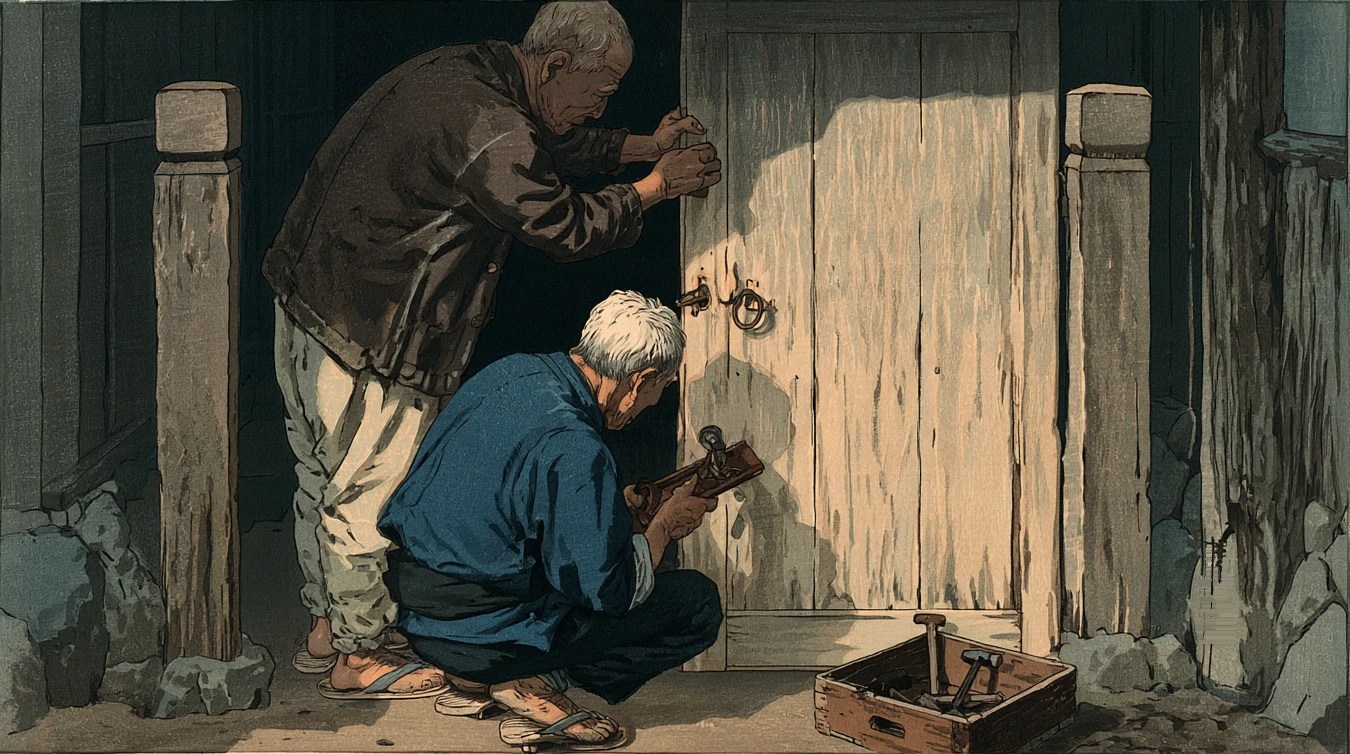
It took about an hour. Neither of us said a thing about the eleven years. We talked about the gate, and the wind. When I was packing up, he said, “The back door sticks too, you know.”
“I know,” I said. “I made it.”
At home, my wife put the last of the zenzai in front of me. “So the gods decided,” she said.
“The gate decided,” I said. She laughed. I am not sure I believe it myself.
I cannot tell you what is decided at that meeting, about you or anyone. I only know that a gate takes two people, one to lift and one to fix. If you come to Izumo in the month with gods, I hope you will stand on the dark sand when the fires are lit and think of someone. And when the gods have gone, I hope you will go home and see about your own gate.