All winter,
the fields are talking.
A short story of winter in Izumi, told by a woman who grew up in a farming family at the edge of the cranes’ fields.
They’re back
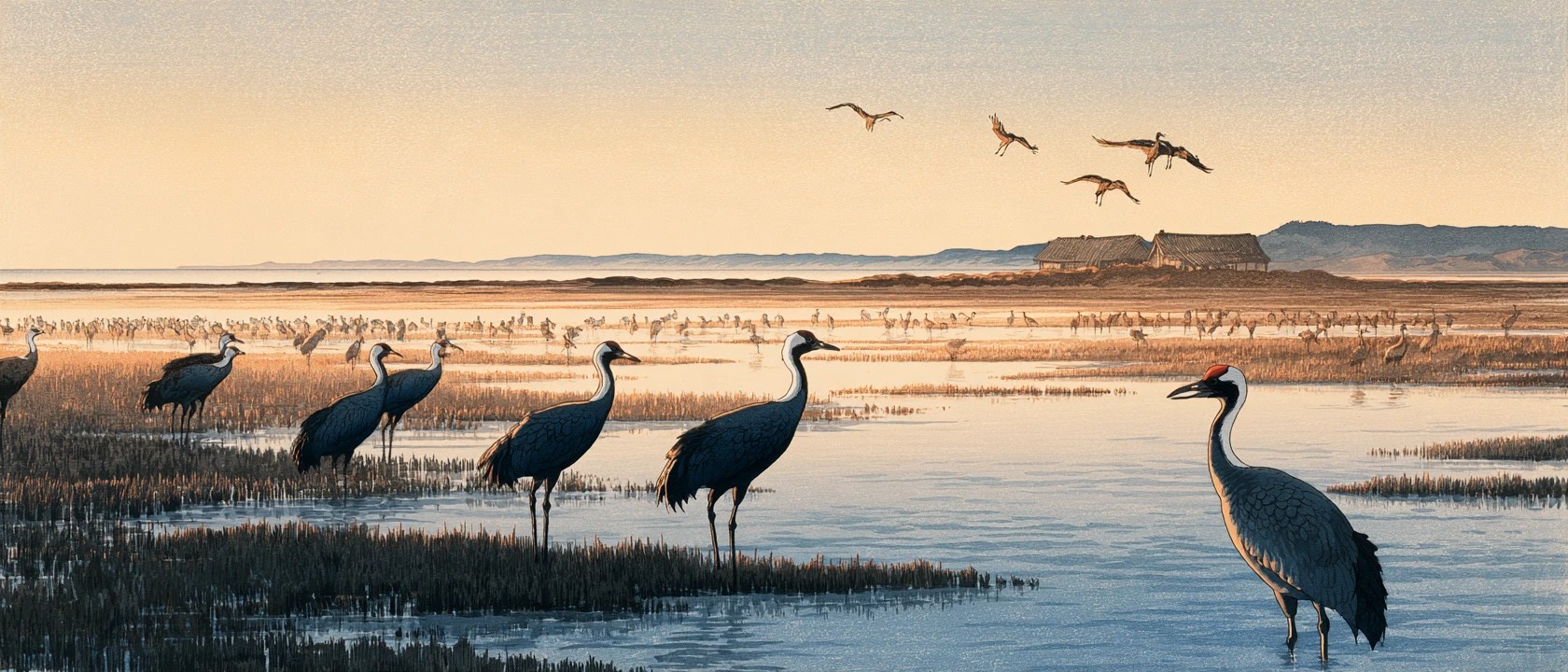
Every October, my grandmother heard them first.
In our house, whoever heard the cranes first said so at supper, and for years it was always her. She would put down her chopsticks and say, “They’re back,” as if someone had knocked at the door. The first of them come in the middle of October every year, from where they nest far to the north, in Russia, Mongolia and China. They stay all winter and fly north again in February and March.
Our house stands at the edge of the reclaimed land on the Izumi plain, in the north of Kagoshima, where three rivers run into the sea. Every field I can see from the kitchen window was sea once. People began making the land in the Edo period, and it took about three hundred years. It is said that the cranes began coming here around the time that work began. My grandmother told it as though she had watched.
In summer the plain is rice. In winter it is cranes, and here and there a field of vegetables.
The second rice
My younger brother farms our fields now, and my father farmed them before him. Out on the reclaimed land where the cranes sleep, the rice is grown earlier than usual, so the harvest that would normally come in October is over in August. When the cranes arrive in October, the rice has put up a second round of ears. Nobody harvests them, and they make good food for the cranes. My father chose to do the same on our own fields, and my brother still does.
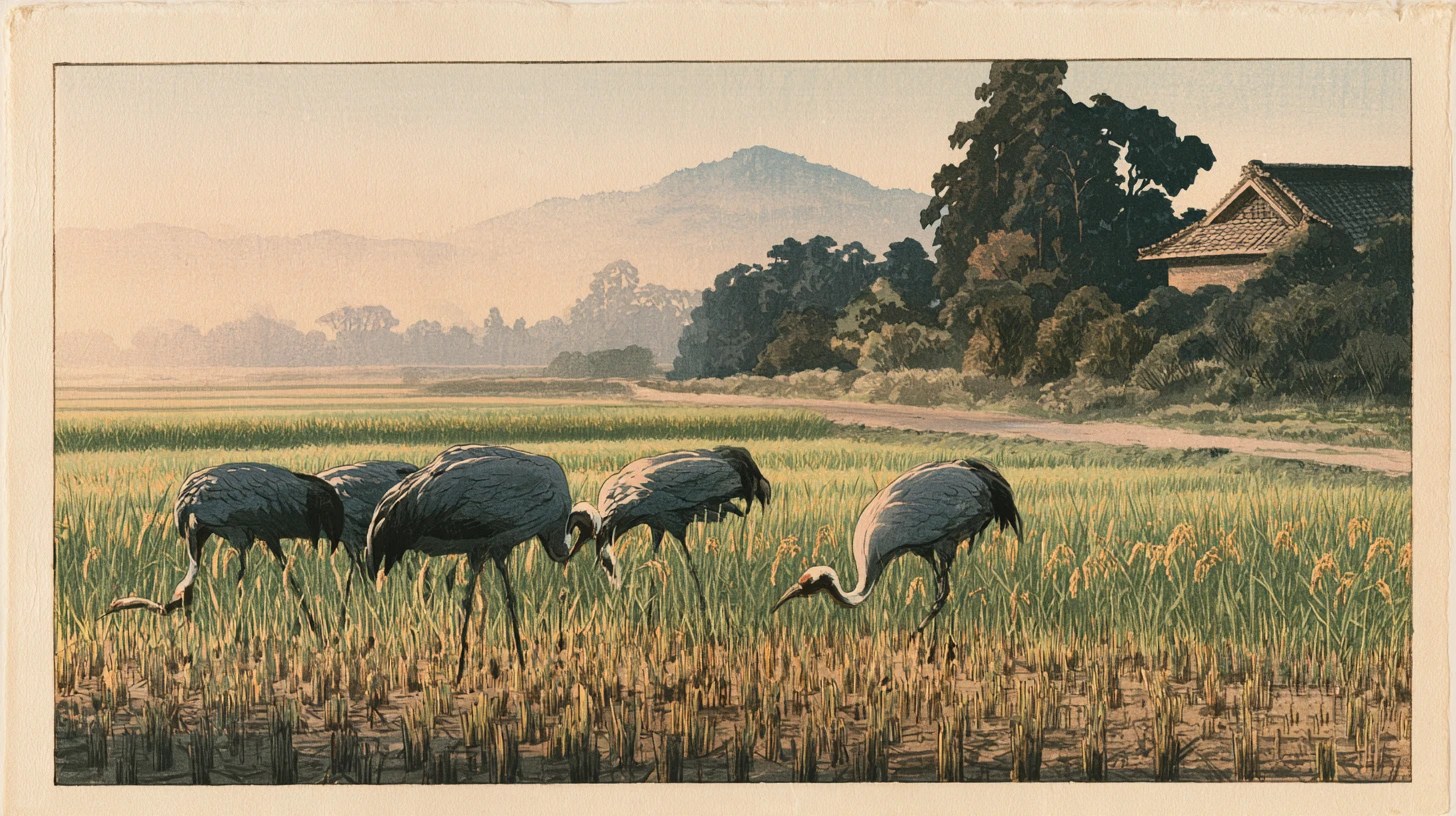
“The first rice is ours,” my father used to say. “The second is theirs.”
More than ten thousand cranes come every winter now, most of them hooded cranes, with white-naped cranes next. About nine in ten of all the hooded cranes in the world spend the winter here. My grandmother came to this house as a bride in 1952, the year the cranes and part of their fields were made a Special Natural Monument. That year, only about three hundred came. The numbers grew because people in this city looked after the cranes for more than half a century. My grandmother lived to hear ten thousand, and she never stopped being pleased about it.
Winter voices
Some of the fields out there are kept under shallow water all winter, so that the cranes can spend the night in safety. From our house I hear them begin while it is still dark, calling to one another across the fields, more voices than I could ever count. The sound of the cranes here has been chosen as one of Japan’s hundred soundscapes worth keeping. My grandmother said she could have told them that for nothing.
In the early morning they rise from where they slept, a great many at once. All day they are out on the fields, feeding, cleaning their feathers and sometimes dancing. When I was seven, I tried their dance in our yard, arms out, jumping, and my grandmother laughed so hard she had to sit down on the veranda.
My mother had one rule for winter, and she called it our winter voice. From October to March we did not shout in the fields, we did not run at the birds, and we watched them from our own yard. “They’ve come a long way to rest,” she said. “Let them.” All winter my father drove the farm road at a crawl, as though the truck itself were trying not to wake anyone.
Home for New Year
My daughter lives in a city far to the north now. She comes home every New Year, in the weeks when there are usually the most cranes on the plain.
On her first morning home last winter, she came into the kitchen before dawn with her coat over her pyjamas. “I’d forgotten how loud they are,” she said. We took our tea out into the yard and stood in the cold, listening. It was too dark to see a single bird. The voices came from everywhere at once, near and far, rising and falling, as if the whole plain were talking in its sleep.
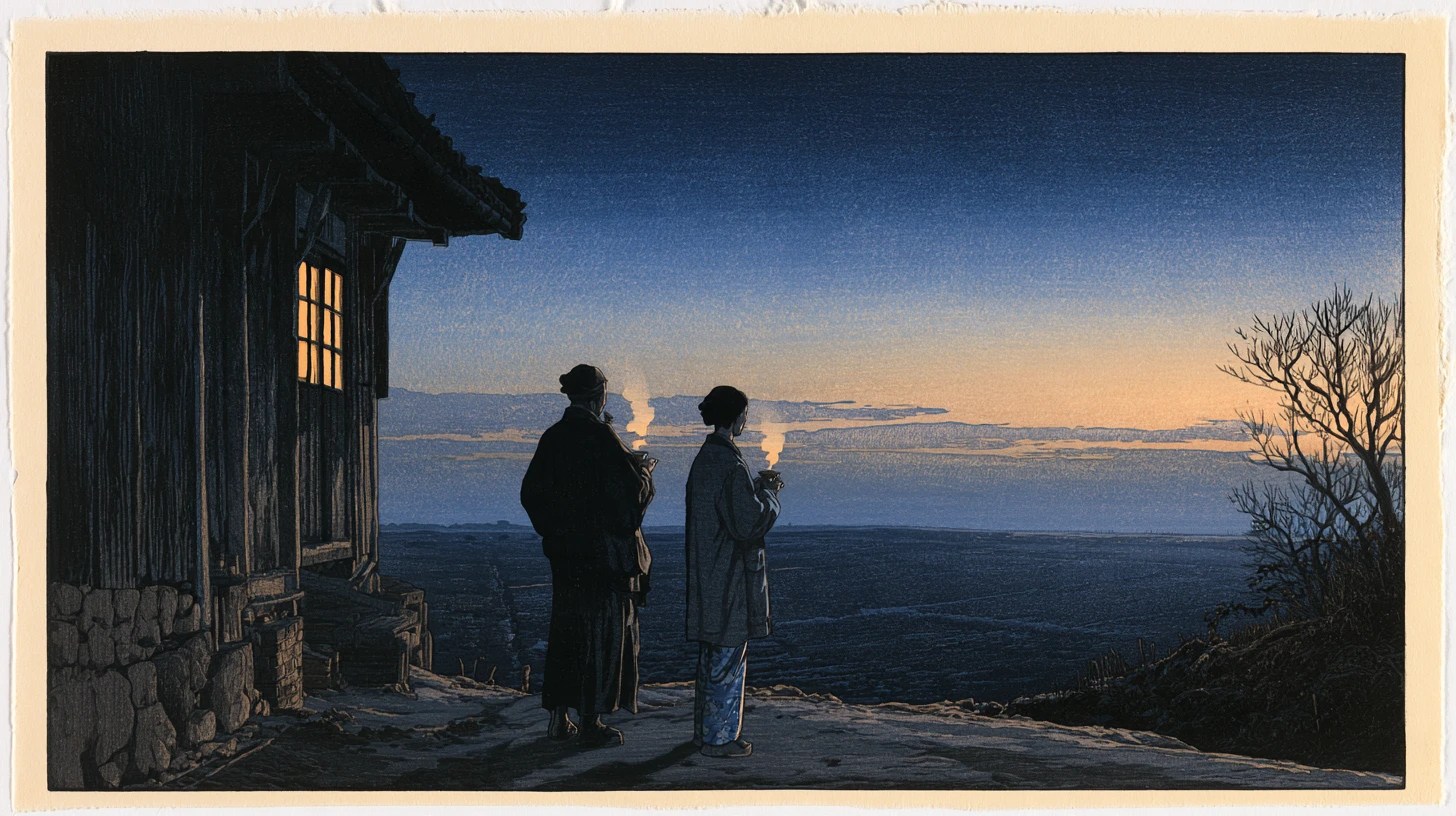
“It sounds like us at New Year,” my daughter said. “Everyone home, and everyone talking at once.”
I have thought about that ever since. They come a very long way to be here, and so does she. In winter our house is full in a way it never is the rest of the year.
The quiet
From February the cranes begin to go north. In Japanese it is called hokkikō, the return to the north. They do not all go at once, and in our house we could never guess which morning a flock would leave. Then one bright morning a flock of them passes over the house on its way, and the next morning the fields are a little quieter.
My grandmother used to stand in the yard and watch each flock until it was gone. She never waved. She only said, “Mind how you go.”
Then one morning in March I wake in the dark and lie there, waiting, and nothing comes. That is how spring begins in our house: with the quiet. It is a wide, strange quiet, and I have never got used to it. That evening my daughter telephones. “Have they gone?” she asks. I tell her yes, and for a moment neither of us says anything at all.
Then the fields are ours again, and my brother starts to think about rice.
If you come to Izumi in winter, I hope that for a moment you simply stand still and listen, and that you keep your winter voice, as I always do. Everyone you hear out there has come a very long way, and this is where they rest.