All day I waited
for the sunflowers to move.
A short story of summer in Hokuryu, told by a woman who once spent a whole day waiting for her family’s sunflowers to follow the sun.
A hundred square metres
The summer I was eight, I spent a whole day waiting for the sunflowers to move.
That was 1980, the year our town began to grow them. The idea came a year earlier, from someone at the farmers’ cooperative who went on a study tour of Europe and saw sunflower fields around Belgrade airport, in what was then Yugoslavia. They came home thinking of how beautiful the view was, and of sunflower oil as a healthy food. So in 1980, 422 households in Hokuryu each planted a hundred square metres of sunflowers, to make oil and to make the town more beautiful. Ours was one of them. Our square was beside the house, and by the middle of summer the tallest plants stood above my father’s head.
I knew where the name himawari comes from: the flower turns as the sun moves. I wanted to see it.
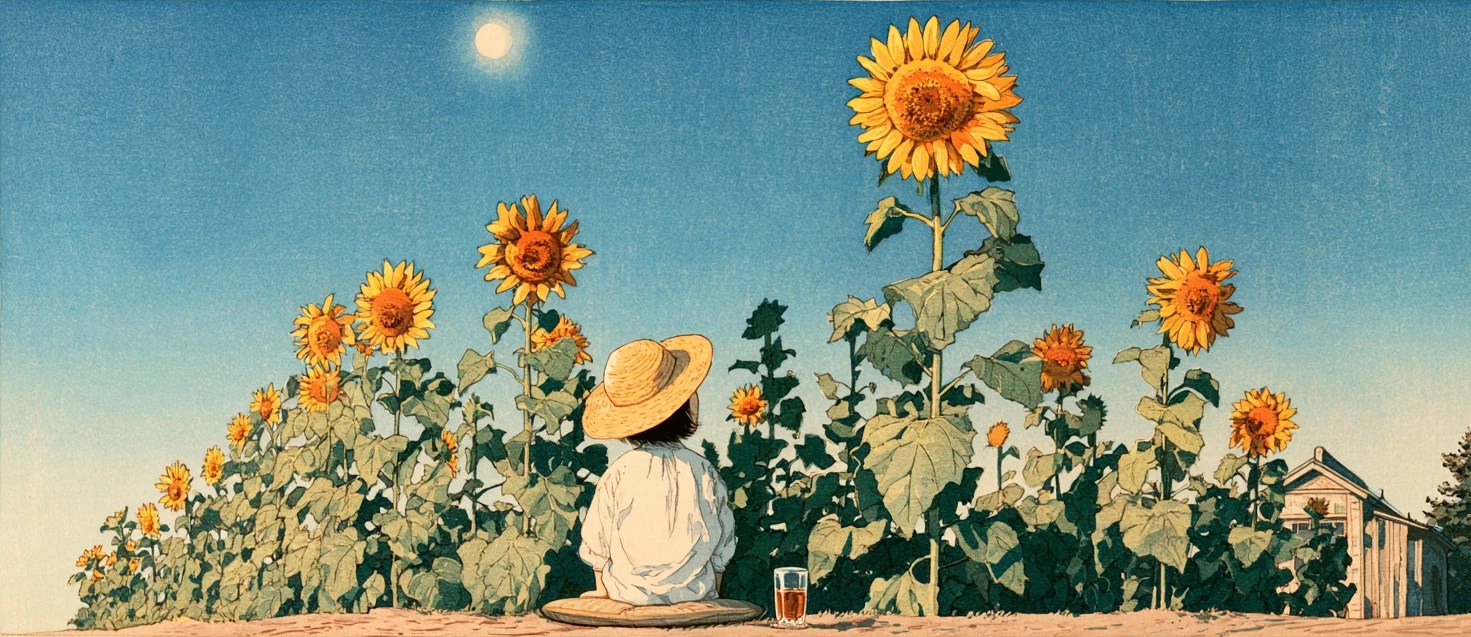
So one clear morning I took a cushion out to the edge of our square, sat down in front of the biggest flower and waited. My mother came out twice, once with a straw hat and once with a cup of barley tea. My younger brother sat with me for twenty minutes, said it was more boring than school, and went off to play. The sun climbed over the house and went all the way across the sky, and the flower did not move. Not once.
At supper I announced that our sunflowers were broken. My father said perhaps they were shy, and did not like being stared at.
Too late
That autumn I saved a handful of seeds from our square, and the next spring I planted a short row of my own by the back door. This time I did not wait for the flowers. I watched the plants while they were young.
In the mornings their tops leaned towards the sun coming up, and by evening they had followed it round to the other side. They did move. I had simply come too late.
I know now what I did not know then. It is said that sunflowers follow the sun, but they do it only while they are young and growing fast. Once they have grown and flowered, they face east or west and hardly move. That day, I had sat down in front of a flower that had already made up its mind.
Fifty-six thousand
Sunflowers became our town flower in 1982, and in 1987, when I was fifteen, the first Sunflower Festival was held. In 1989, the town rented six hectares of farmland to make a Sunflower Village. Young farmers brought their tractors, and everyone in town was asked to come with a hoe and help with the weeding. I was seventeen. I took the old hoe from our shed and weeded until I had blisters.
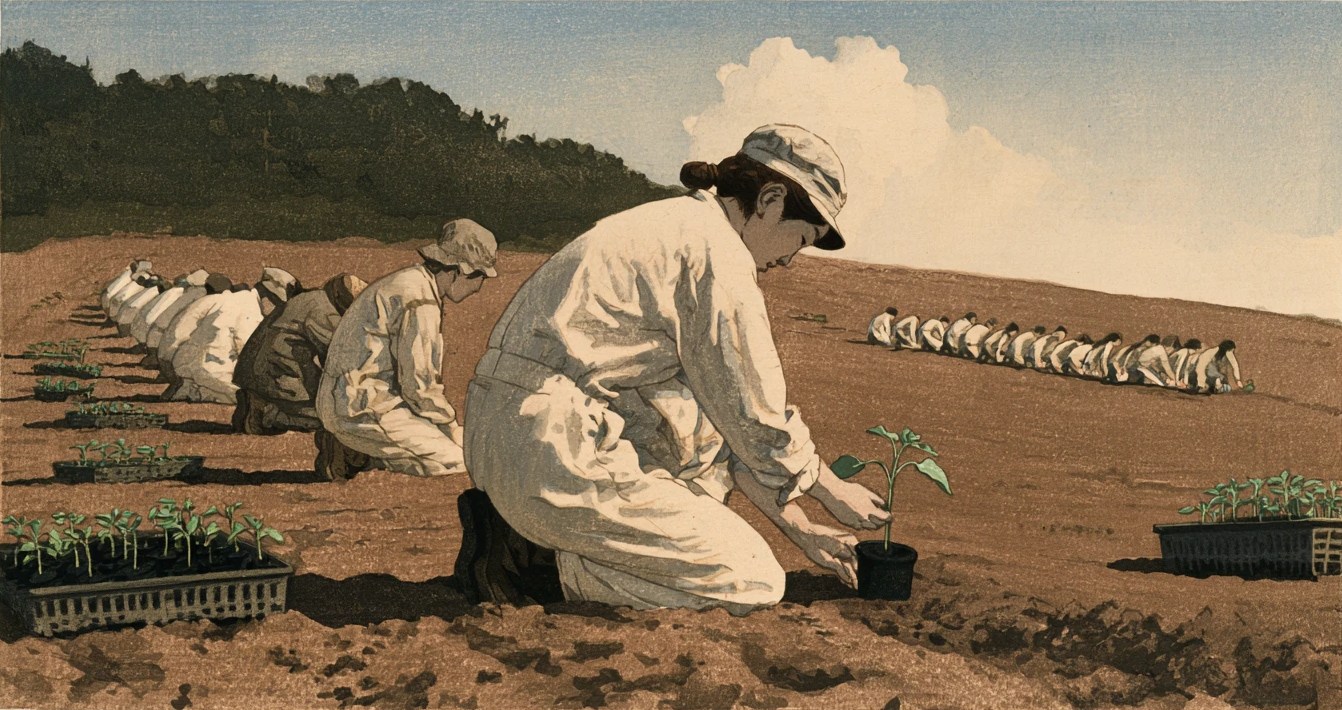
The next year, the young shoots were damaged by starlings. Pot seedlings were raised in a hurry in plastic greenhouses, fifty-six thousand of them, to fill the gaps. Three hundred and fifty of us from the town went to plant them, and all hundred and fifty pupils of the town’s junior high school came to help. I knelt in a row with neighbours I had known all my life and pressed seedling after seedling into the soil. I remember thinking that each one would choose for itself which way to face, and that not one of them would ask me.
Their help that year was the start of the World Sunflower Corner, which pupils of the school still grow. Over the years, the village grew, step by step, to about twenty-three hectares. Now about two million sunflowers grow on the hill.
Two million faces
In July and August, the hill turns yellow. I go up as often as I can, and I keep to the paths, as we are all asked to. From the observation deck I can see the whole hill at once, with nothing above it but sky.
Close up, each head is a face of its own, and most of the faces are plain gold. In the World Sunflower Corner, among the rare kinds from other countries, I have seen reddish ones and double ones, and I always stop there.
These days there is a sunflower soft serve, made with oil pressed from sunflower seeds and sold only during the festival, and I allow myself just one. It tastes faintly of nuts. I eat it slowly on a bench in the shade of Nonno no Mori, the woodland path beside the fields. Nonno means flower in the language of the Ainu, an Indigenous people of Japan.
And every summer, before I go home, I stand on the path in front of one sunflower for a few minutes and wait, just in case. In all these summers, not one has moved while I was watching.
The ones who turn
One August, a girl of about eight stood beside me on the path, very still, staring at a sunflower as if she expected it to do something. Her father had to call her three times. I did not say a word. Some things are better found out for yourself, with a cushion and a whole day.
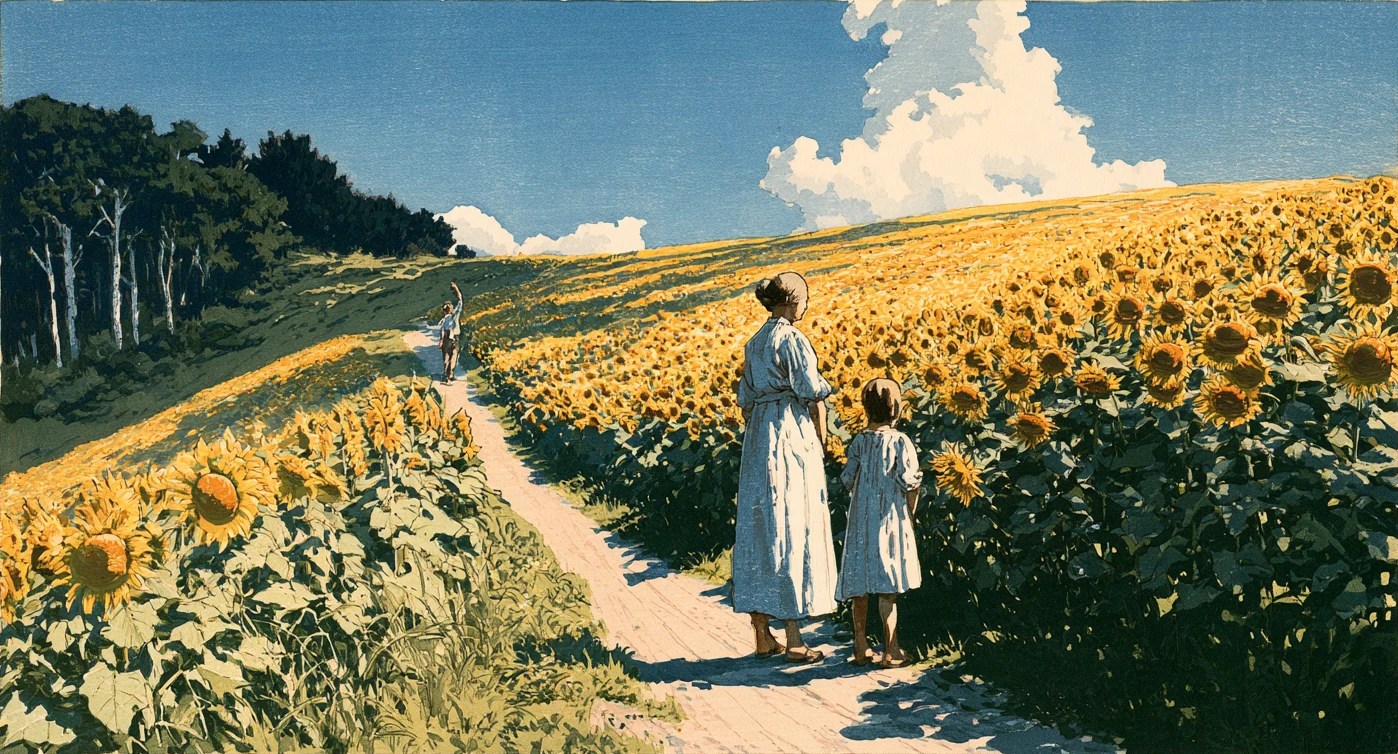
But over the years I have noticed something else. By the time anyone comes to see them, the sunflowers have stopped following the sun. It is the people who move. They come up the path, see the hill for the first time, stop, and turn to face it, as if someone had called their name.
I have lived in Hokuryu all my life. Somewhere along the way, I suppose, I stopped turning too, and found that I was facing this hill.
If you come to Hokuryu in summer, I hope you will stand on the path for a while in front of a single flower. It will not move for you. But I think you will find that you have turned towards it.