Where the train changes direction,
my mother waves.
A short story of the rainy season in Hakone, told by a fifteen-year-old who has lived all her life in a house on the slope above Ohiradai Station, on the mountain railway.
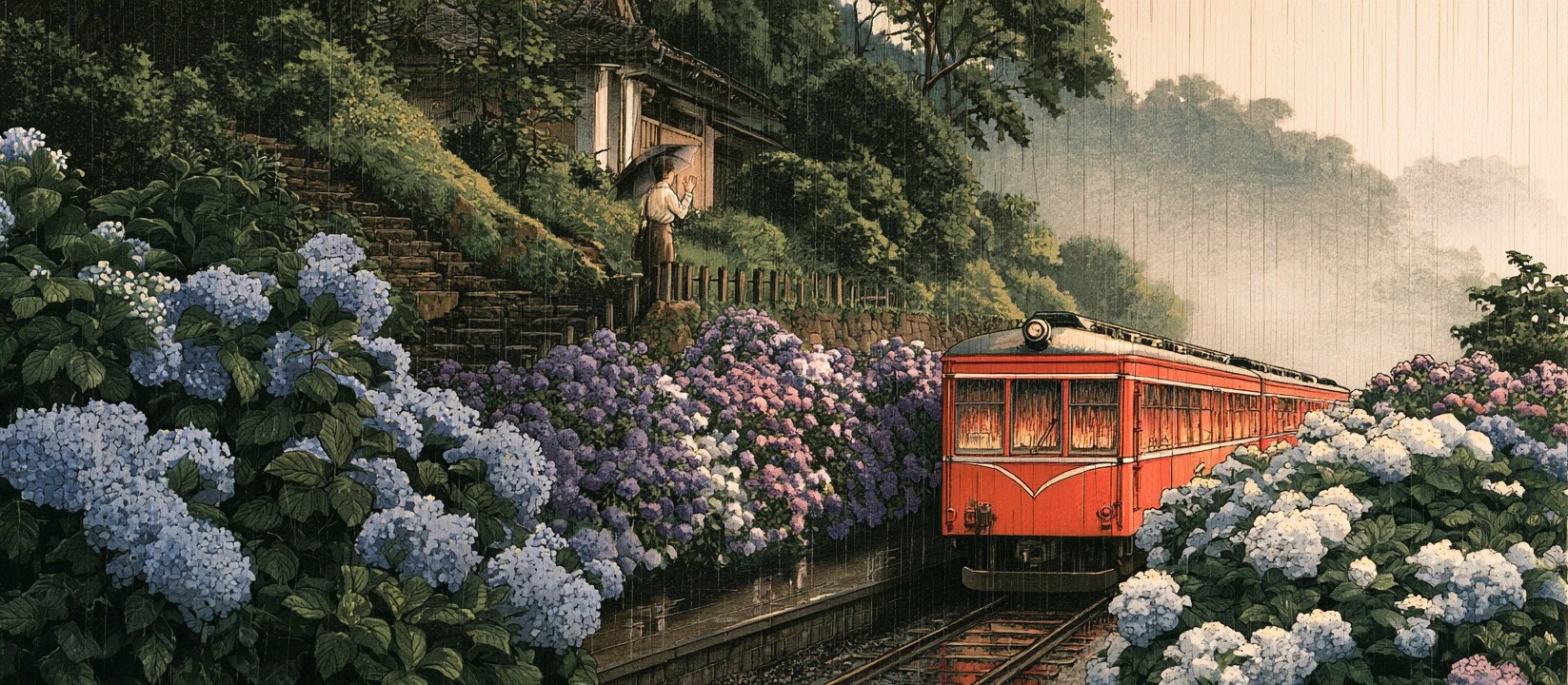
The train below the garden
Our house stands on the slope above Ohiradai, one of the places where the mountain train changes direction.
The Hakone Tozan line climbs from Hakone-Yumoto up to Gora. To climb the side of the mountain, it goes up in a zigzag. Three times on the way, at Deyama, here at Ohiradai and at Kami-Ohiradai, the train stops, the driver and the conductor change places, and it goes on the other way. Ours is the only one of the three where passengers can get on or off. On its steepest stretch, the line climbs eighty metres in a kilometre, with nothing but the grip of its wheels on the rails. The line up the mountain opened in June 1919.
So I have grown up with a train that comes in below our garden, waits while the crew change ends, and goes out again higher up the slope. In our house, it is almost one of the neighbours.
My mother waves at it. If she is in the garden when a train comes in, sweeping the steps or pulling weeds by the fence, she lifts whichever hand is free, only as high as her shoulder, the way you might wave to a neighbour across the road. Nobody taught her; it is just something she does. She has done it for as long as I can remember, and she says for longer than that.
When I was small, I waved with her. At about ten, I stopped. It seemed like something for little children.
Down in the morning, up in the evening
This April I started high school down the mountain, and now I ride the train twice a day, down in the morning and up in the evening. I had ridden it all my life, of course, but nearly always from our station down, hardly ever up.
In April and May, I spent the ride looking at my phone. To me, the train was just the slow way to school.
Then, in early June, the rainy season set in, as it usually does here. On average, more than four hundred millimetres of rain falls in Hakone in June, and a little more in July. The windows ran with water and the slopes turned a darker green. Every evening the train stopped at Deyama and changed direction, and then again at our station, where I got off.
One evening in the middle of June, I looked up from my phone, and the hydrangeas had begun to open.
The colour climbs
In this season, people call the train the hydrangea train, the ajisai densha. In places the flowers grow so close to the line that they almost touch the windows, heavy with rain, nodding past the glass.
I had always thought they had simply been there. They had not. In about 1973, people who worked on the railway began planting hydrangeas on their own initiative. By about 1985, there were many along the line, and the name had caught on. The railway’s staff still look after them all year, so that passengers can enjoy them. These days they also have to protect them from deer, which eat them.
Gora is more than four hundred metres higher than Hakone-Yumoto, so the flowers do not all open at once. The best of the colour moves up the mountain slowly, a little at a time. On the way home, I began to watch for it. In the middle of June, the colour reached the slope around our station, where the hydrangeas grow thick on both sides of the line. Higher up, near Gora, the flowers were still waiting their turn.
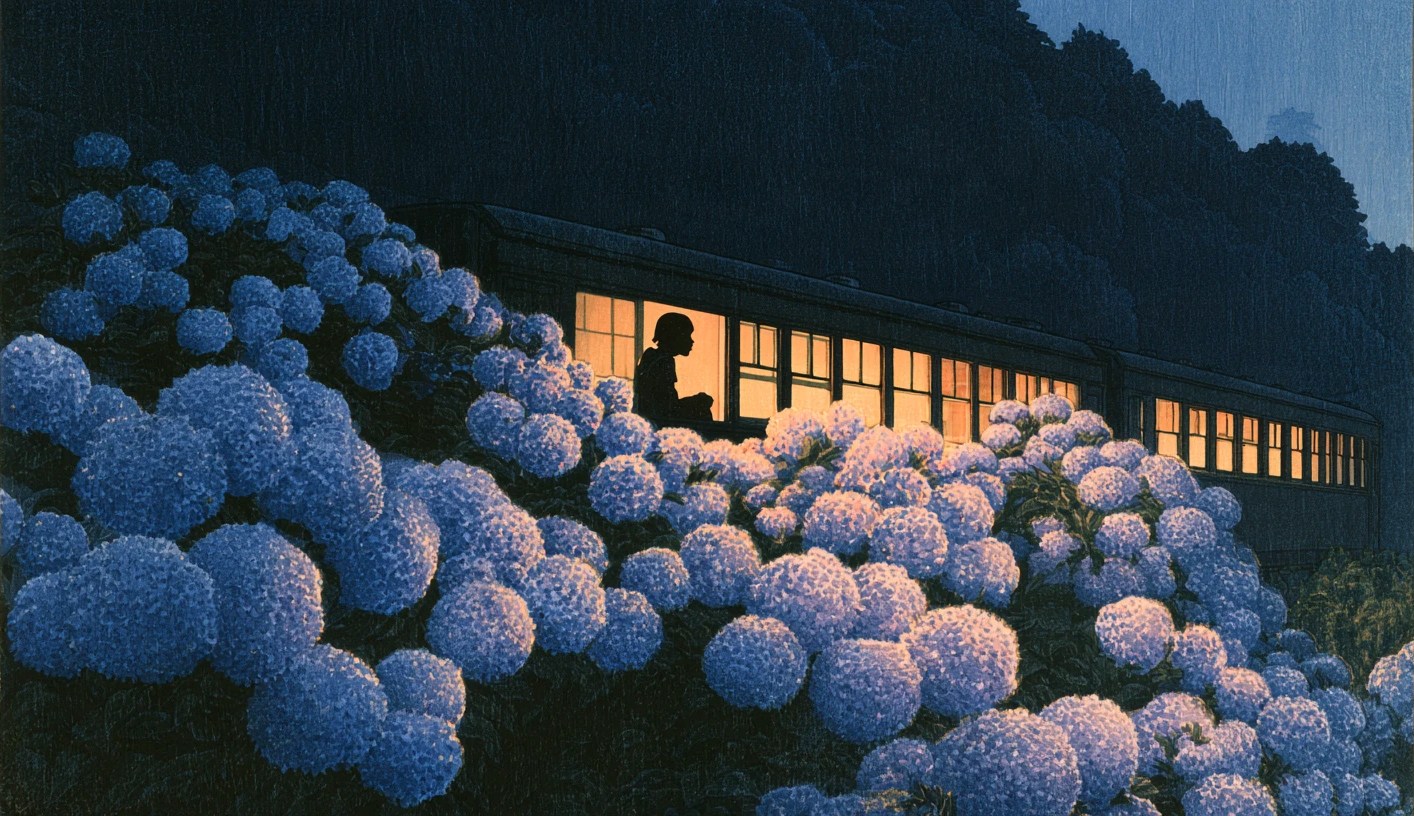
On evenings when I came home late, there were places where the flowers were lit, as they usually are from about the middle of June to the end of the month. They hung in the dark outside the window like lamps. I put my phone away. I did not tell anyone.
A hand in the rain
Late in June, on a rainy evening that was still light, I was watching the flowers on the far side of the carriage when we came into our station. By the time I looked round, the doors had closed and we were moving again, the other way, up the slope.
That was how I saw our garden from the train.
My mother was at the fence under her umbrella, lifting her free hand to the train. She did not know I was on it.
Across from me sat a man and a small girl in a yellow raincoat. The girl saw my mother and waved back through the glass, hard, with her whole arm. Then her father raised his hand. Then a woman further down the carriage did the same.
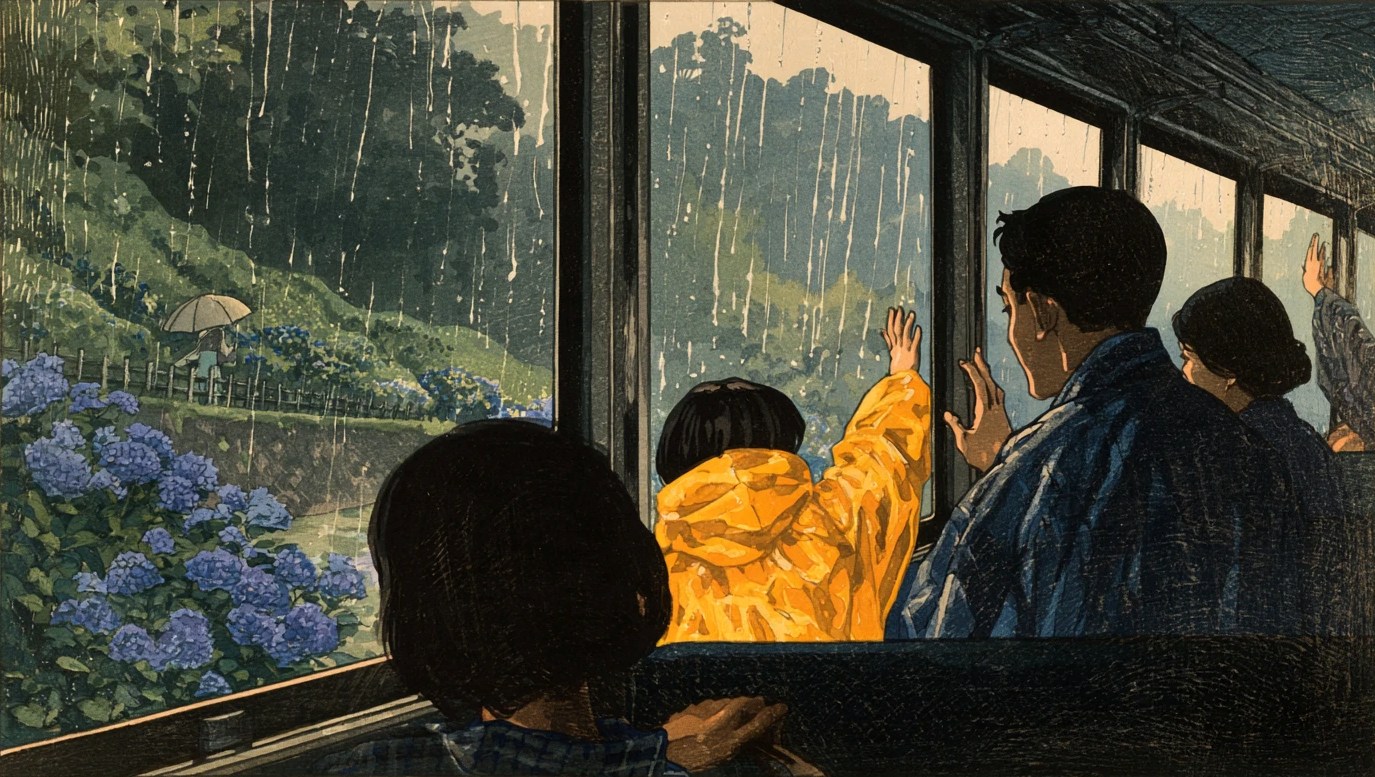
I did not wave. I was too surprised, or too fifteen.
From our garden, with rain on the glass, you cannot see who is inside a train. All my life, I had thought my mother was waving at nobody. She was not. That evening, she was waving at people who had come to see the flowers, some of them, I suppose, from a long way off. I wondered how many others had waved back over the years. If anyone had, she had never once seen it.
I thought of the people who look after the hydrangeas all year for passengers they will probably never meet. My mother had been doing something like that, with one hand.
I rode on to Gora, where the colour was only just arriving, and came back down on the next train. “You’re late,” my mother said when I came in. I told her I had gone up to see how far the colour had got. That was true, in a way.
Higher
In July, the colour leaves our slope behind. It lingers around Gora, then climbs beside the cable car up to Sounzan, where it usually comes in early to mid July. Around the third week of July, the rainy season usually ends. By then the flowers by our station are past their best, but the trains still come in below the garden and go out higher up.
Now, on Saturdays, when I am in the garden and a train comes in, I lift my hand, only as high as my shoulder. The first time, my mother looked at me. Then she lifted hers too, and neither of us said a word about it.
If you ride up the mountain in the rainy season, I hope you will look out of the window and watch the colour climb with you. Those flowers by the glass have been looked after all year by people you will probably never meet. And on a Saturday, one of the trains my mother and I wave to might be yours.
Things to do in this area
Travel information, separate from the story: food and experiences in this area in the season of the story, from our guides. The people in the story are fictional and did not visit these places.
- Yamanashi Houtou (Food, where: Fuji Five Lakes) — Houtou is a Yamanashi dish of broad wheat noodles simmered with seasonal vegetables such as kabocha in a miso broth. At Kosaku by Lake Kawaguchi, each portion is cooked to order in its own iron pot.
- Yoshida Udon in Fujiyoshida (Food, where: Fuji Five Lakes) — Yoshida udon is a thick, firm noodle from the Gunnai region around Fujiyoshida. Bowls are often topped with boiled cabbage and meat simmered in a sweet soy seasoning. Spicy suridane is added at the table, while broth and toppings vary by shop.