My birthday tree
used to cross an ocean.
A short story of December in Hakodate, told by a man who was named for Christmas Eve and has spent every birthday of his life in the port city where he was born.
Holy night
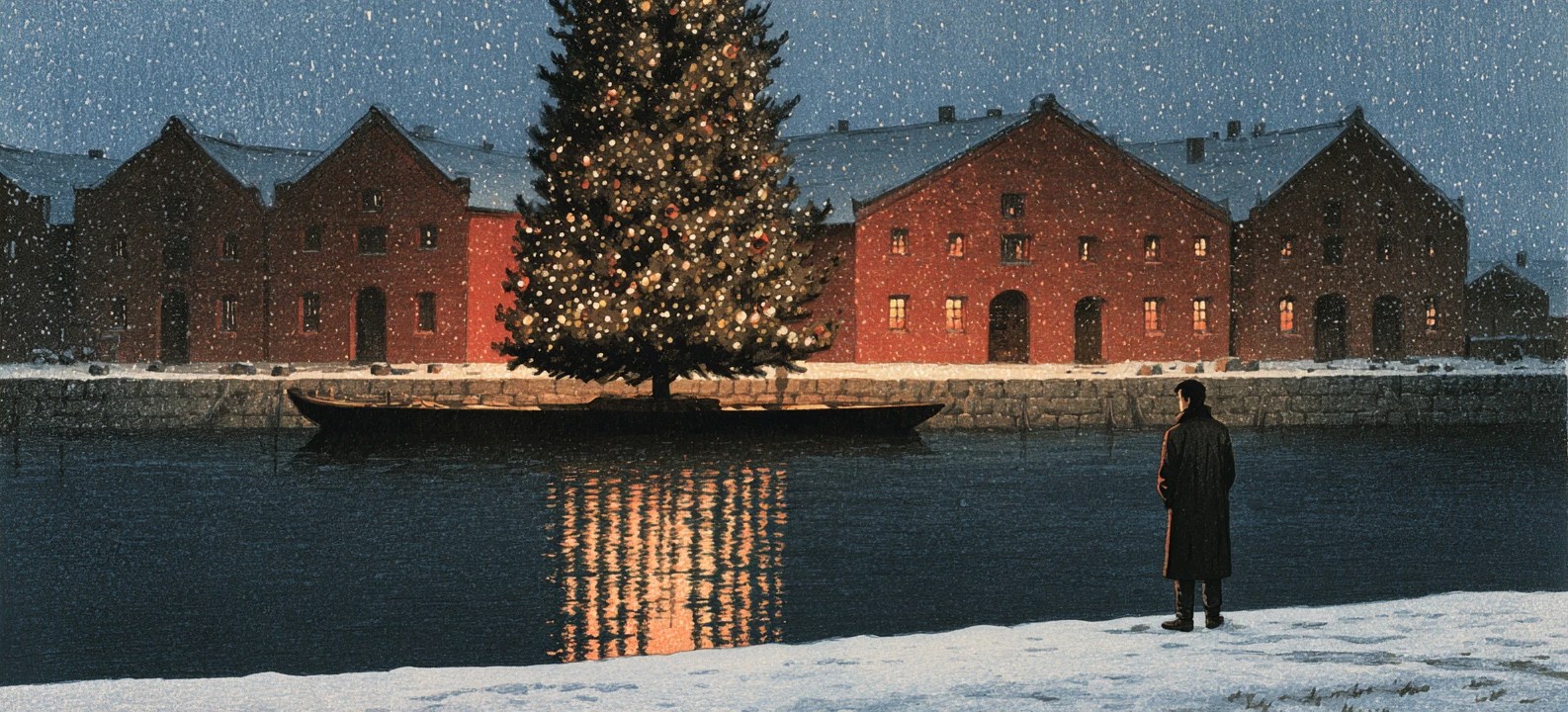
My name is Seiya. Written the way my parents wrote it, it means “holy night”, and I was born on the twenty-fourth of December in Hakodate, a few streets back from the harbour. I have lived in this city ever since.
My father chose the name. My mother says she agreed to it because she was too tired to argue.
In our house, the twenty-fourth was mine, and Christmas waited until the twenty-fifth. There was one cake: strawberries, cream and a chocolate plate that said “Merry Christmas”, with my name written underneath in my mother’s hand, squeezed small to fit.
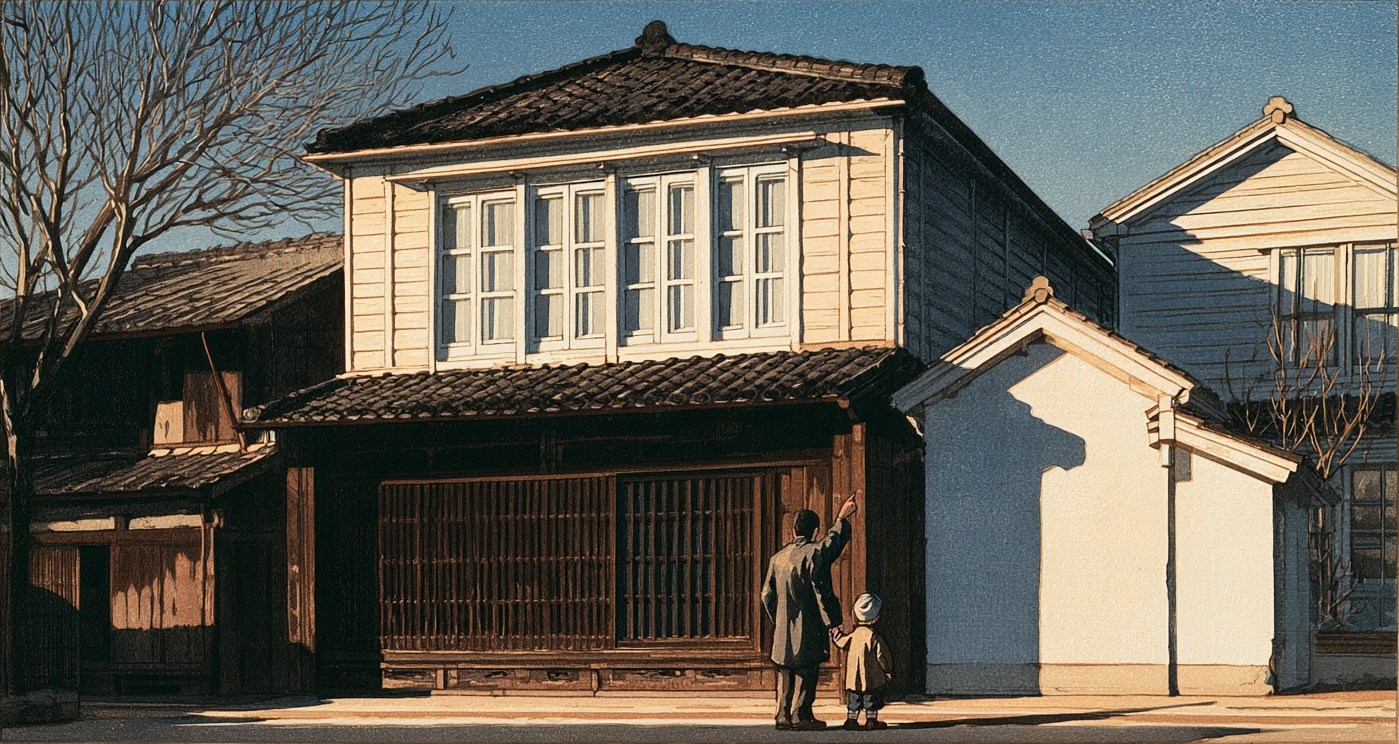
At school, a boy called Holy Night was easy to tease. When I complained, my father said a name like mine suited this city. Hakodate grew up as an international port, he told me, and Western ways settled here, Christianity among them. He walked me through the old part of town to show me: churches, and townhouses built Japanese-style below and Western-style above.
“Half and half,” he said. “Like the houses. Like you.”
A tree from across the sea
Every December, until Christmas Day, a Christmas tree stands on the water in front of the red-brick warehouses by the harbour. It is set on a barge, and about a hundred and fifty thousand lights cover it.
When I was small, the tree was a fir from Halifax, on the Atlantic coast of Canada. Halifax had been Hakodate’s sister city since before I was born. In those days, my father said, the fir was brought all the way by ship, eighteen thousand kilometres.
I did a small boy’s arithmetic. The tree crossed an ocean. It arrived in December. My birthday was in December. Therefore a city on the far side of the ocean was sending me a tree. Nobody in our house corrected me. My mother even helped me write a thank-you letter in pencil, addressed to “Halifax”. I never found out where she posted it.
I had one worry. The tree stood out on the water, so how did they plug it in? My father did not know. I have never asked anyone since. I would rather picture a very long cable.
Grown here
For some years, I learned much later, the firs from Halifax had been arriving dry and dropping their needles, and they were patched with todomatsu, Sakhalin fir grown in Hokkaido. Then it became hard to ship them in time. The organisers thought long about how to keep the event going for years to come, the two cities talked it over, and it was decided: no more firs from Halifax. From then on, the tree would be a todomatsu from Hokkaido, to make sure of a steady supply, and with the environment in mind.
I won’t pretend it didn’t sting. My present from across the ocean was not coming any more.
Then I read the word the organisers used for the new tree: chisan-chisho, grown locally and used locally. I had only ever seen it on food. I laughed out loud in my kitchen. I was born here, I grew up here, and I have never lived anywhere else. The tree and I had the same label now.
When the lights go out
On the twenty-fourth I leave work on time and walk down to the waterfront. Some years my birthday is white. There have also been Christmases in Hakodate with no snow at all. After dark the cold usually drops below freezing, and I keep well back from the edge of the quay, as my father always told me to.
By the time I get there, the lights are on; they come on as the sky darkens. Their colours keep changing, so the tree is never quite the same twice, and it looks different depending on where you stand. On the water below it, a second tree shines upside down.
Then, a little before the fireworks, the lights go out. For a short while the tree is only a shape on the black water. This is the part I like best.
In the dark I count down under my breath, the way I always have. Then the tree lights up again, fireworks go up, and for a moment the whole waterfront is full of light. If the wind is not right, there may be no fireworks; it is decided there and then. I have had birthdays with fireworks and birthdays without, and I count them all as good ones.
The boy I was would have been sure it was all for him. I am in my thirties now, and once a year, for the length of my countdown, I still let myself think so. Last year a small girl standing with her family beside me heard me and joined in, counting in a language I did not know. She shouted the last number twice.
I have spent a few of these birthdays with a girlfriend and most of them on my own. Still, there in the dark, waiting for the light, I have never once felt alone.
One candle
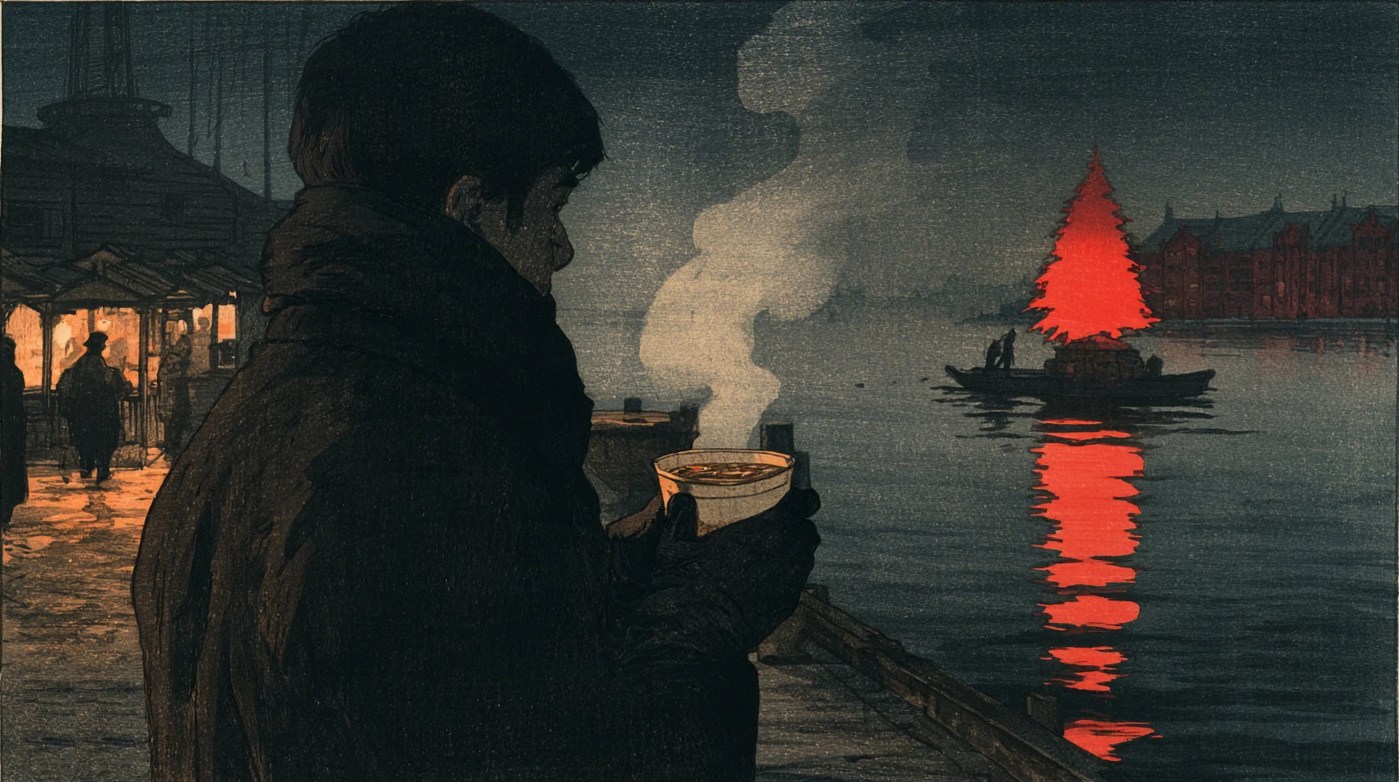
A little later the whole tree turns red for a while. People around me take pictures. To me it looks like a single candle.
My birthday dinner is a cup of soup, eaten standing up. Along the pavement, local restaurants serve hot soups made with food from the south of Hokkaido. Grown here, eaten here.
Then I take the tram to my parents’ house. There is still one cake, and my name is still under “Merry Christmas”, in my mother’s hand. My father still says it suits the city.
I used to think the best things in this city had come from far away: the churches, the Western rooms upstairs, Christmas itself, a fir that crossed an ocean every year. I love them all still. But the tree is from here now, and so am I. Lately I think this port has always worked that way. Things come in from the sea, they stay, and one day they belong here.
If you come to Hakodate in December, I hope you will be on the waterfront when the lights go out, and count with me, in whatever language you count in. On any evening, I like to think, it is somebody’s birthday out there. On the twenty-fourth, it is mine.