Once, we grew it
for its scent.
A short story of July in Kamifurano, told by a woman who grew up on a farm that grew lavender for its oil.
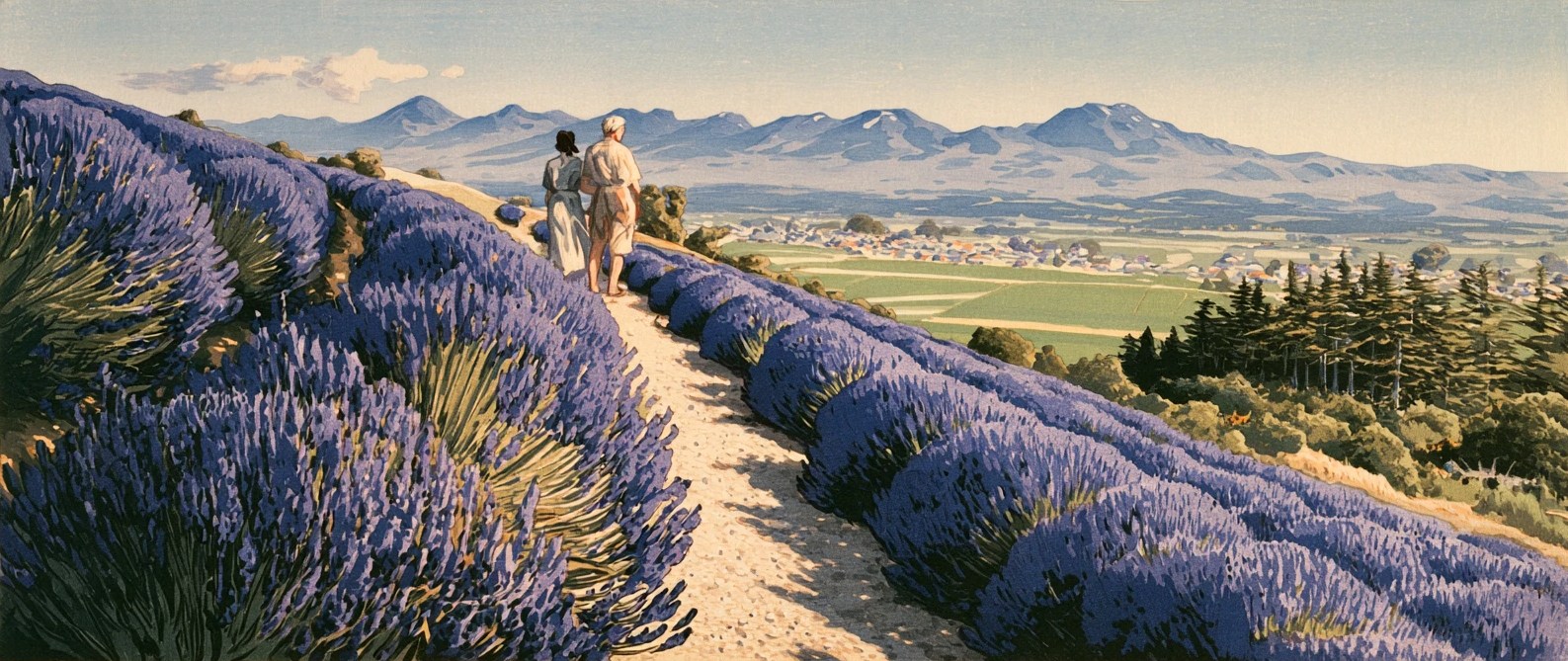
Before full bloom
When I was a girl, July smelled of my father’s shirts.
We farmed in the hills of Kamifurano, a town near the middle of Hokkaido, and my father grew lavender for its oil. Lavender comes from the Mediterranean coast, but it was found to grow well in Hokkaido, and in 1948 farmers in our town began growing it under contract for a perfume company. At its height, it is said, the town had eighty-five hectares of it. There were stills in different parts of the town then, and every July my father took our cut lavender to one of them. For days afterwards the smell was in his shirts, his hair and the seat of the truck.
What I remember most is that I hardly ever saw our field in full flower. Ours was Okamurasaki, which had become the main kind in the later years of growing for oil because it was so rich in scent. Its stems and spikes are long, and they sway in the wind. If you want oil, you cut before full bloom. Every summer, just as the purple was getting deep, my father and the neighbours went out early and cut it, and what was left behind was green.
The July we looked
For years, imported natural oils and cheap synthetic scents had been pushing lavender aside. In 1977, the year I turned ten, the perfume company stopped buying the oil, and that was the end of lavender as a farm crop here. After that, my father turned our field over to other crops. He left one long row beside the house, because my mother wanted it for drying.
Around then, pictures of lavender fields in this area appeared in a national railway calendar and in a newspaper, and people began to come to see them. “We used to sell the smell,” my father said. “Now they come for the colour.”
In 1980 the town planted lavender on the hill in Hinode Park, and the next year it made lavender the town flower. So it was on the town’s hill, not in our field, that I first saw lavender go all the way. The boy from the next farm and I climbed up every evening for a week and hardly said a word. We had grown up beside it and never really seen it.
The purple is the bud
It was that boy who taught me to look properly. Years later, I married him.
Early in the summer, he showed me, the stems and spikes are still wrapped in a soft down. Then the buds swell and turn purple, and it is easy to think that is the flowering. It is not. The flowers are tiny, and they open from the tips of the buds, a few at a time. After a few days they shrivel, still purple, but if rain catches them while they are open, they turn brown. “When it rains,” he said, “the buds keep their colour. It’s only the flowers that sulk.”
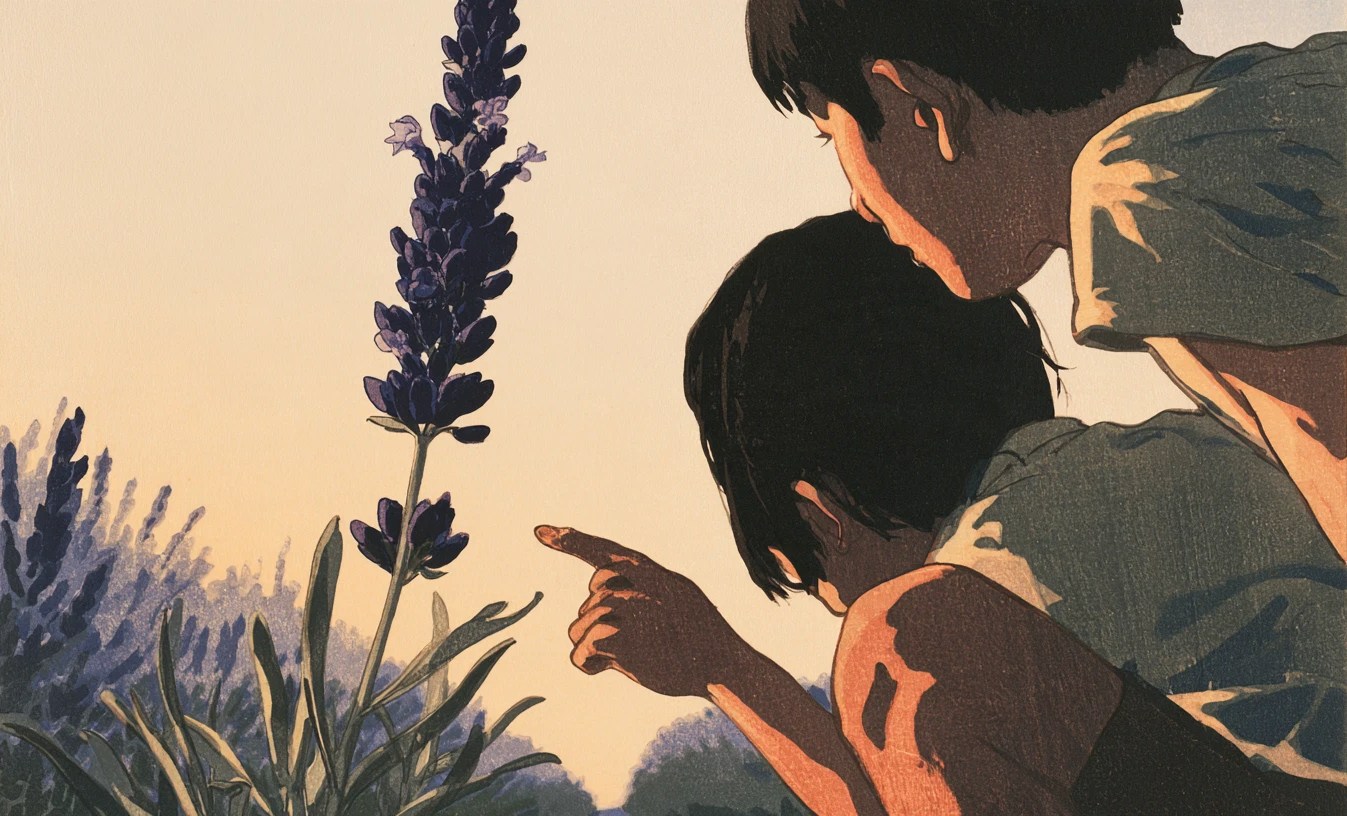
His favourite is No. 3, the very early kind. Its stems and spikes are short, but its buds are big and deep purple even while they are closed, and it is loveliest just before it opens. Mine is the long-stemmed Okamurasaki, which is best from about seven-tenths open to full bloom. We have never needed to agree. Most years the hill is at its best in July, and every summer it gives each of us a day.
Bundles in the shade
At full bloom, the bees on the hill are busy. When the flowers are over, the hill darkens, and you can tell even from a long way off. Then the cutting begins.
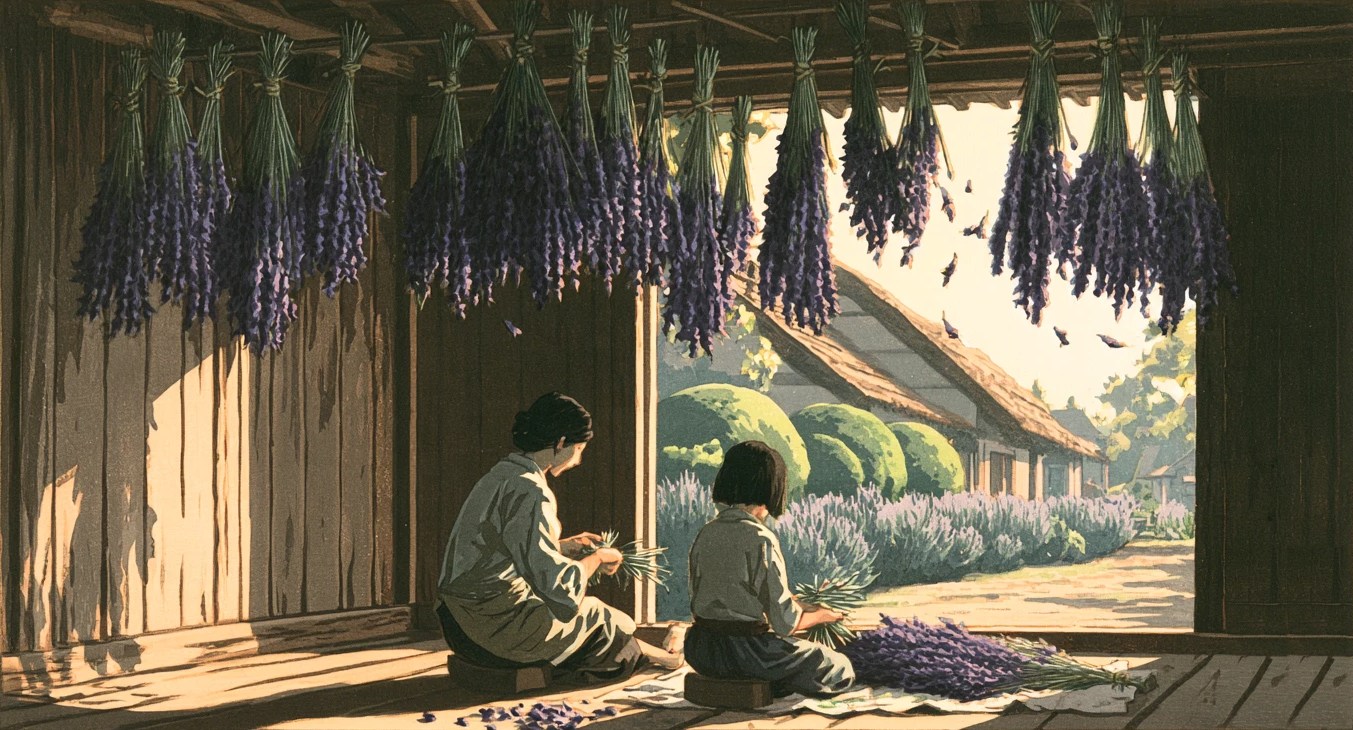
In our house we cut our row to dry it. My mother always cut it at about eight-tenths open, the right time for drying. She cut each bush into a round shape, leaving a little of the new growth, so that what remained was green. Cutting is not only for the harvest. It makes the plant branch, so that there are more stems the next year.
We tied the stems in small bundles and hung them flowers-down in the shade of the shed, where the air moves. Buds fall while you work, and those went into a big glass jar on the kitchen windowsill. My mother sewed them into little cloth bags for the drawers and the pillows, and put a handful in the bath in winter. I like opening a drawer in January and finding July inside.
Two sides of the hill
Every summer my husband and I walk up the hill in Hinode Park together: once on his day, when the early kind is dark and still closed, and once on mine, when the long kind is open and swaying. The paths climb to an observation deck at the top. On its west side lies the lavender. On its east side stand the Tokachi mountains, a range of volcanic peaks. In July the days here are warm and the nights cool, and when the wind comes across the slope, I smell it before I see it move.
The town, introducing its flower, writes that the scent drifts all over the foot of Tokachidake. I would have said it gets into your shirts.
Around us, people take photographs and talk in languages I cannot name. When I was ten, I would not have believed it. The flower we used to cut before full bloom now stays on the hill to the end, and people come a long way just to stand beside it.
If you come here in July, I hope you will climb the hill in the town park, with the lavender on one side and the volcanoes on the other, and stay until the wind crosses the purple. From the path, I hope you will look closely at a single spike, still on its stem: much of the colour you came for is the bud, and the flowers are the small ones opening at its tip, a few at a time. When they are over, the hill will be cut, and because it is cut, it will come back with more stems the next July.