The red comes up
where we cut the grass.
A short story of September on the Eriyama rice terraces in Ogi, told by a man from a farming family who has cut the grass on the same field banks all his life.
Forty-one fields
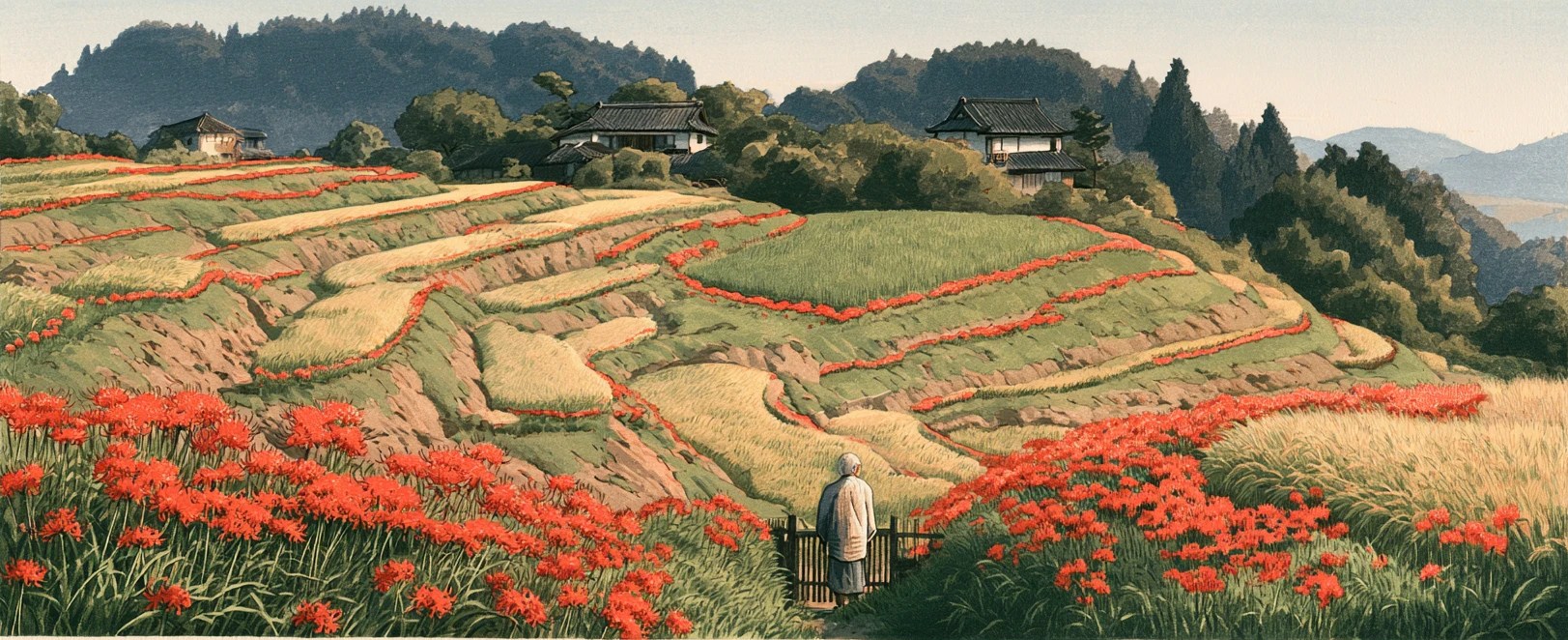
From the step outside our kitchen door, I can count forty-one rice fields. I have been counting them since I was small, and the number has never changed.
There are about six hundred on the whole slope. They climb a hillside in the north of Ogi, in Saga Prefecture, about 250 metres above the sea in the Tenzan mountains, and our houses stand among them. People call them the Eriyama rice terraces. To us they are just the fields. Every field is held up by a bank, every bank has a narrow path along its top, and every path follows the curve of the hill. I was born in the house I still live in, and I have grown rice on our family’s fields all my life.
In September, people come with cameras to photograph those paths. For a few weeks they are lined with red spider lilies, higanbana, and the whole slope looks as if someone has gone round each field with a red pen. What the photographs do not show is that every red line starts with grass.
The first week
In our family, we cut the grass on our banks at the start of September, so that the lilies can be seen clearly when they come up. Our neighbours cut theirs in the same few days, and for those days the hillside hums. There are engines above you and below you and over the next rise, and the air smells of cut grass and petrol.
I work from the bottom of our fields to the top. Our banks are steep, and many of them are earth rather than stone. A city newsletter once suggested that the earth is why the lilies come up so readily along our paths, and said that the cool air up here suits them too. I cut along the wire-mesh fence as well. It is there now to keep the wild animals out of the fields.
Above ours are the fields of the woman next door. She is eighty-six. Some years ago she stopped growing rice, and her fields have been grass ever since. But every September she still cuts her banks, with a sickle, a stretch each morning, starting a few days before we do.
Once, years ago, I asked her why she bothered, with no rice to look after.
“The lilies don’t know that,” she said.
Matches
Then we wait.
The lilies do things in their own order. Their flowers and their leaves come in different seasons, so what comes up out of the cut banks is a bare green stalk with no leaves at all, only a bud at the top. A few come first, then more all along the banks, until they stand in rows like matches waiting to be struck.
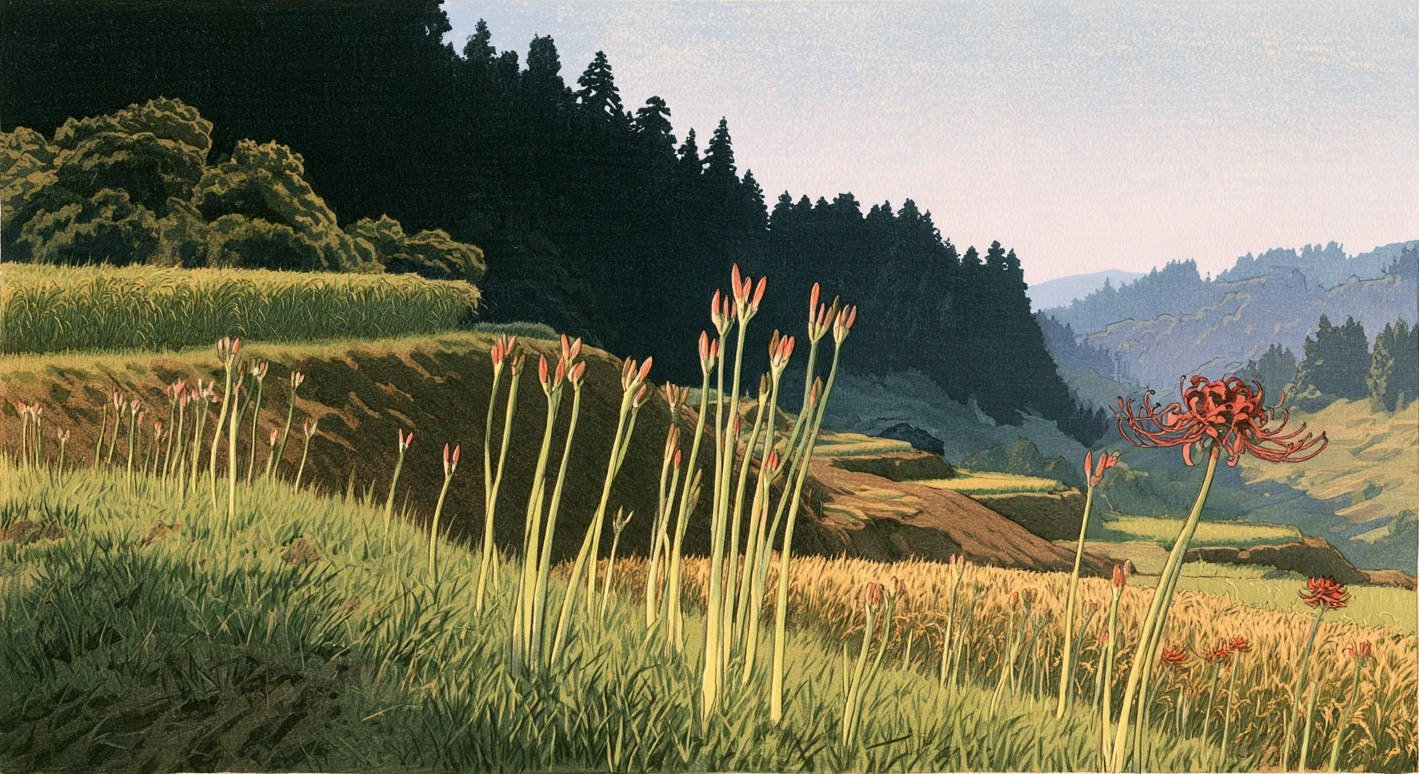
In the middle of the month, they begin to open. Every year I mean to watch it happen, and every year I miss it. Over a few mornings the lines are drawn, and it always feels as if it happened in a single night. By then the rice is ripening and turning gold, so the red runs between green and gold, field after field, up the hill. That is what the cameras come for.
The lilies were on these banks long before anyone came to look at them. To me, as a boy, they were just part of September. In the early 1990s, when I was a young man, the village set out to make this a place known for its terraces and its red spider lilies. In 1999, Japan’s agriculture ministry put our slope on a list it called the hundred selected rice terraces of Japan, and it is on other such lists too. I am proud of the lists. The lists do not cut the grass.
Her banks
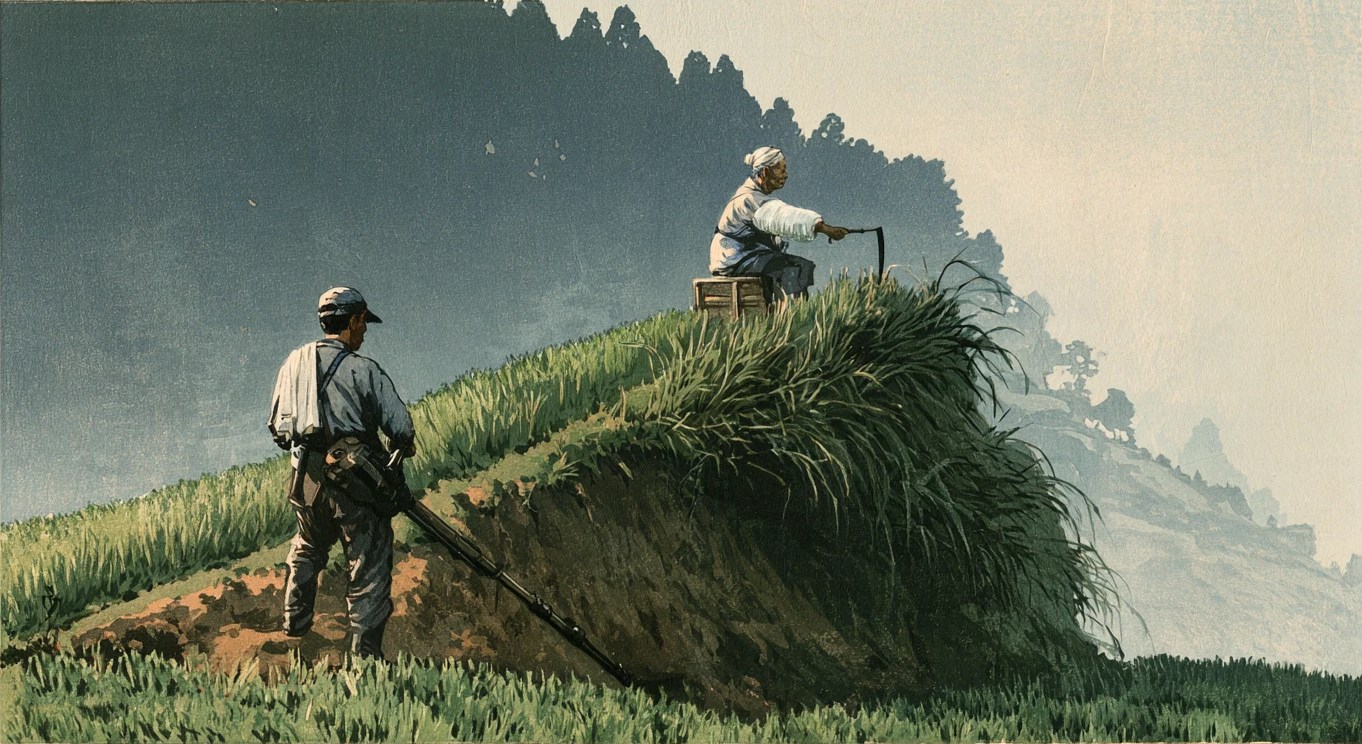
This August, the woman next door hurt her wrist, and at the start of September it was still in a cast. On the first morning of our cutting I found her at the edge of her yard, holding the sickle in her other hand and looking at her banks.
“I’ll do yours,” I said. “It will take me one morning with the machine.”
She looked at my brush cutter for a long time, the way you look at a dog you do not quite trust. Then she sat down on an upturned crate at the top of her field, watched me work, and told me where I had missed. I had missed quite a lot.
Later in the month, her banks came up red with everyone else’s. She walked down the lane to our gate and stood looking up at her fields: no rice in them, only grass, and every edge drawn in red.
“There they are,” she said.
She did not mean the flowers. She meant the fields, the shape of them, the same shape they had when she came here as a bride and planted them with rice.
Green until February
In our house, we cut the rice once the red has faded. Then the slope goes quiet, and brown.
But the lilies are not finished. From about October, thin leaves come up along the banks where the flowers stood, and through the winter, when the rice stubble and the grass have turned brown, green lines run round the fields. Around February the leaves die back, and nothing shows until the bare stalks come again the next September. So the lines are there for almost half the year, if you know how to look: red in September, green in winter, and in between only grass, waiting for somebody to cut it.
Her wrist has healed. She tells me that next year she will cut her own banks again. I believe her. I will keep the brush cutter ready all the same.
If you come to Eriyama in September, I hope you will enjoy the red from outside the fields, far enough back to see a whole field at once. The paths are the tops of our banks, the walls that hold the fields up, and the red is so clear because somebody cut the grass there earlier in the month. And if you see a field with only grass inside its red line, I hope you will look at that one a little longer. Somebody is still keeping it.