One day in June,
the horses have the road.
A short story of June in Takizawa and Morioka, told by a woman who grows rice near the shrine where the belled horses set out.
The stable corner
On the morning of the horses, my father washes the tractor.
He has done it every June that I can remember. He backs it out of the shed, fills a bucket and goes over it with a cloth, wheels and all, before the rest of us have finished breakfast. When I was small, I asked him why. “It does the horses’ work now,” he said. “It can have their day as well.”
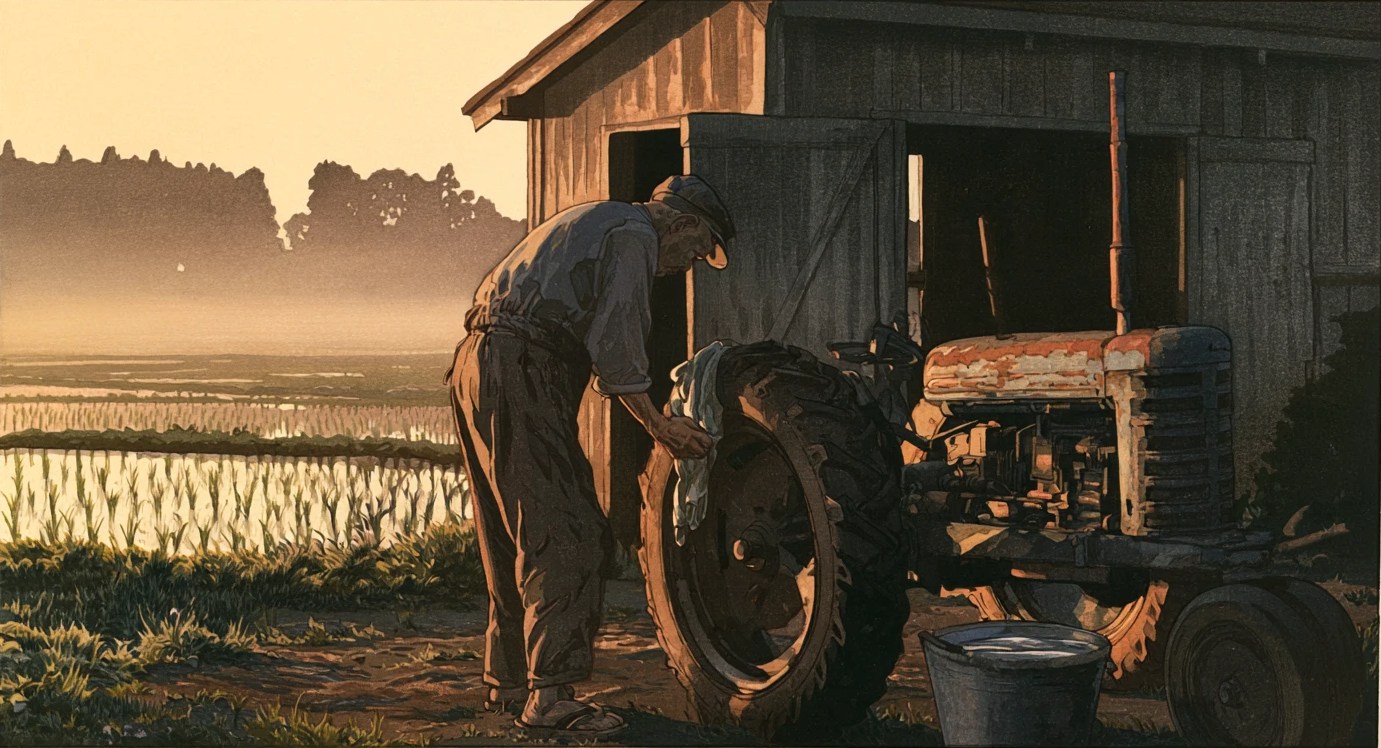
Our house is in Takizawa, next to Morioka, with rice fields on every side. Iwate has been known for its horses since very early times, and farmers here once lived with them under one roof, in farmhouses called Nanbu magariya. My father’s grandfather’s house was one. My father says it was L-shaped, with the horses in one wing. It was rebuilt long before I was born, but the tractor shed stands just where the stable used to be.
We have not kept a horse in my lifetime. We have kept the morning, though, and the bucket, and the cloth.
My first planting
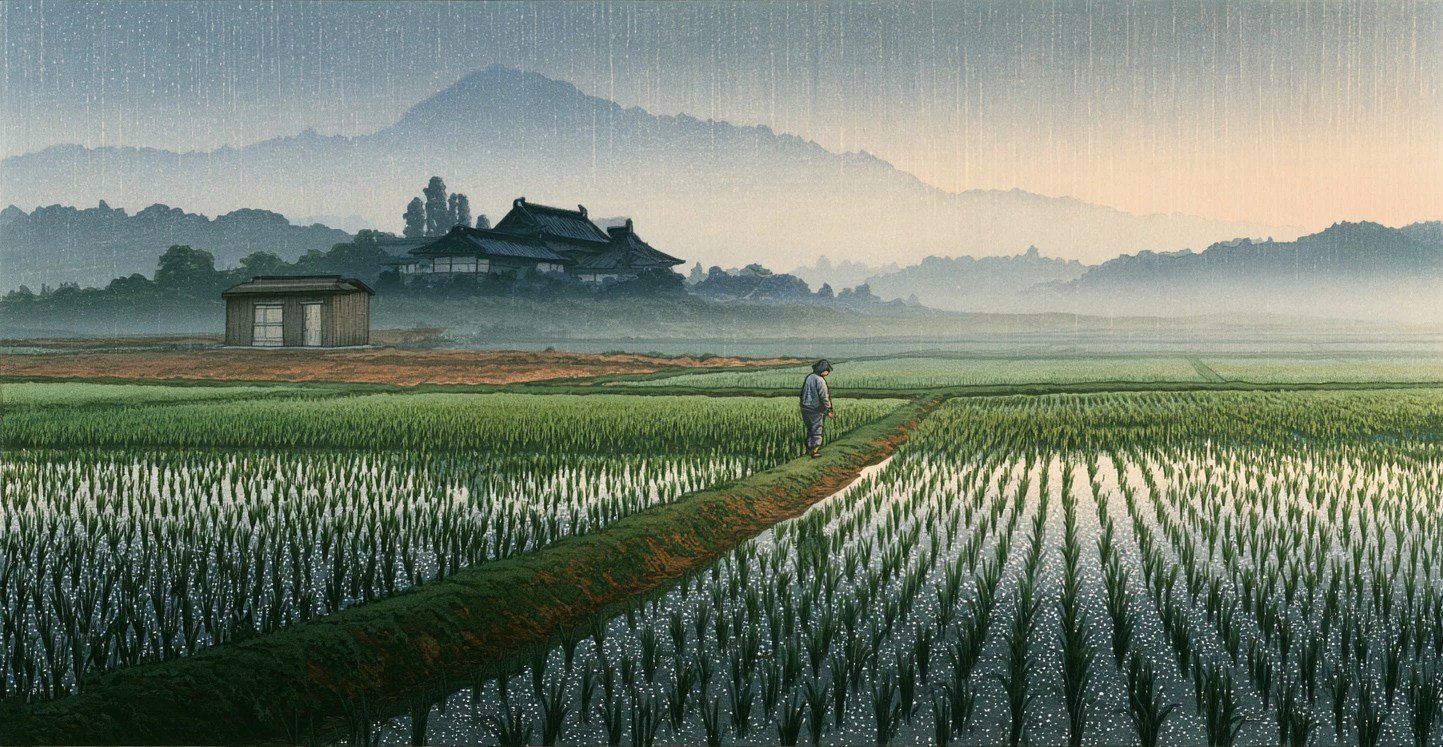
I have helped in these fields since I could walk, but this spring, for the first time, the planting was mine to run. My father is seventy-nine, and his back decided it for him. In our part of Iwate, mid to late May is planting time, and while I planted, he sat on a folding chair on the ridge between the fields and watched. He did not say much. I could hear him not saying it.
By June the fields had settled. The young rice stood in its rows, and on still mornings the water held the sky and, beyond the last field, Mount Iwate.
Not far from our fields stands Onikoshi Sozen Shrine. It enshrines Sozen-sama, a god of farming and a guardian of horses, shown as a man on horseback.
Sozen-sama’s day
Long ago, the shrine’s festival day was the fifth day of the fifth month of the old calendar. It fell when the rice fields were being made ready for planting, and the horses were worn out from the heavy work. On that one day the farmers rested. They took their horses to the shrine, prayed that they would stay well, and spent the day there.
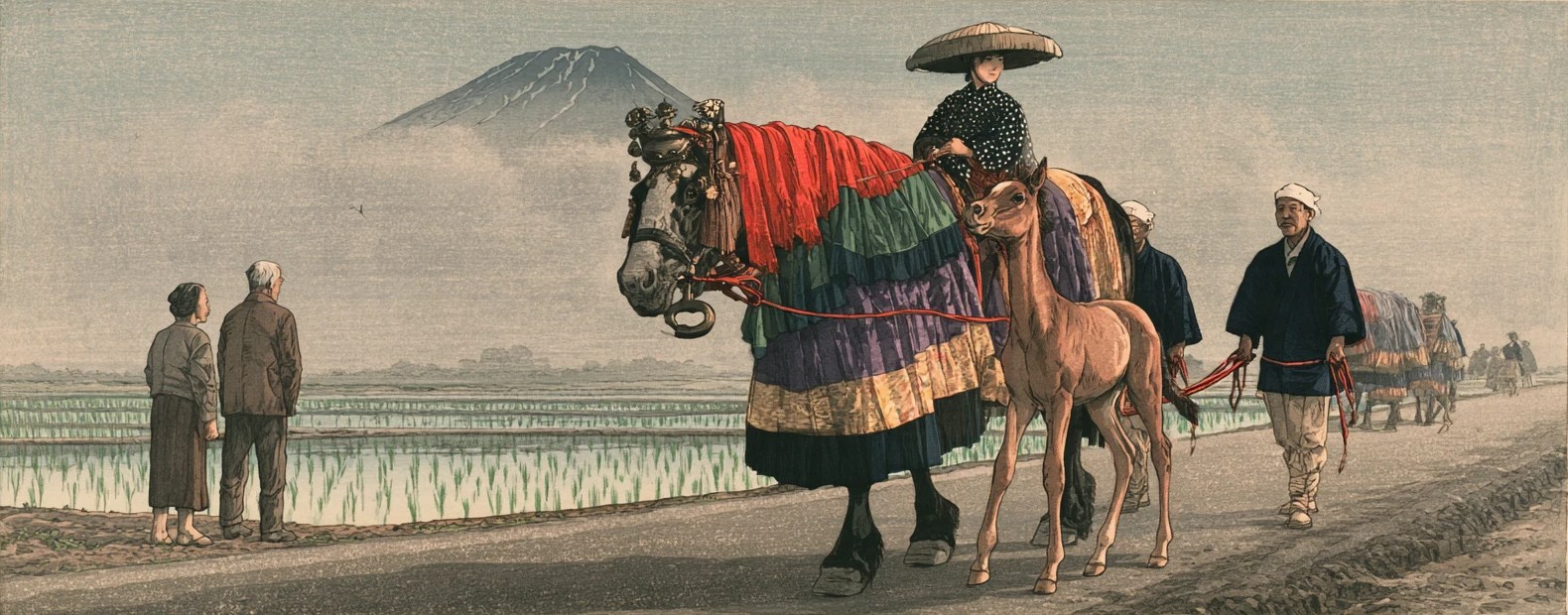
Chagu Chagu Umakko grew from that day. Now, once a year, the horses are dressed up and thanked for their work, and they walk about fourteen kilometres, from Sozen-sama all the way to Morioka Hachimangu Shrine in the city. They first went on to Hachimangu in 1930.
In our house, nobody works in the fields on the horses’ day. That is my father’s rule, not the town’s, and he keeps it the way he keeps the tractor clean.
The old date came to clash with the busiest weeks of rice planting, so in 1958 it was moved to the fifteenth of June. When I was a girl, it was the fifteenth whatever day of the week that was, and on school days I heard the bells from my classroom window. The ring that hangs at each horse’s neck is a relic of keeping the wolves away, and in open country, it is said, it can be heard four kilometres around. Since 2001, the walk has been on the second Saturday of June.
A foal on the road
This year the morning was grey and soft. In an ordinary year the rainy season here begins around the middle of June, and I could feel it waiting just behind the hills.
My father and I walked to the end of our lane and stood well back from the road, the way he has always made us stand. “They’re timid,” he said, as he says every year. “No shouting. No flash.” The notices for the day say the same: horses are very timid animals, so no loud noises and no flash photography.
We heard them before we saw them: chagu chagu, chagu chagu. The name is said to come from that sound. Then they came round the bend, one after another, in costumes of every colour. Each horse is said to carry more than seven hundred bells. The costumes are said to go back to the outfits of the pack horses in a lord’s procession, and each family makes its own in its own way and hands the method down.
Two handlers lead each horse, and a child rides on its back. When I was small, I envied those children more than I could say. We had no horse, my father had a tractor, and that was that.
Some of the horses, I have read, still work in logging. I like to think I can see it in how they walk.
Then, beside one of the big horses, came a foal. It kept close at its parent’s side on legs that looked too long for it, and every few steps it looked up, as if to make sure the big one was still there. Sometimes a foal walks beside a parent like that. I don’t know if it was that one’s first time on the road. It looked like it.
My father watched it all the way past. “Keeping up,” he said. Then he looked at me, and I knew he did not only mean the foal.
Into Morioka
The bells went on toward Morioka, fainter and fainter, until I could not tell them from the wind. The whole walk takes about five hours. The horses cross the Kitakami River with Mount Iwate behind them, pass Morioka Station, and go on through the city to Hachimangu.
I have seen them in the city only once, the year the fifteenth fell on a Sunday and I was seventeen. A school friend and I went into Morioka and stood by the river while the horses crossed the bridge, small and bright against the mountain, and the bells came to us over the water. Then she said, “They came all the way from your house,” as if I had sent them.
In the afternoon the rain came, the fine kind that hangs in the air more than it falls. My father put the clean tractor back in its corner. I walked along the ridges and looked at the rice, which is not work, I told him, only looking. He let it pass.
If you come to Iwate in June, I hope you will give the horses the room my father always gave them, and listen until you cannot tell the bells from the wind. They have worked for us for a very long time. For one day in June, the road is theirs.