Every August,
the city walks in two-beat time.
A short story of August in Tokushima, told by a woman who has played the kane, a hand-held gong, in the same dance group since her first summer at work.
A gong in one hand
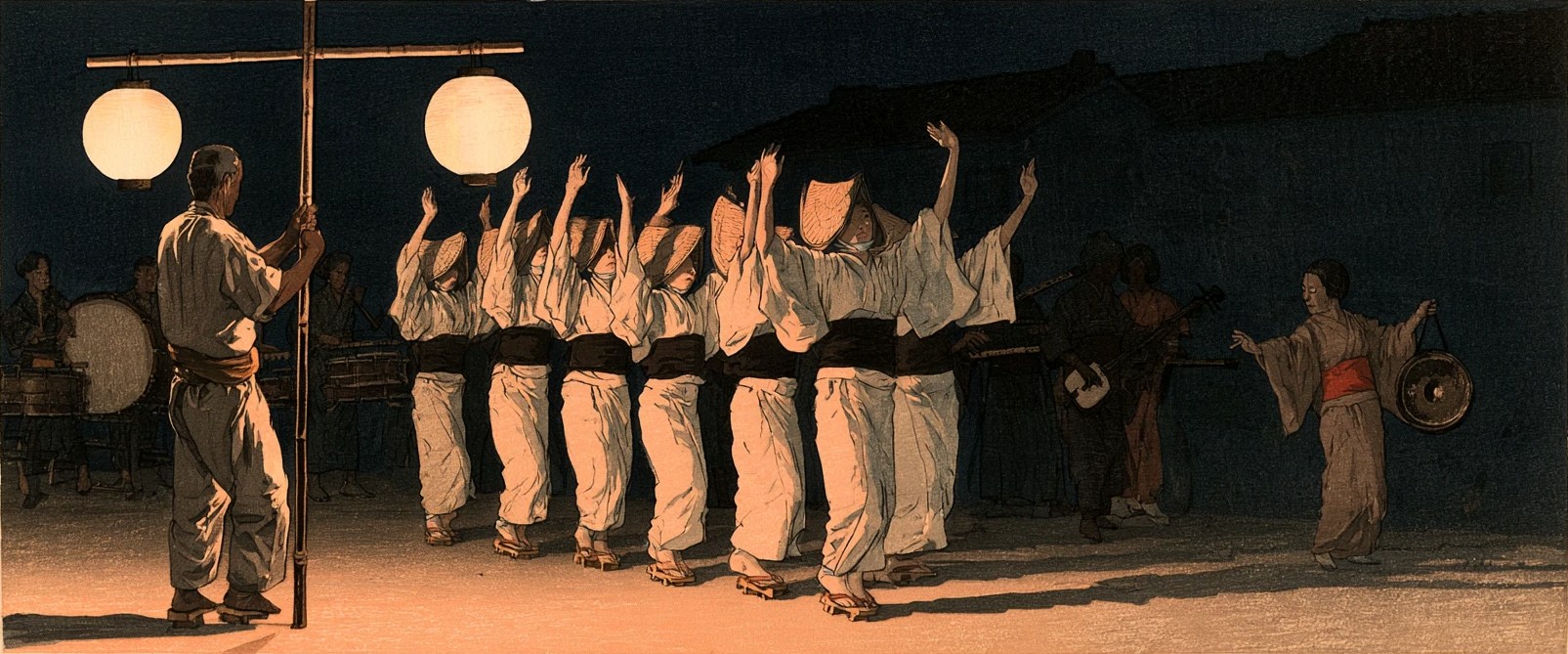
I play the kane. It is a gong small enough to hold in one hand, and in our music it keeps time together with the big drum and the smaller drums, the flute and the shamisen. On a good night they are all listening to me.
I was born in Tokushima, and I have never lived anywhere else. Every year in the middle of August, in the Bon season, the Awa Odori fills the centre of the city for several nights. Groups of dancers called ren dance through the streets, with musicians playing for them. Some are famous, with long histories. Ours is not. It is made up of people from the company where I work, with their families and friends, and I have played the kane for it since my first summer there, thirty-three years ago.
People say the dance is more than four hundred years old. There are three stories of how it began: a celebration when the castle was built, an old performing art, or the Bon dances of the castle town. I have never felt I had to choose. The part I like best comes later, about the indigo merchants of this city of water, who flourished and made the dance grander.
Same steps
In April a new colleague came to our floor, transferred from a city far away. Her name is Yuki. One evening in June she stopped by my desk and asked, very quietly, whether someone who had never danced in her life could join us.
“Everyone starts like that,” I said. Mrs Hamada said the same to me when I was twenty-two. She played the kane before me, and she still comes to every practice with a folding chair, to tell me when I am rushing.
We practise through July in the car park behind the office, after work, while the asphalt is still giving back the heat of the day. “Which dance should I learn?” Yuki asked. I told her what I had been told. The basic steps are the same for men and women, but there are two ways of dancing them. In the men’s dance you go low, with your knees and feet turned out. In the women’s dance you balance on the front of your wooden geta, with your hands raised high.
She chose the women’s dance and bought geta that weekend. For two weeks she practised with her arms up and her eyes on her feet, as if her feet might run off without her.
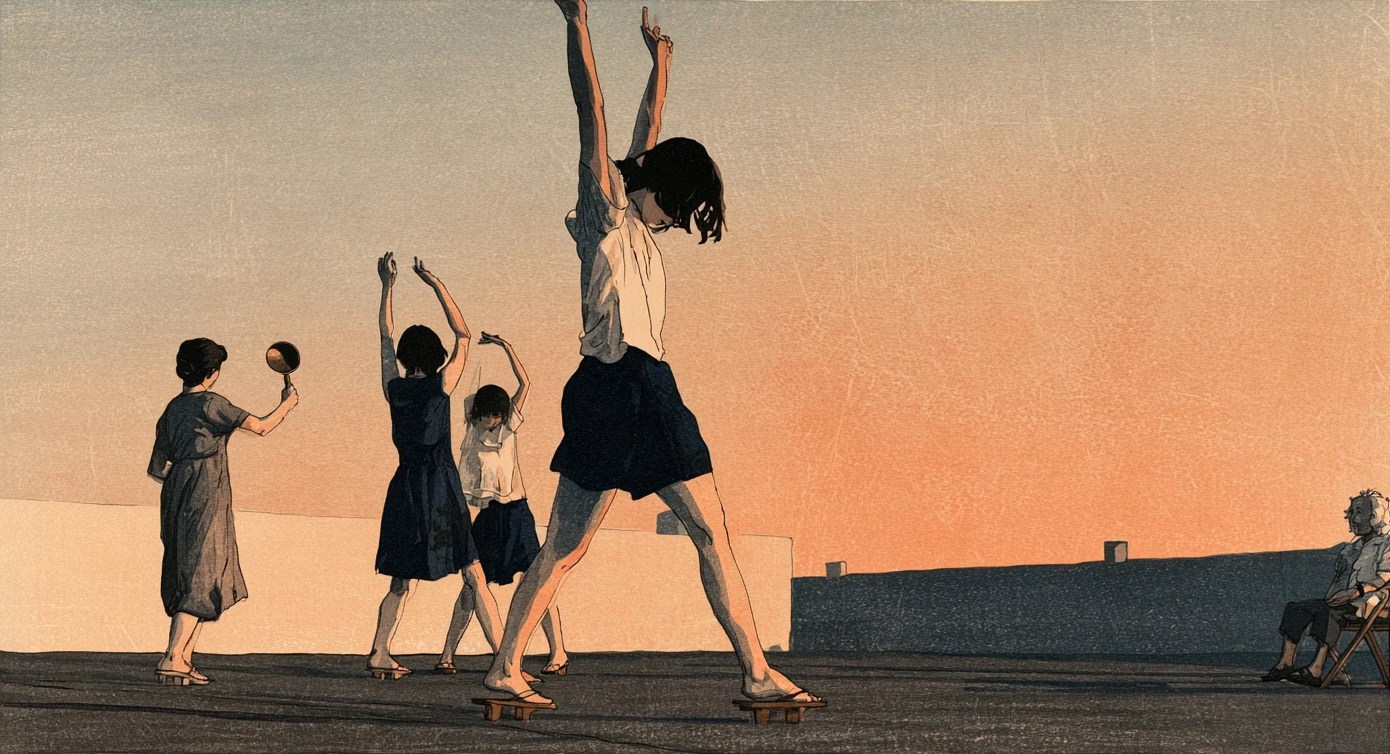
The other women in our ren taught her the steps. I could only teach her what Mrs Hamada had taught me. “Don’t play the kane to be heard,” she told me in my first summer. “Play it so everyone knows where the next beat will be.” So I told Yuki to stop watching her feet. “Listen for the kane,” I said. “I’ll be there on every beat.”
Somen and sudachi
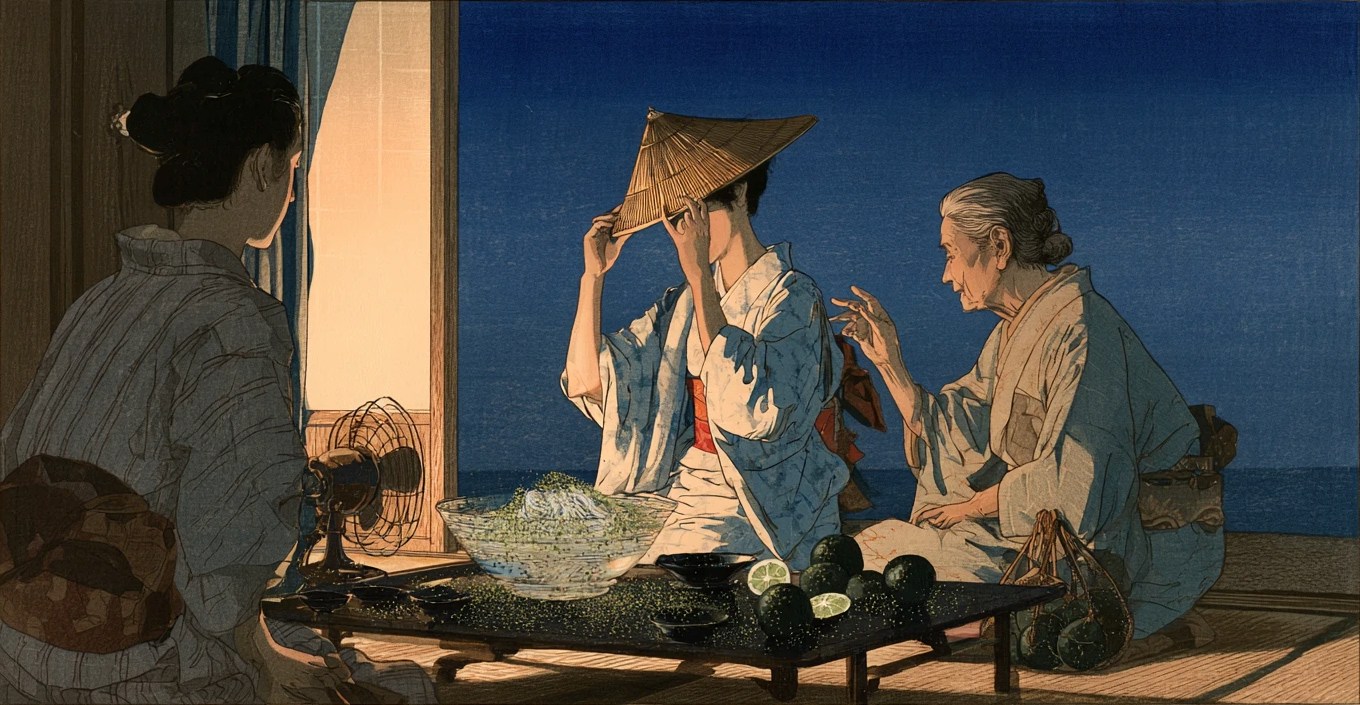
After practice, Yuki often came home with me for supper. In our house, a summer practice night means cold somen. In August the sudachi start to come in from the open fields, small and very green, and I grate the peel straight over the noodles. More than nine in ten of Japan’s sudachi are grown in Tokushima Prefecture, and here some people squeeze them over miso soup. Yuki thought I was teasing her until she tried it.
Even after dark, the heat stays. In an average year, the coolest hour of a mid-August night here is still around twenty-five degrees, and the air is so damp that the bowls sweat on the table. We ate on the floor in front of the fan.
One evening Yuki brought her hat to show me, the kind called a torioi-gasa. The name means a hat for scaring birds. I have read that hats like it were first made to hide the wearer’s face completely and to scare birds away from the fields. In the dance the women pull them low over their eyes, so that the face is only partly hidden. Yuki put hers on and pulled it down. “Lower,” said Mrs Hamada, who had come round with a bag of sudachi. “Let them wonder.”
Lanterns on bamboo
Then the nights come, and the middle of the city is swept up in the dance. At the front of every ren, two paper lanterns ride high on a long bamboo pole. They set the pace for the whole group, and when the wind catches them it takes real strength to hold them. In our ren the pole goes to a man from the warehouse with very good shoulders.
When the group ahead of us moves off, we follow. The music is a cheerful two-beat rhythm called zomeki, and by the second street it is no longer in my hand but somewhere in my chest. One dancer calls out, “Yattosa!” and the others answer, “A, yatto, yatto!”
On Yuki’s first night I kept looking for her hat in the line of hats. For one street her hands were a little late. Then they were not. Her chin came up under the brim, her hands rose with all the others, and she did not look down at her feet once. That is how I knew she was listening.
I have kept the beat for a long time. I had never before heard it come back to me in someone else’s steps.
Two beats home
On the last night the lanterns go out, and the streets slowly empty. My wrist aches for days afterwards, as it always does.
Yuki and I walked home along the river, not saying much. Halfway there I noticed that we were walking in step, the same two beats, our footsteps landing together on the warm pavement. Neither of us had meant to. “Does this stop?” Yuki asked. I told her that in my case it never had.
The next week at work, she left a small green sudachi on my desk, with a note under it: “Same time next year?”
If you come to Tokushima in August, I hope that somewhere in the warm night you will find the kane under all the other sounds, small and bright and always on time. And afterwards, walking back through the streets to wherever you are staying, I hope you notice your own feet keeping the two beats, and let them. It does not stop, and I have never wanted it to.