Every morning,
I borrow the mountain.
A short story of November in Arashiyama, told by a draughtsman who has drawn the hills across the river from the same upstairs window every morning since he was fifteen.
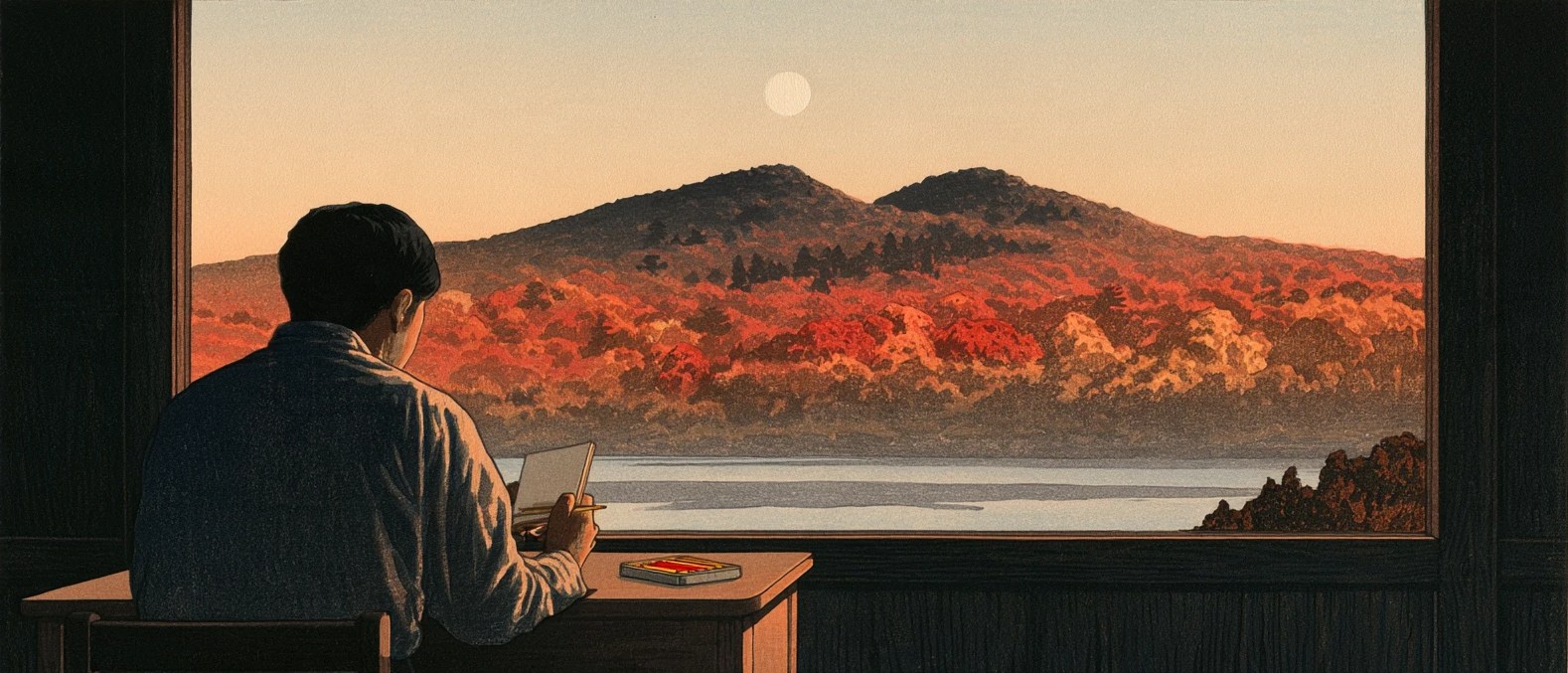
Five minutes
Every morning before my train, I give the mountain five minutes.
I was born in Arashiyama, on the western edge of Kyoto, in the house where I still live. From the upstairs window I can see the river, one end of the Togetsukyo bridge and, on the far bank, the wooded hills that are also called Arashiyama. I sit there with a small sketchbook and a pencil and draw them.
I started in the winter I was fifteen, when my desk faced that window and I was meant to be studying for exams. I needed something to look at that was not a textbook. I am forty-two now, and the sketchbooks fill most of a shelf.
On every page, the river is a strip of bare paper between the bridge and the trees. I never write its name, because I have never known which one to use. On the map it is the Katsura; a law settled that in 1896. But it has gone by many names over the centuries, and in different places it still does. Up in the gorge it is the Hozu. I grew up calling it the Oi. That name comes from a great weir that the Hata clan built on the river long ago, to open up the land.
Mostly green
For most of the year, my pages look alike. There is pink for a while in spring, when the cherries are out on the hills, and new green in summer. The rest is green of one kind or another, and I do not mind. All day, at an office in the city, I draw walls, stairs and window frames: lines that must meet other lines exactly. At the window, nothing has to meet anything. That is the point.
Then November arrives. Autumn colour comes late to Kyoto. The season usually begins in the middle of the month, and on these hills the colour is usually at its best from the middle of November to the end. In November my pages stop agreeing with each other. The hills turn red and yellow and a dozen shades I have no names for, and change from one morning to the next.
I keep my red and yellow pencils in a tin of their own, and I do not open it until the first of November. Five minutes is never enough for that tin. Every November I miss my train at least once; my manager calls it my season.
Which day
This year a new architect took the desk next to mine. She is new to Japan, and to Kyoto. In early November she turned her chair towards me. “You live in Arashiyama,” she said. “Which day should I go?”
I said I did not know. She thought I was being modest, so the next morning I brought in some old November sketchbooks and opened them, one after another, at the same date. In one year the hills were still mostly green. In another they were already red. The mountain does not keep a calendar.
Then she picked up last year’s book and let its November pages run under her thumb. The hills on the paper flushed, deepened, turned brown and went quiet. She laughed out loud, then did it again, more slowly.
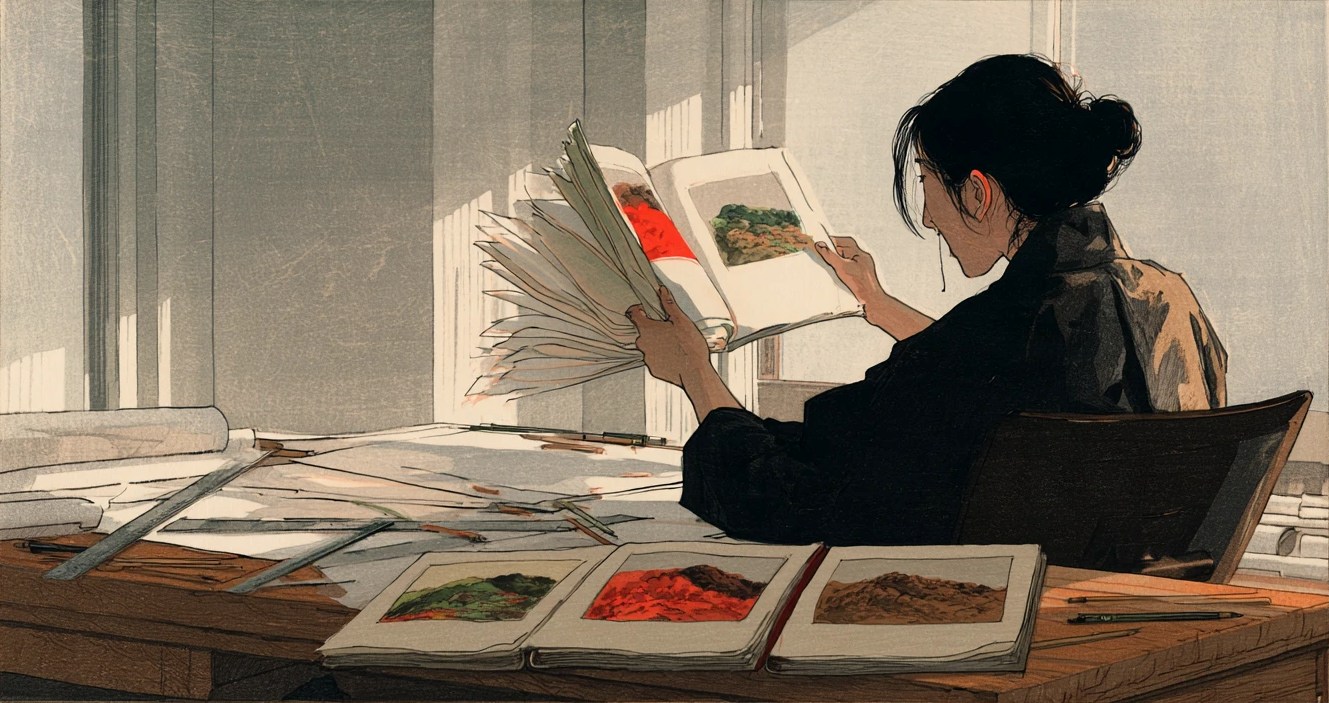
“So you can’t tell me,” she said.
“Not the day,” I said. “Only that no two mornings are alike.”
Borrowed
She had been to Arashiyama once, in summer, to see the garden at Tenryu-ji, on our side of the river. She knew a word I had learned at school and half forgotten: shakkei, borrowed scenery. The garden still looks much as the Zen master Muso Soseki made it nearly seven hundred years ago, and it borrows the hills across the river as its background.
“So your mountain is in a garden,” she said. “The temple was borrowing it long before you were.”
I had never thought of my five minutes as borrowing, but I suppose they are. Every morning I take the hills onto paper, and when I close the book, I give them back.
She asked about the bridge, too. Togetsukyo means “moon-crossing bridge”. Long ago, a retired emperor, Kameyama, watched the moon move across the sky above it and said it was like a clear moon crossing over, and the bridge was named from his words. There is only one moon in all my sketchbooks, from a November morning when it was still up, pale, over the hills. I had drawn it before I noticed.
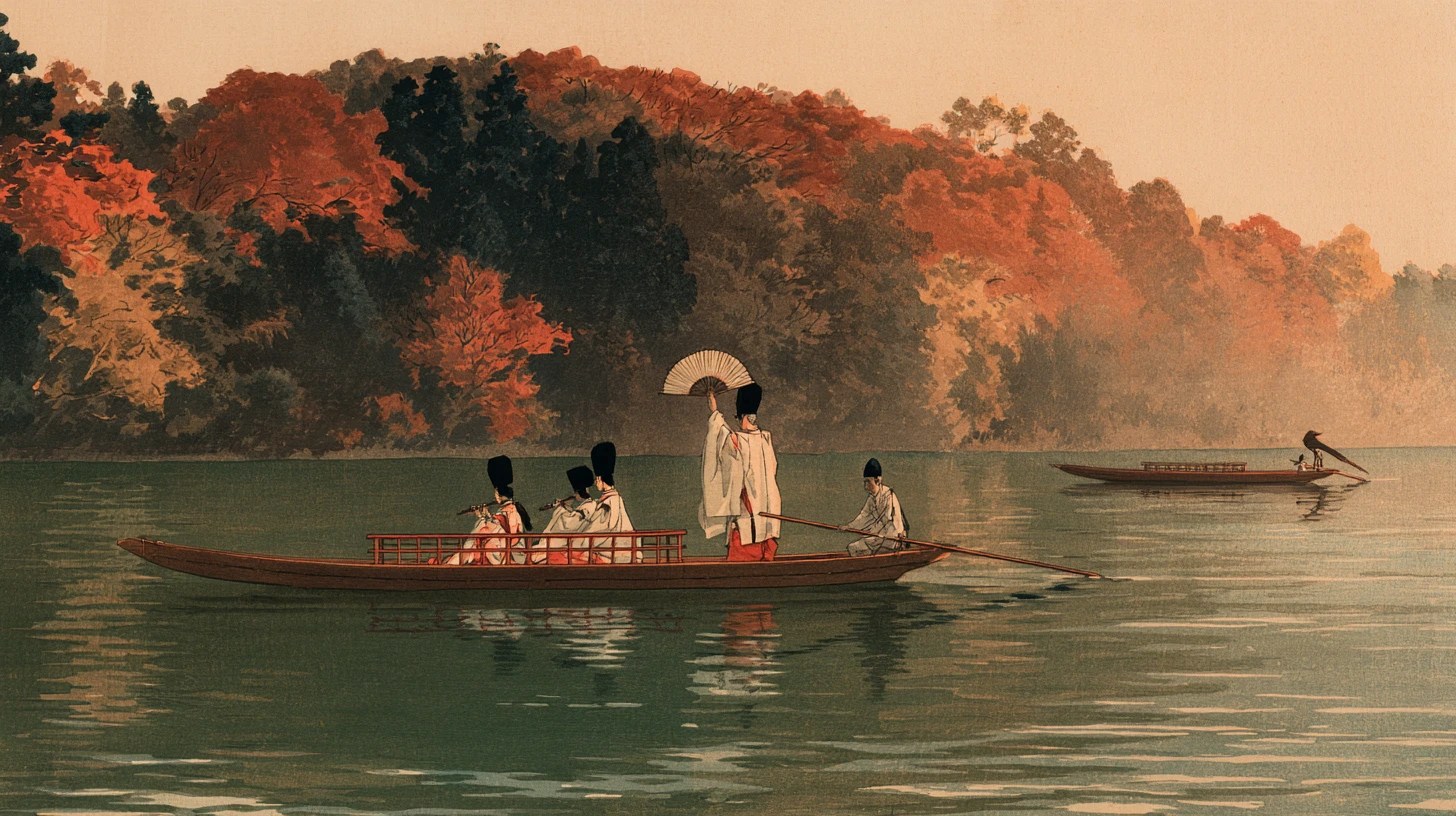
There is only one day in the year when people appear on my pages. On the second Sunday of November there is a maple festival, and boats on the river above the bridge bring back the boating parties of Heian nobles, with old songs and court music on the water and along the bank. I have no train to catch on a Sunday, so I wait for the boats and draw them, small curves on the bare strip of river.
Giving it back
Late in the month came a morning when the hills were so full of colour that I could not finish. Five minutes went by, then fifteen. My train went without me, and in the end I closed the book on a half-done page. It is the only unfinished page on the shelf. I have left it that way.
My colleague went to Arashiyama on a day she chose herself. On Monday she unfolded a paper napkin in front of me. On it, in blue ballpoint, were the hills, the end of the bridge and, between them, a strip of nothing.
“I didn’t take a single photo,” she said. “I wanted to see how long it takes.”
“And?”
“Longer than five minutes.”
She had left the river blank too. I did not ask her what she would have called it. I have never been sure myself.
In December the colour goes, the hills go quiet, and the tin goes back in the drawer. My pages start agreeing with each other again, and I catch my train.
If you come to Arashiyama in November, I cannot tell you which day. My shelf does not agree with itself. But whichever day it is, I hope you give the hills a few minutes, as long as it would take to draw them, even if you never draw a line. They are only borrowed. You give them back when you leave, and in the morning they are still there.