In August,
the lights put down roots.
A short story of August in Akita, told by an electrician who has held up his district’s kanto poles since he was a boy, in his first summer as a father.
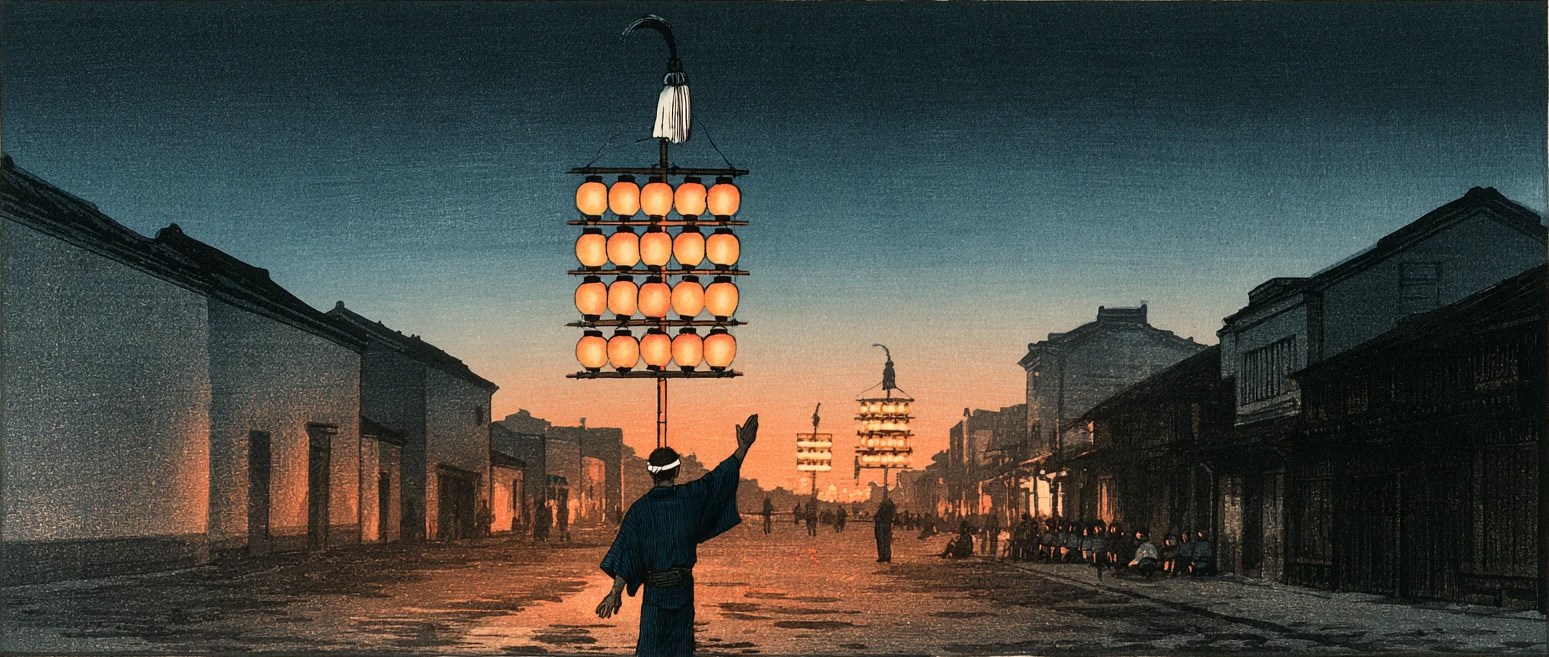
Nothing overhead
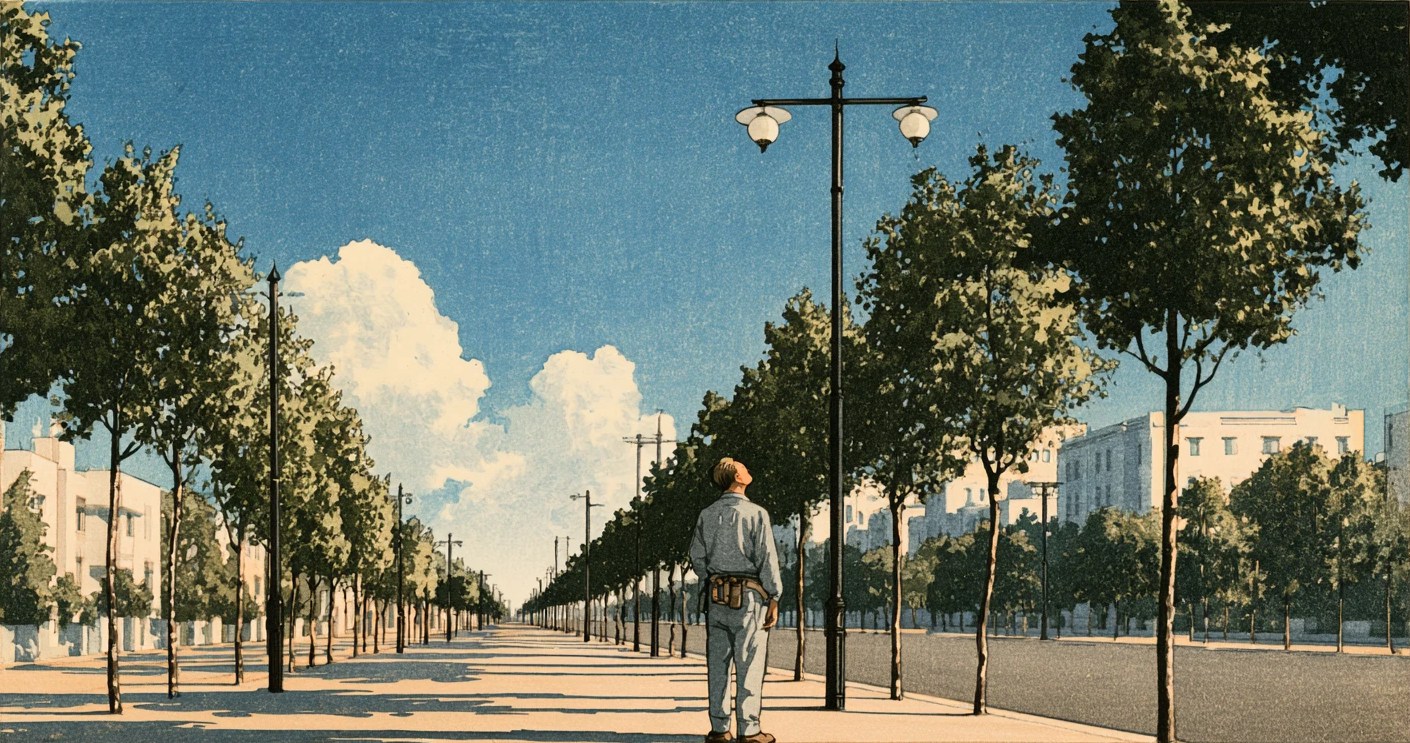
I am an electrician, so I spend my working days looking up. Wires on poles, wires along walls, wires in ceilings, with a torch held in my teeth. I was born in Akita and have spent my whole life here, and by now I know the wiring of a good part of this city better than I know some of my cousins.
Kanto Odori, the main street through the middle of the city, has none. There are no power lines along it. They were put underground so that they would not get in the way when the kanto go up. Even the street lamps there are modelled on kanto lanterns, and some of our manhole covers show kanto poles bending around the city emblem. I have always liked living in a city that arranged its wires around a festival.
For four nights every year, from the third to the sixth of August, that empty sky fills. A kanto is a long bamboo pole with crossbars, hung with lanterns. The whole pole stands for an ear of rice, and the lanterns for bales of rice. About ten thousand lanterns go up into the dark, to ward off misfortune and to pray for a good harvest.
Inside the lanterns
I am a sashite, one of the people who hold the poles up. I started as a boy, on the smallest kind, the yowaka, five metres long. Now I hold an owaka, the largest: twelve metres of bamboo, about fifty kilograms, forty-six lanterns, each with a candle burning inside.
Last August, Aya and I had a secret that was two weeks old. On the last night, when our district took its lanterns down, I caught myself looking into each one for longer than the work needed. Candles used in kanto lanterns are known as charms for an easy birth, and it is said that the shorter the candle, the shorter the labour.
Mr Shoji, the oldest of us, watched me for a long moment. He did not ask. When we had finished, he said only, “Next year, you won’t get much sleep,” and went home.
Our daughter was born in April.
Four parts strength
In our district we practise in the evenings through July. People say that holding a kanto takes four parts strength and six parts skill, and the skill is the kind your body learns long before you can explain it.
There are five moves. The shoulder is easy to hold, and it is the one you learn first. For the forehead, you let the pole slide from your palm onto your brow, hold it still there, open both arms wide and plant your feet. The hip takes a great deal of practice. The best of us can hold a pole on one hip and keep a folding fan going at the same time. I am not the best of us.
This July I came home from practice to a different kind of weight. At the hospital they had shown me how to hold her: one palm under the back of her head, always. She did not like to sleep. She liked to be walked, up and down our hall, at two in the morning, and again at four.
The kanto is thought to have begun as nemuri-nagashi, a custom for sending away the drowsiness of high summer. Long ago, people believed that the heat and the hard work made you sleepy, and that while you were drowsy, a sleeping sickness crept in. I had never understood them so well. Mr Shoji had been right.
Rooted
On the first night, as the sun begins to go down, the poles gather on Kanto Odori to the walking music, nagashi-bayashi. When the sun has set and the lanterns are lit, a flute gives the signal, the music changes to hon-bayashi, and the performance begins. The drums go straight into your ribs. The flutes go up into the open sky.
The first move is nagashi. Two of us raise our pole. I push it up with my right arm, and the next sashite adds a length of bamboo to make it taller. I lift it high and let it come to rest on my palm.
Forty-six lanterns hang above me, our district’s crest on almost every one. I had never paid much attention to the crests of other districts. This year I noticed that some of them are wishes: for good crops, for long life, for children.
All along the street the call goes up: “Dokkoisho, dokkoisho,” and on, “Oetasa, oetasa, nekko tsuita, oetasa.” Dokkoisho is what you say when you lift something heavy. Oetasa means that a kanto that has settled well does not move, like rice that has put down roots.
For a few long breaths, up on my palm, our pole had roots too.
Back to our street
When the performance on the main street ends, the districts hold modori kanto, the “returning kanto”, in their own streets. Our poles went up once more among the houses, and the music sounded as if it did not want the night to end.
I got home late, smelling of sweat and candle smoke. Aya had fallen asleep with the light on. Our daughter had not.
I picked her up and held her against my chest, one palm under the back of her head. Without thinking, I set my feet apart and planted them, as I do on the main street. My feet, it seems, had not noticed that we were at home. She wriggled, and then she stopped. Her weight settled against me and stayed there.
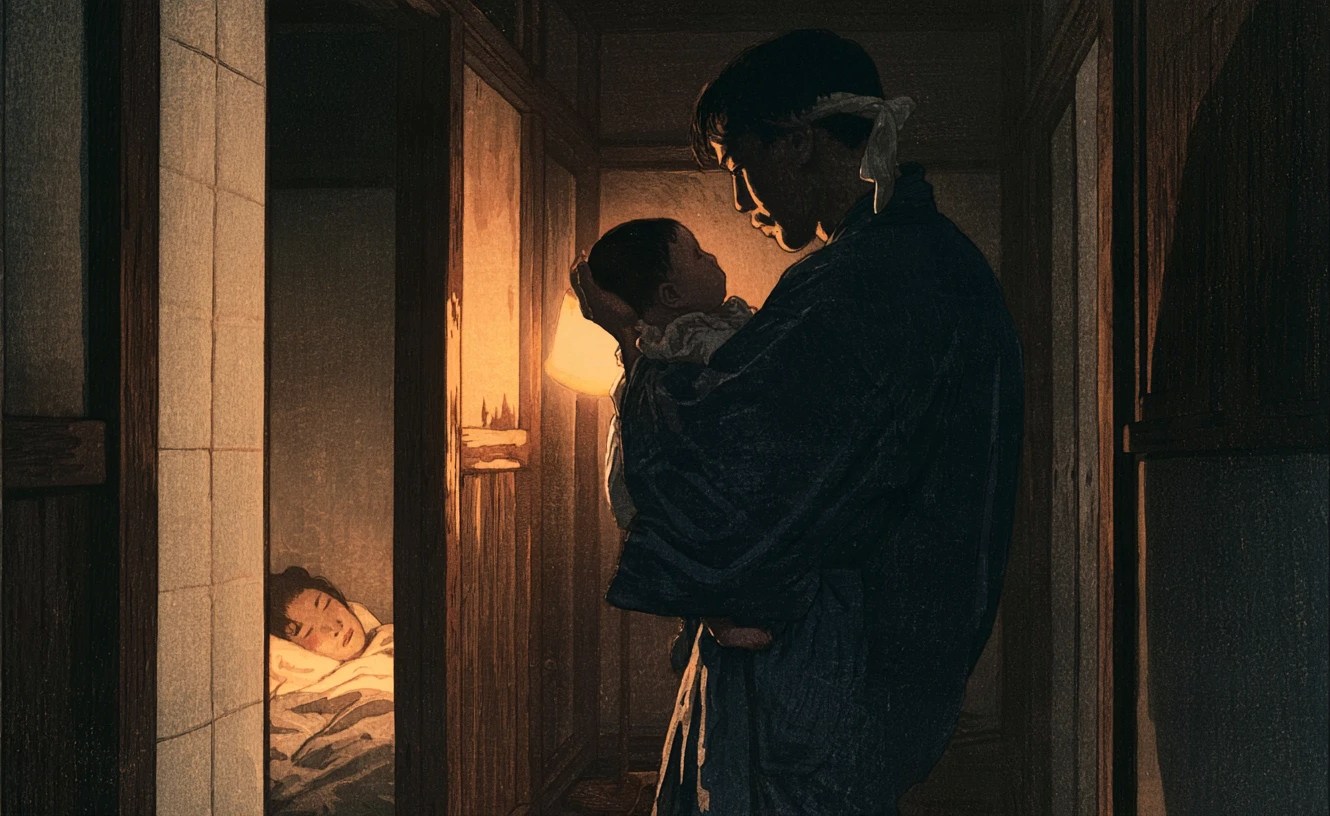
“Oetasa,” I said, very quietly. Nekko tsuita. She slept.
On the morning after the last night, the gohei, the offerings at the tips of the poles, are floated on the Asahi River, to carry away impurity and misfortune. That morning, all three of us slept through it.
I hope that some August night you are on Kanto Odori when one of the poles goes still above the street, forty-six lights resting on a single palm, and that you hear the call that means it has put down roots. It works, I have found, on more than bamboo.