This winter,
the dog learned to wait.
A short story of the drift-ice season in Abashiri, told by a woman who has lived above the beach all her life and walks her young dog along the top of it every morning.
Matte
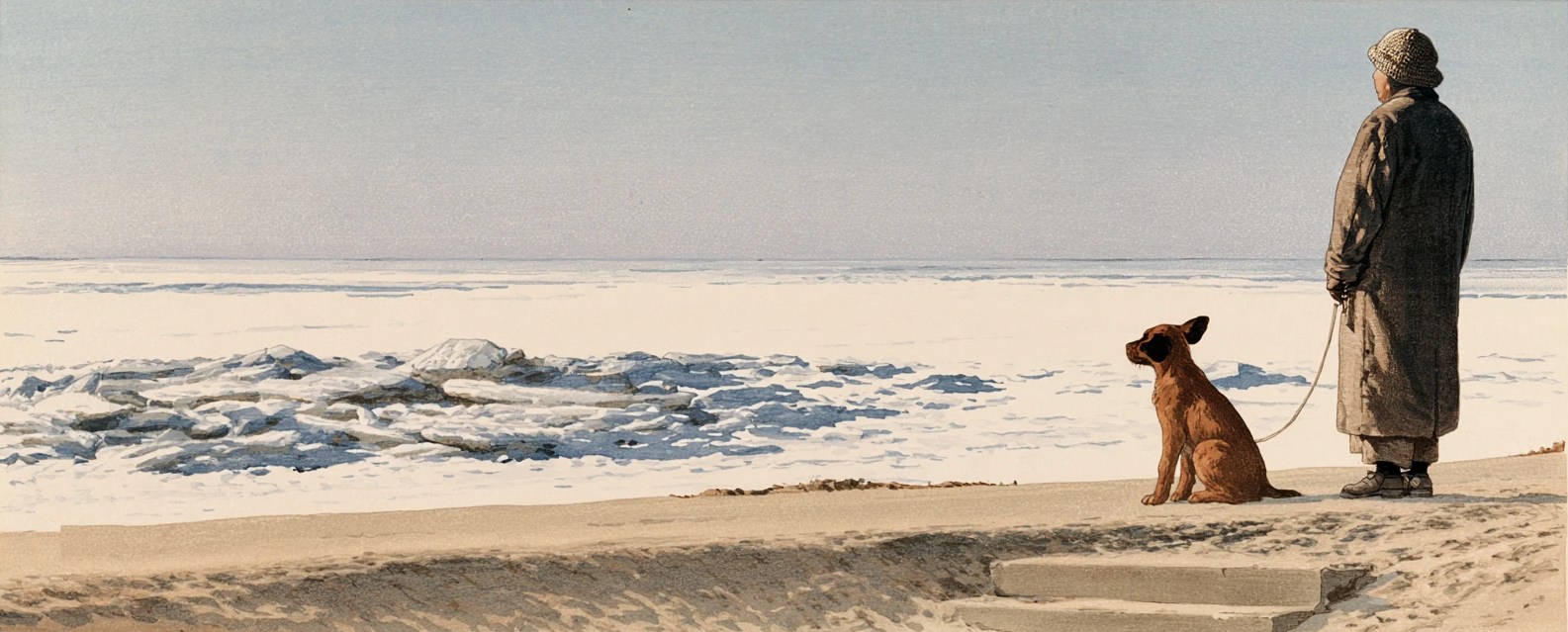
Mugi came to me in the spring, a brown puppy from a friend’s farm inland, with ears that could not agree on which way to point. I had wanted a dog since I was a girl. At sixty-one, I stopped waiting.
The first word I taught him was matte: wait. He was very bad at it.
I was born in Abashiri, on the north-east coast of Hokkaido, where the land meets the Sea of Okhotsk, and I have lived all my life in the same house on a street above the beach. The coast here is mostly sand, with few rocks. Every morning Mugi and I walk the road along the top of the beach, and every morning he wants to go down to the sea.
This was his first winter. In November and December the sea was dark and loud, and Mugi barked at the waves as if they had been rude to him. “Wait,” I told him. “Something is on its way.”
Born in the north
It had been born far to the north, along the north-western shores of the Sea of Okhotsk. There, in the bitter cold, once the seawater has cooled to minus 1.8 degrees, tiny needles and plates of ice form near the surface. These knock together and join, and grow into ice shaped like lotus leaves. Then the strong north-west wind of winter and the East Sakhalin Current carry it south, slowly, and it keeps growing on the way. It usually reaches Hokkaido’s Okhotsk coast in late January or early February.
I explained all this to Mugi on our walks. He was more interested in the crows.
For many years, the weather office here watched for the ice by eye, and each winter it wrote down the day the ice was first seen and the day it reached the shore. I keep my own watch from the road, with a dog who would rather watch crows.
A white line
One morning near the end of January, there was a thin white line where the sea met the sky.
“Mugi, look.” He looked at my finger.
The ice is usually first seen from land in late January, and it usually reaches the shore in early February. That is what usually happens. The ice has never promised anything. Some winters it has taken weeks to come in. One winter when I was in my twenties, it came within sight and never reached the shore at all.
So every morning Mugi and I checked the line. Some mornings it seemed nearer. Some mornings I was not sure. Mugi checked the crows.
The morning the waves stopped
In early February I woke before the alarm and lay still, listening. All winter the waves had been loud under the window. Now I could not hear them.
When ice spreads out over the sea, the wind has less open water to blow across, and the waves are held down. I opened the curtains, and the sea was white as far as I could see.
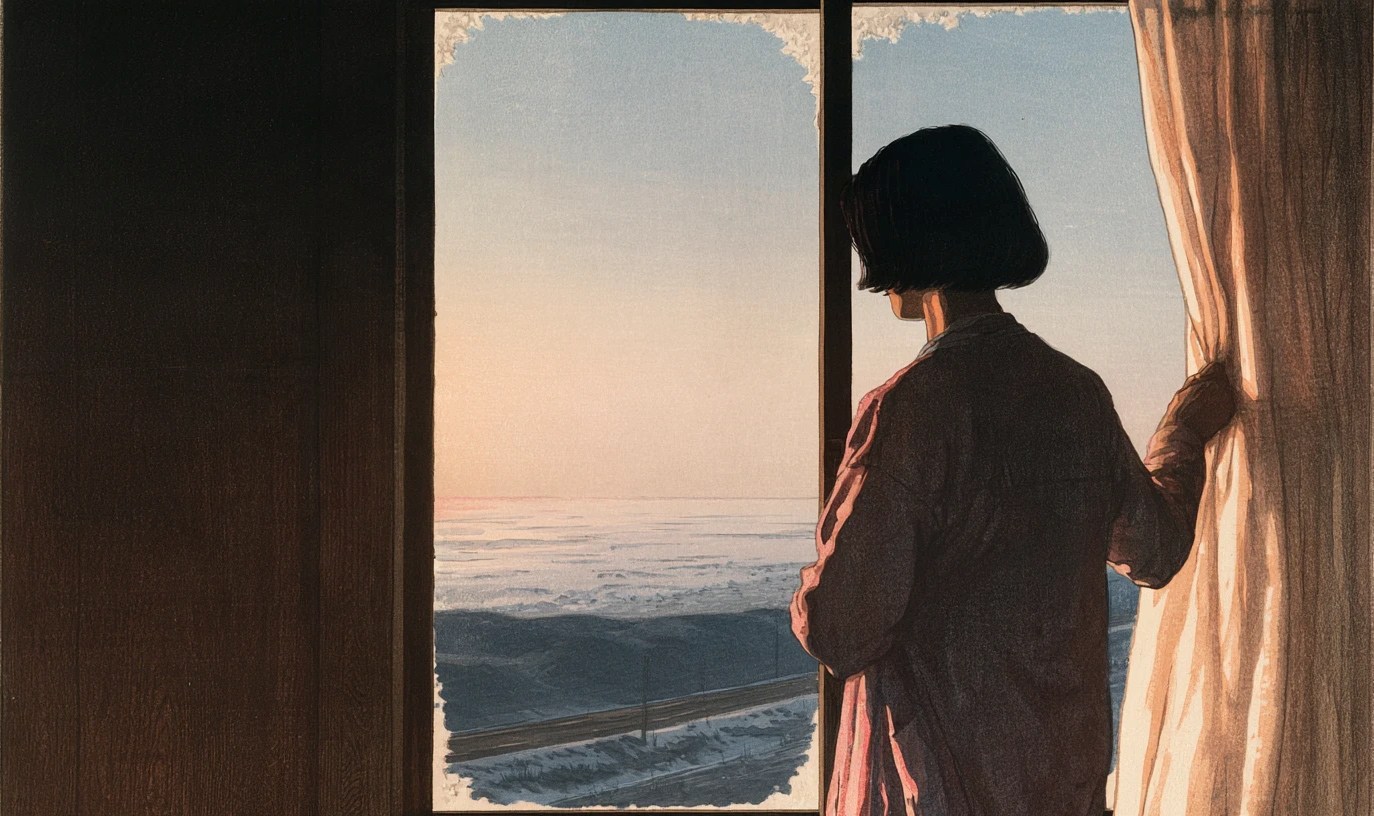
The ice had reached the shore: by the official definition, it had closed off the open water along the coast, so that ships could no longer get through. When the ice comes, the fishing here stops for a while.
Mugi stood at the top of the beach steps and barked at all that white. Then he stopped and tilted his head, listening, perhaps, for the waves. He pulled towards the steps, and I kept the lead short.
In our house the rule was my mother’s, and she said it often: the ice is for looking at, from the land. The town tells visitors the same: never get onto the ice, because if you fall into the sea, your life is in danger. Mugi is learning the rule the way I did, by hearing it every day.
When the ice comes in, the cold deepens, because the sea can no longer give its warmth to the air. But the light changes too. With the sea covered, fewer clouds form, and the sun stays out longer. In February our kitchen is cold and full of light.
The waves come back
As a girl, I thought the sea went to sleep under the ice. It doesn’t. Under the ice, plankton of many kinds are busy in enormous numbers, and fish come after them in crowds. The clione lives down there too, the creature people call the angel of the drift ice, and it is hard to see except in the drift-ice season. On the coldest nights Mugi sleeps by the stove with his paws twitching, and I like to think he is chasing something small and bright under the white.
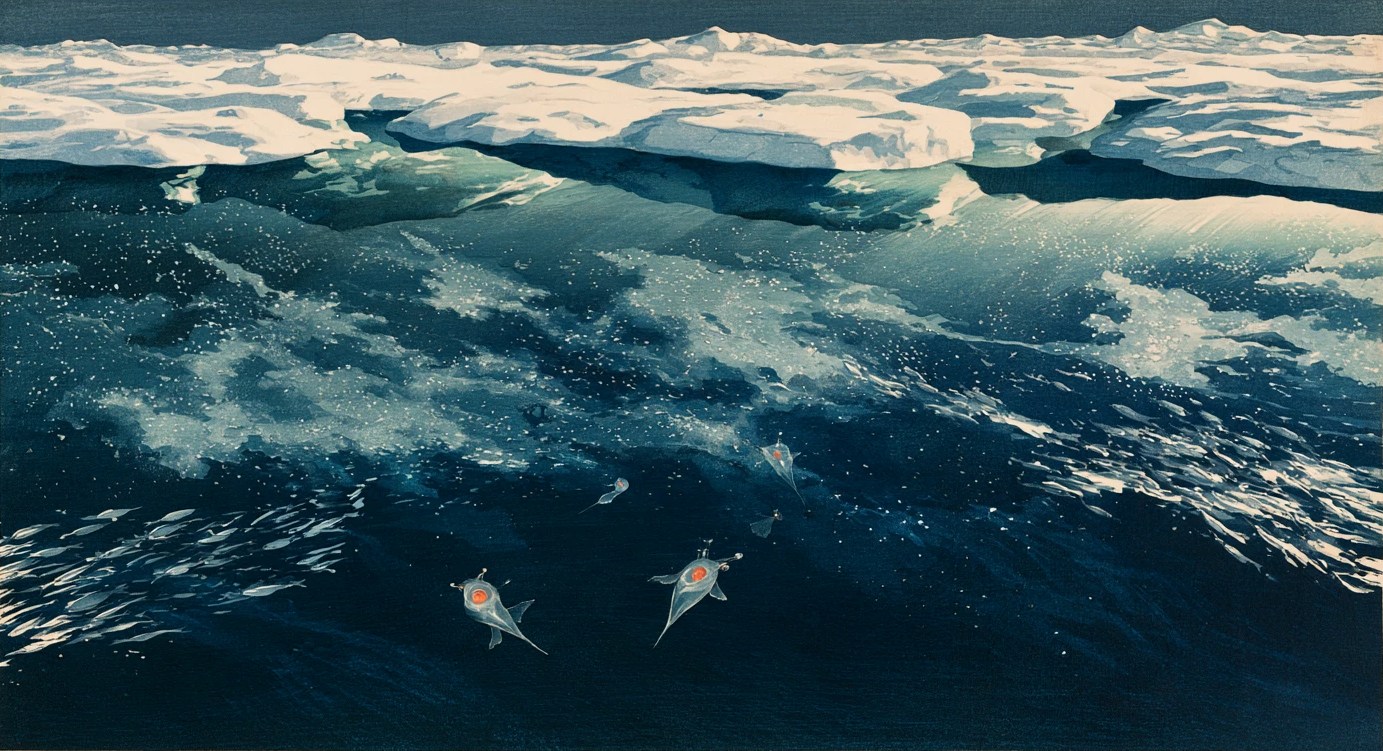
Around the middle of March, a channel usually opens along the coast, and ships can pass again. In April, when the warm south wind blows, the ice melts as it moves away. The last of it is usually seen from land in early April.
One morning I heard them again under the window: the waves. Mugi ran to the window, barking, as if an old friend he had never met had come to call.
The weather agency says that, over the long term, the largest area the ice covers on the Sea of Okhotsk each winter has been shrinking. I try not to think about that on our walks. I think instead about how far it travels to reach us, and that at the end of all that way, someone is watching for it: a woman on the road, and her dog.
This winter, Mugi learned to wait. Now, when I say matte, he sits at the top of the beach steps and does not move, trembling all over, until I tell him we can walk on.
If you come to Abashiri in winter, I hope the sea is white for you, and that you look at it from the land, as we do. If it isn’t, I hope you will forgive it. It sets out from the far end of the sea, and it has never promised anything. And if you see a brown dog sitting very still at the top of the beach steps, that is Mugi, waiting. He is much better at it now.